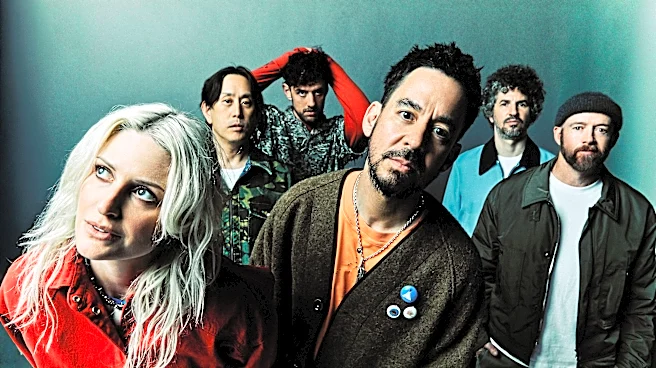



There are many moments during “Linkin Park: Unshatter” that feel like you’re accidentally eavesdropping.
That’s because the documentary from the alt-rock-metal mainstays – in theaters Sept. 30 – is unsparing in its honesty.
Whether remembering lead singer Chester Bennington, who died by suicide in 2017, discussing the merits of new members Emily Armstrong (lead vocals) and Colin Brittain(drums) or ruminating about if the band should continue, the camera captures it all.
Along with chronicling Linkin Park’s rebirth with 2024 album “From Zero” – which spawned the No. 1 rock hits “The Emptiness Machine” and “Heavy is the Crown” – the documentary is interspersed with visually arresting footage from the band’s 2024 concert in São Paulo. The brawny songs,
anchored by Armstrong’s roar of a voice, are also available on “Unshatter Film Soundtrack (Live in São Paulo),” out now.
The band’s creative director and DJ, Joe Hahn, pulled double duty as director of the documentary, which includes participation from members Brad Delson (guitar/keyboards), Dave Farrell (bass) and Mike Shinoda (co-lead vocals, rhythm guitar).
Hahn and Armstrong recently chatted with USA TODAY about the emotional undercurrent of the documentary and how Bennington would feel about the revived Linkin Park.

Question: The title “Unshatter” comes from the song, but it's also such a great name for the documentary because it connotes healing. What does that word mean to you as a band today?
Joe Hahn: It represents the spirit of resilience that we developed over time, just trying to fix what was broken and not knowing what to do and getting strength and encouragement from each other.
How did the documentary change the relationships within the band?
Hahn: (Mark Fiore), a longtime friend of Dave (Farrell) has been with us since the beginning as our videographer and he’s always there to capture the moment. When we started making music together again, we thought we should capture this on tape. We had a lot to say and an experience to share beyond the stage and all of us felt this desire to share more of what people could see.
Was it just emotional readiness that this was a good time to do a documentary? Or the success of “From Zero” that felt like it was the beginning of a new chapter?
Hahn: It was all of that. We’ve never really wanted to show how the sauce is made, but we realize that the music is a lot more than just sounding cool. When we play shows you see it, you feel that energy.
Emily Armstrong: When we set out, it wasn't even a documentary. And Joe being Joe, he's a really good storyteller and was like, I could see this as a documentary. And he did it so well, showing the whole story arc. I'm so fortunate to be in a place that so much has happened (and) to have such a great story.

Emily, looking back on it now, are there moments where you could see your confidence growing or, conversely, realized how uncertain things still felt?
Armstrong: I've been in one band my whole life (Dead Sara) and that's pretty much all I know. Now I'm singing songs that the whole world knows, like, what makes you think you could do this? I thought, you know what? (Linkin Park) obviously gave me the confidence to do this, so I didn't want to let anybody down.
Fans of the band have generally been accepting of you. But for those who are skeptical, do you think they’d come away from the film with a better understanding of you?
Armstrong: I can confidently say yes. Because I've also heard it from people who had been on the (From Zero) tour who have said, “I've known you this whole tour and I've learned more about you in this film than this whole tour.” There's a lot of vulnerability in (the film) that I think is hard for me to watch back. But I think those are the moments when people really understand you more.
Joe, how did you balance protecting your bandmates while also telling an honest story?
Hahn: I feel like there's like a shorthand of just us spending time with each other, getting to know each other, being open and honest and for that trust to be there. I think we're all pretty humble, but at the same time, we have a lot of pride in what we do … there's a lot of pain you have to go through and a lot of stuff that makes you just feel stuck and you just don't know why. I think the process (of doing the documentary) helped me get unstuck in a lot of ways.
Was there any footage that you were hesitant about using, but did anyway because it felt essential to tell the story?
Hahn: Exposing some of the talking about Chester and talking about (former drummer and co-founder) Rob (Bourdon). And even Brad (Delson), who was hesitant to come back … But I just decided to say, hey, this is how things unfolded. I think the whole thing was very therapeutic for us to go through these motions. This was two years of reflecting and putting it to a presentation and everyone was really proud of what it took to get us here.

If Chester could watch ‘Unshatter’ today, what do you think he'd recognize immediately about this version of Linkin Park?
Hahn: I think he would be the biggest champion of it. Because I think the last thing he would ever want is for us to stop doing what we're doing. And that's pretty much what happened. He'd be really proud that we were able to figure it out and do it in a loving way. In the film there’s a moment that really shows the spirit of him. There’s moments we talk about (his death) because that’s the big elephant in the room, but the story is about the present and moving forward. At some point you really realize that he's gone, but he's always here.
Emily, your vocal transformation is incredible to witness, from just talking in a normal tone to screaming in the recording booth. How do you take care of your voice for live performances?
Armstrong: I take care of it very well, even down to my diet. It’s a very not fun place to be on your days off when you have to mime everything, but it’s worth it. I try to get as much sleep as possible. And our crew works so hard to make sure my schedule allows for me to have sleep and food. But it was definitely an adjustment being out there for two hours instead of 45-minutes as the opening band.
Hahn: She trains like an athlete. It’s beyond what I’ve ever seen anyone do. There’s a lot of sacrifice because there might be opportunities to do something fun or be careless. But she knows people want to see her sing.
What else is on the Linkin Park docket?
Hahn: We’re an old band (originated in 1996), but you see in the film that with the last two years of touring, we’re a brand new band. With that comes much excitement, so even when we’re on the road with a day off, we find a studio and just make noise. But I cannot say any more. It would be cool if there was a new record we were working on right now.
This article originally appeared on USA TODAY: Linkin Park says Chester Bennington would be 'proud' of band moving on