


A new record for total distance driven has been set – in space.
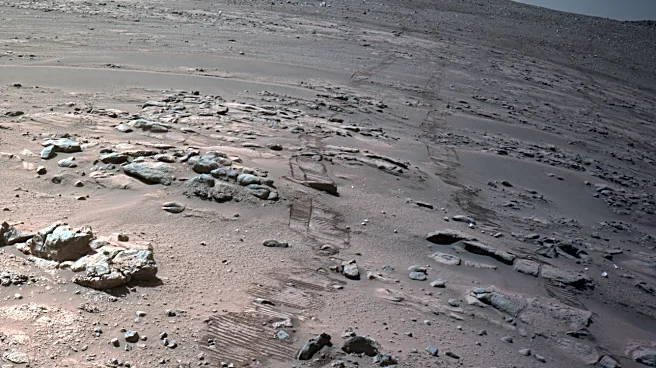
NASA's Perseverance Mars rover has driven 28.1 miles and counting, breaking the record driven on another planet of 28.06 miles set by the space agency's Opportunity rover, in less than half the time. Perseverance landed on Mars on Feb. 18, 2021, on a mission to search for signs of ancient life.
Since then, the rover has driven "farther, faster than any vehicle ever has on the surface of another world," according to NASA.
It reached the new milestone on Oct. 11, on a Martian day, called a sol (roughly 24.6 hours long), that a 299.6-foot drive put it over record, NASA's Jet Propulsion Laboratory said in an announcement. Opportunity roved Mars from 2004 to 2018.
"The original mission called
for no more than 12.4 miles of driving. We’ve blown well past that, and with all mobility systems fully operational and favorable extended-ground-life test results, we expect Perseverance to keep adding to this record for many years to come," said Steven Lee, the project manager of the Curiosity and Perseverance rovers at NASA’s Jet Propulsion Laboratory.
The other rover currently on Mars, Curiosity, has driven more than 23.65 miles.
Perseverance was driving toward an area called Idubi, through an area off the western rim of Jezero Crater on Mars' surface, when it beat the record. There, it it is "investigating what may be some of the oldest terrain ever explored in the solar system," NASA said. In the Idubi area, scientists are hopeful to find signs of ancient hydrothermal systems.

Perseverance, about the size of a small car, uses a self-driving technology that its team calls "thinking while driving," NASA said. An autonomous navigation system called AutoNav enables it to take images of the terrain, build a 3D map of hazards and plan a course between points selected by rover planners on Earth.
In one Martian day, Perseverance can cover 1,351 feet, a speed faster than previous rovers. One obstacle it faces is the glare from sunlight hitting the navigation cameras that limits how long in a sol it can continue rolling, said Mark Maimone, deputy team chief for robotic operations on Perseverance.
Perseverance was launched in 2020 and went on a 200-day, 300 million-mile journey before landing on Mars in the Jezero Crater, which scientists believe was once flooded with water. It has spent years exploring and collecting rock samples for a potential return to Earth.
A significant discovery came from Perseverance in 2024, when it found rock that contained a potential biosignature, "the closest we have ever come to discovering life on Mars," former NASA Acting Administrator Sean Duffy said in an announcement last year.
NASA recently extended Perseverance's mission, which will see the robot's exploration of the rim of Jezero Crater through about the end of 2028.
This article originally appeared on USA TODAY: Mars rover Perseverance breaks driving record on another planet