
HAVANA – Óscar Fernández marveled at the rows of dehydrated mango and pineapple as he stood in the aisle at a Trader Joe’s in Washington, DC, wondering how to get his Cuban company’s mango slices on those
shelves.
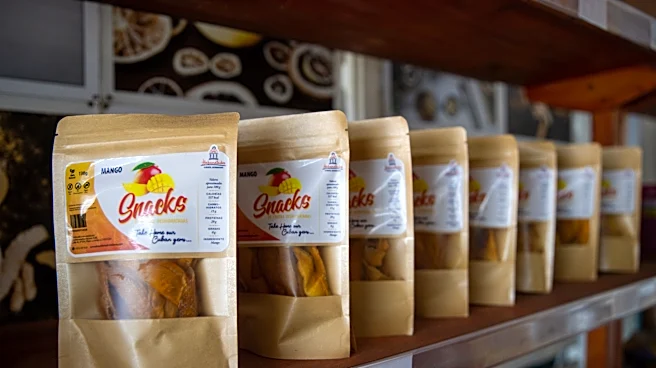
By the end of a prestigious six-week fellowship to America, he’d crammed his suitcase full of dried bananas, mango slices, pineapple rings and pineapple with chili. Those 60 packages from stores across nine cities would help him research and develop how private Cuban businesses could break into the U.S. market.
Back in Havana, he hatched a plan.
“We have our sights set on Trader Joe’s,” Fernández told USA TODAY recently while touring the Havana facility for his company, Deshidratados Habana. “Our products line up perfectly with theirs.”
But Fernández knows his company has a ceiling. Even after Cuba changed its laws Sept. 2 to allow private businesses to deal directly with foreign companies, he’s at the mercy of stalled negotiations between Cuba and the United States.
A U.S.-imposed oil embargo, along with decades of neglect and mismanagement from the Cuban government, has nearly crippled Cuba’s energy grid. The crisis has led to island-wide blackouts and water and food scarcity in many parts of Cuba.
New U.S. sanctions and longstanding restrictions have stunted Cuba’s private businesses' growth and, in some cases, forced them to close.

Fernández’s company is no stranger to obstacles: Dealing with a stifling lack of resources, including turning an old pizza oven into a food dehydrator, his business has grown from producing 60 pounds of dried fruit a day when it launched in 2021 to more than 660 pounds today, shipping to France, Italy and Germany. A new factory cobbled out of old shipping containers on the outskirts of town could produce more than 16 times that amount.
But Fernández’s predicament underscores the dichotomy of U.S. policy toward Cuba: For years, U.S. officials have urged Cuba to open its economy and empower its private sector, but sanctions aimed at punishing regime leaders and fomenting political change on the communist island have stunted its growth.
“The mango tree doesn't care who the U.S. president is,” Fernández said.
Cuba opens its economy, runs into ‘obstacles’
In June, Cuban officials announced 176 economic reforms that analysts say are some of the most significant economic changes in the country’s recent history. The Cuban government announced some of those key measures became law, including eliminating a cap on the number of employees and allowing direct access to foreign trade.
The moves show Cuba depends on its growing private sector, Carlos Luis Jorge Méndez, Cuba’s deputy minister of foreign trade and foreign investment, told USA TODAY in an exclusive interview Aug. 28 in Havana.

Today, 40% of the country’s goods are imported by private Cuban companies, up from 17% at the end of last year, he said. There are more than 11,300 micro, small and medium-sized predominately private enterprises operating in Cuba, according to government figures.
U.S. policy is stunting that momentum, Méndez said.
U.S. Secretary of State Marco Rubio has insisted there is no such thing as private enterprise in Cuba; the government has its tentacles in the entire economy.
After a round of sanctions in July, foreign companies, fearing U.S. repercussions, diverted shipping containers bound for Cuba to other ports across the Caribbean, disrupting supply chains and delaying shipments of food, medicine and other vital items, Méndez said. Many private companies lost access to their products for weeks, driving up costs and prices for their Cuban customers.
“Every time a step is taken – whether a small move or profound economic transformation – you run into obstacles designed so that Cuba doesn’t function properly,” Méndez said. “[U.S. officials] want us to operate as a market economy, yet they won't let us function as one.”
Just two years ago, Fernández, a former economics professor, would’ve blamed Cuba’s clunky bureaucratic system and lack of economic freedoms for any challenges to Cuba’s private sector.
Today, however, he points squarely at U.S. policy.
“Right now, I don’t feel there are any domestic restrictions whatsoever,” Fernández said. “The main obstacle right now is the critical situation the country is facing, which deeply affects us – and great uncertainty regarding the U.S. government's actions.”
‘The mango tree doesn’t care’
Rotting mangos sparked the idea.
Fernández read with alarm – and curiosity – how farms across Cuba were tossing acres of mangos because they didn’t have the resources to harvest them all.
Cuba produces more than 440,000 tons of mangos each year, but half that many go unpicked and rot on the ground, Fernández said.
“If there are no farmers, no transport company, no fuel to harvest the crop, or if a processing contract falls through – whatever the case – the mango tree doesn't care,” he said. “The fruit falls and goes to waste.”
In 2020, as the coronavirus pandemic canceled his classes, Fernández began experimenting with drying ripe plantains, mangos and pineapples. He enlisted an industrial designer to turn an old pizza oven into a dehydrator in the side patio of his parents’ house.
“It didn’t exist in Cuba,” Fernández said. "You had to go do it yourself.”

He burned countless batches of fruit at first, until he attached discarded cooling fans from an old personal computer to the dehydrator. Eventually, the contraption worked, producing chewy, flavorful mango slices.
In December 2021, he launched Deshidratados Habana. In the warm shade of his parents’ patio, gloved workers peeled and sliced mangos and plantains by hand, arranged them on the dented trays of the pizza-oven-turned-dehydrator and later packaged them. Trucks he purchased backed right up to a swinging gate and ferried the fruit to markets and restaurants across Havana. He marketed his company on Instagram.
Diplomats living in Havana loved the dried mangos and pineapple. Some bars around the city bought his dried lime rounds to toss into cocktails. But Fernández quickly realized exporting the fruit was the way to make real money. He started shipping his fruit to distributors in Italy, France and Germany.
As his company grew, Fernández needed money to buy more equipment and pay employees. He persuaded a Cuban-American friend who was pursuing a doctoral degree in the United States to take out a student loan and lend him the cash. He repaid the loan in monthly payments to the friend’s family in Cuba, saving his friend remittance fees.
He bought two industrialized-sized dehydrators from the United States – through a Canadian company, since importing directly at the time was barred under Cuban law, he said.

“That’s when we started dreaming bigger,” Fernández said. “We wanted to become a full-fledged factory.”
He worked out an agreement with the Cuban government to take over a bankrupt medicinal herb plant near the airport in Boyeros, about 14 miles south of Havana. He leased the land for 20 years and built a 1,100-square-foot facility made from modified shipping containers.
When the factory opens later this year, it should produce five tons of dried fruit a day, Fernández said. The number of employees is expected to jump from 21 today to 84 when the factory opens to 250 within two years, he said.
In 2024, he became the first Cuban ever to win an Eisenhower Fellowship, a prestigious six-week program named for the 34th U.S. president. As he described his dried fruit production, other fellows kept telling him, “You have to go to Trader Joe’s!”
“Up until then,” he said, “I had no idea what that was.”
His visit to the supermarket chain in Washington, D.C., and other cities revved him with renewed ambition. Someone gave him a copy of a book by Joe Coulombe, the chain’s founder: “Becoming Trader Joe: How I Did Business My Way and Still Beat the Big Guys.” He crammed it into his suitcase, along with the fruit samples.
Fernández and his team now had a new vision. But obstacles remained.
Though U.S. regulations allow private Cuban entrepreneurs to export directly to the United States, there are many exceptions and obtaining the proper licensing can be an ordeal, Fernández said. During his Eisenhower fellowship, Fernández studied how to get a license, even hiring a Miami law firm to help. Two U.S. companies interested in importing his product applied.
Two years later, they're still waiting for a reply, he said.
Reforms open the door
When the Cuban government announced reforms in June, a WhatsApp chat group shared by Fernández and other entrepreneurs blew up: Message after message marveled at the new freedoms and shared ideas on how to capitalize on them.
One of the entrepreneurs on the group chat was Juan Carlos Blaín Noste, who began delivering homemade hamburgers 14 years ago to fellow students at the University of Computer Sciences in Havana. Today, he is owner and chief executive of Juanky’s Pan (his grandmother’s nickname for him), a burgeoning franchise of markets and restaurants selling everything from fresh bread to $45 bottles of aged Cuban rum. Juanky’s Pan now employs 118 people across four Havana locations.

Blaín recently expanded his business to include a logistics company, which imports, transports and stores goods for other businesses.
But blackouts and water shortages have eaten into his profits, Blaín said. He’s had to refit his restaurants’ kitchens with coal-burning stoves and invest in generators to keep the lights on. Lack of access to U.S. capital also threatens to muzzle his company’s growth.
“Cuban private businesses are at a critical juncture,” Blaín said.
Fernández also had to divert profits away from his business to install solar panels to keep production going. His new factory will have a solar power system consisting of 96 panels, making it completely self-sufficient, Fernández said.
He and his team dug a well at the factory so it could have direct access to water. Lately, he’s been ferrying barrels of that water into the city so that workers have water to bring home to their families. And he’s allowed his employees to store perishable food in the company’s commercial freezers.
Fernández is also considering trucking in water from the ocean and desalinizing it for consumption.
None of this is about drying fruit.
“It’s absolute madness,” he said. “It’s been very, very difficult.”
Still, the private sector continues to claw its way forward, hopeful that the Cuban government won’t reverse course yet again.
“Essentially, the message now is that the private sector can do anything, anywhere, and partner with any other sector, however they please,” Fernández said. “That is a profound conceptual shift.”
Not everyone believes Cuba will so easily transition to free market capitalism.
Ricardo Torres, a Cuban economist and fellow at American University in Washington, said he questions whether Cuba’s reforms will remain permanent, as long as the island’s communist party retains power over Cuba. Similar reforms, in the 1990s and again in 2010 and 2021, were later rolled back by Cuba’s leaders, he said.
But he agreed with Méndez and others that recent U.S. sanctions on Cuba, aimed at state entities, also hurt the island’s private sector, given how intertwined the two are in communist country's economy.
“There is no way you can target sanctions to the state sector without harming the other parts of the economy,” Torres said.
U.S. officials quietly approached Cuban leaders earlier this year about opening up Cuba's economy. Rubio, looking for an interlocutor, met with Raúl Guillermo Rodríguez Castro, grandson of former Cuban president Raúl Castro, according to an exclusive USA TODAY interview in July.
But those talks, which included U.S. demands to release political prisoners, appear deadlocked.
Rubio laid the blame at Cuba’s feet and its centralized economy, which, for decades, favored the state over private enterprise, he told reporters in Colombia on Sept. 8.

“Their economic model doesn’t work,” Rubio said. “If Cuba is a humanitarian disaster, it is because their government, their regime, is a disaster, because the economic model they follow doesn’t work. In fact, it’s nonsensical, because they don’t allow a private sector to flourish, because they don’t allow individual Cubans to choose their own path in life.”
Fernández acknowledged that Cuba’s economy still needs work, including making the country’s regulators friendlier toward private businesses.
But as Cuba starts to change, the United States should loosen its grip on the island, he said. If U.S. officials want lasting change in Cuba, they should improve relations with Havana, lift the oil embargo and continue bolstering private businesses – something Cuba’s government would struggle to contain, Fernández said.
“That could transform Cuba in less than six months,” he said.
For now, Fernández is focused on surviving the crippling blackouts. He locked up his business for the day, walked home and checked his email. His new solar panels were arriving soon at the Port of Mariel, 30 miles west of Havana, and he needed to coordinate their transport to Boyeros.
He still had a factory to finish.
Jervis is a national correspondent for USA TODAY based in Austin, Texas. He reported this story from Havana, Cuba. Follow him on X: @MrRJervis.
This article originally appeared on USA TODAY: His Cuban mangoes sell worldwide. Why not America? It’s complicated