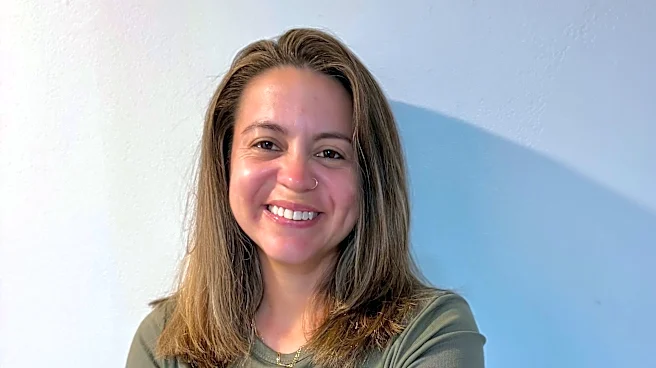








Most people aren't grateful for their acne, but for Claudia Pereira, it was a "blessing in disguise."
After struggling with blemishes in adulthood, she decided to start birth control at 37 to try to reduce them. Little did she know it would lead to her discovering a cancer hiding in her uterus.
After starting the pills, Pereira started bleeding. And it didn't stop − for months.
She was used to regular periods, so the nonstop bleeding raised alarms. Her prescribing doctor said it could take a few months for her body to get used to the new medication. So, she waited.
After months four and five of continued bleeding, Pereira's worries reignited.
"I was like, 'OK, is this normal?' It was too much. I became anemic after six months," she told USA TODAY.
Then the bleeding transformed into a thick discharge that added to her concern, so she went to urgent care. From there, she was transferred to a hospital for imaging. Rounds of testing, including a transvaginal ultrasound and MRI, revealed a 7-centimeter mass.
While Pereira and her care team were hopeful that the mass was a benign fibroid − a common, noncancerous tumor − pathology revealed it was something much worse: uterine leiomyosarcoma, a rare cancer that developed in the smooth muscles of her uterus.
Pereira was shocked.
"I panicked. I froze. I started thinking about chemo, work, my life, what's going to happen," she recalled feeling after learning the diagnosis. "It was terrifying. I went from thinking it was a common gynecological issue to learning that it was a rare form of cancer."

What is uterine leiomyosarcoma?
Uterine leiomyosarcoma is a type of cancer that grows in the muscle layer of the uterus, Mayo Clinic explains.
Sarcomas, a type of cancer that develops in bone or soft tissue throughout the body, are rare − making up only 1% of all cancer, explained Dr. Gina D'Amato, a sarcoma medical oncologist with Sylvester Comprehensive Cancer Center, part of the University of Miami Health System, who helped treat Pereira.
Uterine sarcomas themselves are rare, making up about 5% of all uterine cancers, according to the American Cancer Society.
Given that Pereira was younger than 50 at the time of her diagnosis, her case was even more unusual, D'Amato told USA TODAY.
"Most uterine sarcomas happen in people over the age of 40. The average age at diagnosis is about 60 years old," the American Cancer Society notes.
Like certain breast cancers, uterine leiomyosarcoma can have estrogen or progesterone receptors, which can cause the cancer to grow with these hormones present.

Pereira's tumors tested positive for these receptors, which is why starting the birth control probably triggered the severe symptoms she experienced.
The estrogen released in Pereira's regular cycle could have already been "feeding" the cancer, D'Amato explained, then "really grew quickly" when the extra hormones were added with the medication.
"In her case, she wasn't on (the birth control) for very long. My thought is that she got actually lucky, so to speak, in that it maybe allowed (the cancer) to grow and be found," D'Amato added.
More research is needed to better understand this type of cancer.
'Thank God for the acne'
Pereira's mass was removed and scans showed no evidence that the disease had spread elsewhere in her body. For extra reassurance, Pereira underwent a hysterectomy, in which her uterus, cervix and fallopian tubes were removed.
After all those organs were sent to pathology, "everything came back clean, so that was another worry (gone)," she said. "I was very relieved."
Pereira was lucky. Given the tumor's size, D’Amato said she was “at high risk that it was going to spread.”
Had the tumor been found six months to a year later, the situation could have been "a lot worse" without such a good outcome, D'Amato added.

In July, Pereira celebrated a year being cancer-free. And she's been making the most of it, from traveling to Bali for her birthday to spending time at home with her family, whom she called her "strong support system" that made all the difference in her journey.
"I had a second chance of life, and since then, I've just been living harder," she said.
She hopes sharing her story will help spread awareness about this rare cancer and inspire others to listen to their body and advocate for themselves.

"Be brave. Don't overthink it," she said to those who may struggle to speak up about their health. "Don't hesitate. Listen to your body. Your body will always tell you when something's wrong. I'm living proof."
D'Amato also encourages patients to listen to their bodies and know their family history. Plus, when starting any medication, she encourages patients to monitor closely, with a doctor's guidance.
"If a doctor puts you on a medicine, you have to make sure that you have a follow-up with that doctor, I would say within a month," D'Amato suggests, to discuss any potential side effects.
Pereira remains thankful for those little bumps on her face: "Thank God for the acne."
"Who knows how long (the cancer) was there. If I hadn't had taken birth control, I would have never known," she said.
This article originally appeared on USA TODAY: She took birth control for acne. It started ‘feeding’ a hidden cancer