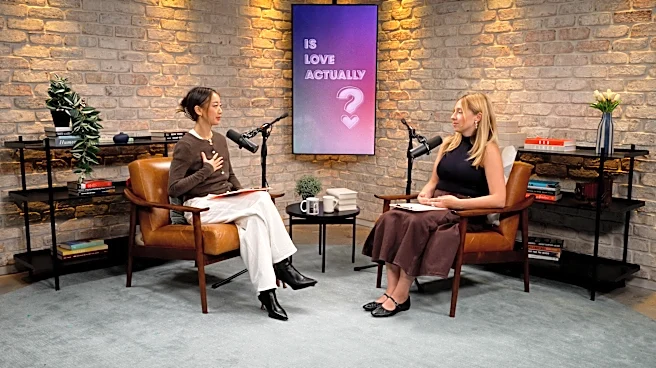





The third episode of "Is Love Actually?," a new five-part vodcast series from Humankind and USA TODAY, tries to understand how love can help us heal. In this episode, hosts Ronnie Li and Madeline Gunderson try to understand how compassion can offer comfort during challenging times.
All five episodes premiere this World Kindness Week, you can watch or listen to the entire series now.
A legacy of love
Grief is a testament to the love felt for someone who is no longer there.
This episode features the story of Symaria Glenn, a Florida teenager who saved her father's life through organ donation after her sudden passing. Symaria's parents joined "Is Love Actually?" and reflected on the profound impact of Symaria's life. They shared their experience navigating grief and leaning
on those who helped them carry it.

Their story offers a deeply personal look at how unconditional love continues to sustain and shape their relationship with their late daughter. Dhima Martin shares how she has changed after the loss of her daughter.
"I'm more patient because I realize how fleeting, how precious life is. I'm kinder because I want to be the mother Symaria thought I was, but also I want to continue her legacy."
Does love heal all wounds?
As much as we'd like to believe love can heal all wounds, it can't. This sentiment is echoed by Dr. Justin Baker, a pediatric oncologist and palliative care physician. In his experience, wounds from grief and loss may never be fully healed. But, love can help families grow around a wound. Not every illness can be cured, but love can still offer comfort.
It can be hard to know how to help someone who is sick or facing a life-threatening diagnosis. Complex medical problems and their potentially heartbreaking realities are difficult to talk about.
Dr. Baker serves as the chief of the Division of Quality of Life and Pediatric Palliative Care at Stanford Medicine Children's Health. His team focuses on improving the quality of life for young patients with life-threatening illness and shepherding their families through difficult decisions.
In his experience, broaching tough topics actually makes it easier to ensure better outcomes for his patients. He describes a dynamic called mutual pretense, where people avoid discussing a difficult truth in order to avoid upsetting the other person.
"A child or an adolescent might be protecting the parent from what they feel. 'I know that I am very sick and maybe will even die, but I don't want to weigh my parents down with that,' and the parents are thinking the exact same thing. 'Oh, we need to protect this adolescent or this child from this information because maybe that'll steal their hope.' So actually, what are they doing? They're using a lot of energy protecting each other from the thing that the other person already knows and are experiencing. So if we can bring them together, the energy can be used for the proper things."
Dr. Baker works to address tough issues directly and offer children and their families a pathway to connection. He encourages them to prioritize accomplishing dreams and goals with the precious time they have together, like going on trips or writing songs together.
He works closely with kids and their families as they navigate serious disease and hospice care, explaining how he focuses on embodying the definition of compassion. The word "is made up of two Latin words, it means com, 'with,' and pati, 'to suffer,'" Dr. Baker explains.
"Compassion literally means to suffer with, and so we try to picture ourselves going into that room and taking some of that burden off our patients and families, and holding it with and for them." This approach focuses on openness, vulnerability and listening.
Dr. Baker invites people to consider how they can support loved ones by making time to allow them to feel heard.
Episode 3 of "Is Love Actually?" offers viewers a roadmap for how they can approach difficult topics and apply the healing power of love in their own lives.
You can watch or listen to "Is Love Actually?" now. The series is available on all podcast platforms, including Spotify and Apple Podcasts
Funding for the project was provided by the Greater Good Science Center and the Templeton Foundation, in conjunction with the GGSC’s “Spreading Love Through the Media” project.
This article originally appeared on USA TODAY: Does love heal all wounds? A physician shares his perspective.