




Biscayne Bay is a "rare example" of a successful shark nursery near a major metropolitan area, according to a recent report.
The bay has been recognized as "essential habitat" for several species of sharks and rays and has been designated an Important Shark and Ray Area, or ISRA — locations which "play a significant role in the development and survival of sharks, rays and chimaeras," according to a release by the University of Miami.
They may be "important to shark and ray reproduction ... essential for newborn sharks in their first year of life, or that are disproportionately important for shark feeding, resting, movement, or aggregations." The effort to designate ISRAs was developed by the International Union for Conservation of Nature.
ISRAs
don't establish protected marine areas, but they do provide evidence that can influence efforts like "fisheries management, environmental impact assessments" and "habitat conservation," as well as "infrastructure decisions."
What species live in Biscayne Bay?
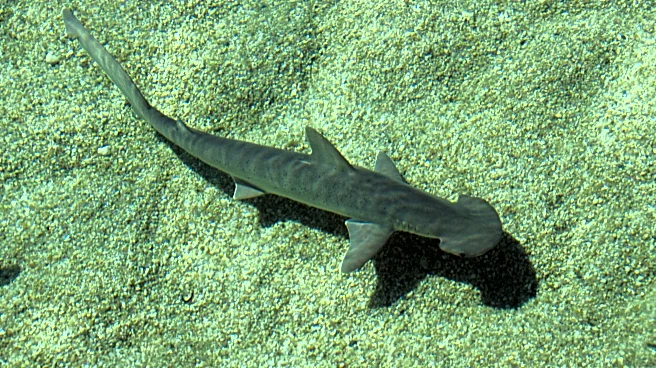
Biscayne Bay "provides nursery and reproductive habitat" for species like bonnetheads, nurse sharks, great hammerheads and tiger sharks.
"Researchers documented an unusually high concentration of young sharks from several species, making Biscayne Bay a rare example of a productive shark nursery alongside a major metropolitan area," reads the release.
Catherine Macdonald, an associate professor at the University of Miami's Rosenstiel School and The Robert K. Johnson Center for Marine Conservation, led the designation effort, according to the university.
Macdonald said the discussion surrounding the Bay's environmental decline is "only part of its story," and that the bay is an "extraordinarily important habitat for sharks and rays." Biscayne Bay's "ecological value," she added, should be considered when it comes to decisions about its future.
Report card revealed 'poor' conditions in Biscayne Bay
Miami-Dade County's annual report on the health of Biscayne Bay reflects overall minimal improvement, with "poor" conditions threatening the region's "economic powerhouse," according to officials.
The Biscayne Bay Report Card, produced by Miami-Dade County’s Department of Environmental Resources Management, examines "water quality and habitat in Biscayne Bay," factors it treats as indicative of the Bay’s ecological health.
"Biscayne Bay is not just a source of beauty and inspiration — it is also our community’s economic powerhouse, generating $64 billion each year in tourism, entertainment, boating, aquatic sports, real estate, and more," said DERM Director and Chief Resilience Officer Loren Parra in a release by the Miami-Dade County.
Biscayne Bay remains "vulnerable and under stress due to continuous pollution," according to the release. On this year’s report card, all regions remain in overall "poor" and "fair" condition. Still, there have been some slight improvements: Southern North Bay-Subregion B, Oleta River and Princeton Canal all went from “poor” condition in 2025 to “fair” condition in 2026. Southern North Bay-Subregion C, however, dropped from “good” to “fair.”
"From Miami Gardens to Homestead, from Miami Beach to Hialeah — our communities, our jobs, and our quality of life depend on a thriving Biscayne Bay," Parra continued. "For all these reasons, we invite everyone to think about what they can do to protect our Bay every single day."
What do the scores on the report card mean?
The report card uses a "stoplight" system to score the health of Biscayne Bay’s many regions — those in "poor" condition are experiencing "considerable water quality and/or ecological degradation," and "essential ecological functions and species diversity are impacted," and therefore not able to perform "beneficial functions" at optimal levels.
Regions with "fair" scores are experiencing water quality and/or ecological degradation, but essential ecological functions and species diversity are considered only limited in performing beneficial functions at optimal levels, rather than incapable.
"Good" regions are maintaining ecosystem function, while essential ecological functions and species diversity are generally performing beneficial functions at optimal levels.
According to the Miami-Dade County, key indicators studied include nutrient levels, bacteria and chlorophyll‑a, water clarity and the health of seagrass and sponges.
Where is Biscayne Bay?
Biscayne Bay is "centered within the large metropolitan area of Miami," according to the National Weather Service. The organization's Biscayne Bay Habitat Focus Area "extends nearly 50 miles from northern Dumfoundling Bay to southern Barnes Sound and Manatee Bay," and includes the coral reef tract that runs parallel to the bay, which runs northward from the Florida Keys.
"Biscayne Bay and its reef support an astonishing array of marine species and are favorite destinations for recreational pursuits such as fishing, boating, kayaking, snorkeling, swimming, and diving," reads the agency's website.
How is Biscayne Bay polluted?
Many areas, particularly parts of northern Biscayne Bay, continue to "show high levels of nutrient and bacteria pollution that exceed established criteria," which the release says demonstrates an "urgent need for stronger, sustained action."
Measures are underway to address the issue, according to the County, including the development of a "Reasonable Assurance Plan" for Biscayne Bay, which intends to establish nutrient targets to help reduce the amount of pollution reaching it.
"Elevated nutrients and bacteria are regularly detected in canals and portions of the Bay, and over time these pollutants can harm its sensitive ecosystem," continues the release.
What’s contributing to the degradation of Biscayne Bay’s health?
According to the County, everyday sources of pollution include:
- Stormwater and sediment runoff that carries nutrients and other contaminants into storm drains
- Uncollected dog waste that washes into waterways
- The use of lawn fertilizers during the rainy season
- Trash discarded on streets or directly into canals
- Leaky or poorly maintained septic tanks
- Improper disposal of fats, oils, and greases from homes and businesses
Sarah Perkel is a South Florida Connect Reporter for the USA TODAY Network's Florida Connect team. You can get all of Florida’s best content directly in your inbox each weekday day by signing up for the free newsletter, Florida TODAY.
This article originally appeared on USA TODAY: This Florida bay 'rare example' of shark nursery near major city