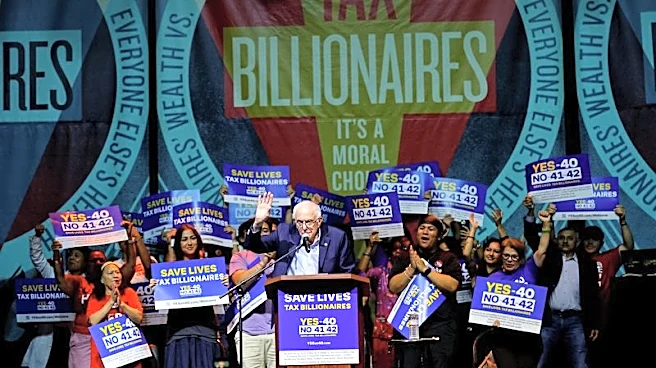

Bernie Sanders is taking advantage of the Democrats' sweep of Congress to tout his plan to save, and even boost, Social Security benefits.
The independent senator from Vermont who frequently caucuses with
Democrats will take the helm in January as the Senate's Social Security subcommittee chair. As the new chair, he posted on X last week he'll not only fully fund the trust fund that supplements payroll taxes to pay Social Security benefits, but increase individual benefits by at least $2,400 annually. And he'll do this for 75 years.
"How?" he wrote. "By scrapping the cap & demanding that the wealthy pay their fair share of taxes."
Eliminating or raising the wage cap that dictates how much income is subject to the payroll tax isn't a new idea, but adding increased payouts to the mix is. And all of it is proving controversial.
"Eliminating the payroll tax cap wouldn’t even cover the benefits Congress has already promised, let alone fund an expansion,” said Romina Boccia, director of budget and entitlement policy at libertarian think tank Cato Institute. “Sanders’s full plan goes much further, adding substantial taxes on investment and business income. His plan is essentially robbing Peter to pay Paul, with the added cost of making Peter poorer in the process. You can't tax your way to greater prosperity by undermining the investment and growth needed to expand the economic pie.”
What's Social Security's problem and how can Bernie Sanders help?
The trust fund that supplements payroll taxes to pay Social Security benefits is forecast to run dry in 2032. If that happens, all beneficiaries will see an automatic 22% pay cut as soon as the fund is empty, according to Social Security's Trustees Report.
Sanders plans to prevent benefit cuts by raising taxes on wealthy Americans. Currently, only salaries and wages up to $184,500 in 2026 are subject to the 12.4% payroll tax, usually split between employer and worker. In 2027, that threshold, adjusted annually for inflation, rises to $192,300.
Sanders wants to make all income above $250,000, subject to payroll tax, and redefine income to include investment income such as capital gains and dividends. Only salary and wages currently count towards payroll tax.
The resulting revenue would be enough to keep the trust fund solvent for 75 years and provide beneficaries with an extra $2,400 annually, he said. Sanders points to a Social Security Administration analysis of his idea in 2023, based on 2022 data, showing these moves starting in 2024 would have achieved his goals.

Does the math work?
Math is usually objective, but in this case, people have different opinions on whether Sanders' plan adds up.
"The financing concept is realistic, but the headline claim needs an updated actuarial estimate," said Martin Mulyadi, accounting professor at Shenandoah University's College of Business, Engineering & Technology. "Social Security’s chief actuary concluded that an earlier version could pay scheduled benefits for the full 75-year projection period, but that analysis used the 2022 assumptions ... The actuarial math is plausible; the 75-year claim needs a current score."
Since 2022, Social Security's health has deteriorated significantly. In 2022, the trust fund's forecast depletion date was 2035 but it's now earlier, in 2032. Using 2025 data, Social Security's trustees said eliminating the payroll tax wage cap to include all wages would only fund the trust for three years before returning to a shortfall and requiring additional new taxes or benefit changes.
Mary Johnson, independent Social Security analyst, simplified the math: If Sanders assumes benefits will be cut on average by 22% in 2032 and the average Social Security benefit today is around $2,000 then, a 22% cut would be about $440 per month, or $5,280 annually. A $2,400 increase "would only go part of the way in addressing a 22% cut," she said.
Other complications to lifting the cap
Eliminating or raising the cap is "a massive tax increase on small businesses, and it would harm the people who work for those firms too," said the Metals Service Center Institute trade association in September in a blog. The top federal tax rate on labor would rise above 50% and above 60% when including the state income taxes of high-tax states, the association said, citing research from tax expert George Callas of the Callas Strategy Group.
"Even liberal economists note that the additional revenue from higher marginal tax rates eventually begins slowing down and then turns negative somewhere between 60 and 73% as high-earners either stop earning additional wages or shift their compensation to lower-taxed investments," center-left researcher Brookings said in an analysis.
If taxes rise that high to fund Social Security, it also "would leave little-to-no room to raise taxes to finance new initiatives in poverty-relief, education, health care, veterans’ benefits, climate policy, childcare, family leave, or infrastructure," Brookings said. "It is unclear why senior benefits—including for wealthy seniors—should be prioritized over those progressive priorities when allocating potential new tax revenues."
Seniors shouldn't hold their breath?
Hope that Congress will find a solution is "reasonable, but retirees should keep it separate from any decision about their money until a change becomes law," said Denise Brinkmeyer, president of Jump Technology Services, which provides software solutions for social services including aging issues.
Laws can take a long time to come to fuition. "None of this is easy, and Social Security reform has always been a highly contentious issue for members of Congress to tackle," Johnson said.
In the meantime, Social Security recipients "shouldn’t be waiting around for our government to act," said Steve Azoury, owner of Azoury Financial. "They need to take matters into their own hands. They should be contributing to their own 401(k) or IRA accounts. It also may not be a bad idea to meet with a Social Security or retirement planning professional to help make a plan."
Medora Lee is a money, markets and personal finance reporter at USA TODAY. You can reach her at mjlee@usatoday.com and subscribe to our free Daily Money newsletter for personal finance tips and business news every Monday through Friday morning.
This article originally appeared on USA TODAY: Can Bernie Sanders really boost your Social Security check by $2,400?