







As shoppers continue to look for ways to save at the grocery store amid rising food prices, USA TODAY reached out to experts to get some money-saving tips.
Cooking at home is going to give the "biggest bang for your buck" when it comes to your budget, especially over choices like ordering through food delivery apps or eating out, said Brian Vines, marketplace reporter for Consumer Reports.
"But cooking at home in itself cannot save you money if you're not doing the right things with your shopping," Vines told USA TODAY.
"I'm noticing folks being a lot more intentional about how they are doing their food spend because unlike your mortgage or your rent or other fixed costs, shopping and cooking at home represents one of those places where you have
the opportunity to save the most," he said.
Vines said by some of his estimates, as much as $5,000 a year can be saved by "shopping smart" and applying those savings to other parts of your budget.
The cost of groceries, or food away from home, was 2.2% higher in August than a year earlier, according to the latest U.S. Bureau of Labor Statistics Consumer Price Index. Several studies have also cited a growing number of shoppers needing to borrow money from family members or charge groceries to their credit card knowing they can't pay the bill the next month.

What does it mean to 'eat down the house'?
One of the first tips Vines recommends isn't for when you're at the grocery store, but when you're at home.
He calls it "eating down the house."
In the past, people may have been stockpiling canned goods in their pantries, Vines said.
"Now it's time to start eating those things that you've been banking on. So before I'm going grocery shopping, I'm exhausting every dried bean that's been in there and every can of corn I have," he said.
The concept isn't new and has had different names over the years, but it can not only help save money but also use food stored in the pantry before it expires, he said.
Plan ahead before you go to the store
Vines also does not run to the store while meal prepping to get one thing or because he has a craving.
"We're just being a lot more intentional about what we're going to eat for the week,'' he said. "A lot of that has to do with what the circular says" for sales, he said.
"Think about your weekly food spend or your monthly food spend and start early," he said. "If you're just thinking about it when you've walked through those double doors at the grocery store, you're already behind the eight ball."
Be aware of marketing tactics
Once you're at the store, be aware of the marketing that may affect what you buy, said Ellen Van Loo, associate professor in agricultural economics at Purdue University. Van Loo studies consumer food choice, decision-making and spending and how behaviors are shaped by things such as labels, food policy and marketing.
"I see the marketing games being played by these big corporations, that sometimes consumers are misled and are paying higher prices for things they think is worth it, but maybe that's not always the case," Van Loo told USA TODAY.
For instance, Van Loo said, eggs are often marketed or labeled as hormone-free, but according to U.S. laws, hormones can't be used in the egg-producing process.
Check the serving size
Compare the weights and serving size of products because sometimes packages look a lot bigger, but they're filled with more air, said Van Loo.
Order online for pickup
Doing your grocery shopping online for pickup helps a shopper stick to the shopping list and avoid any impulse buys while in the store, said Van Loo.
Look beyond eye level
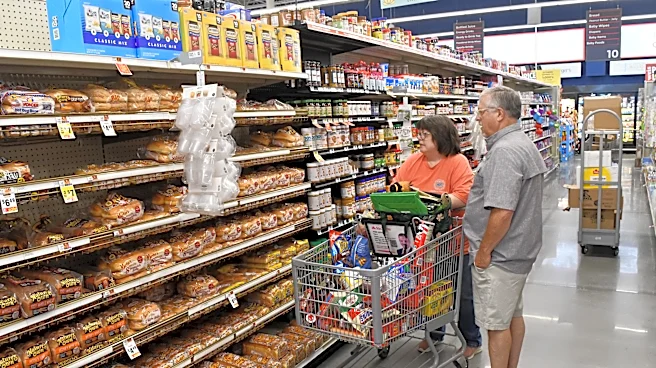
Grocery stores have agreements with manufacturers for product placement on shelves, with some paying more to be at eye level or to have more products taking up the premium shelf space, said Van Loo.
"It's good for consumers to not limit yourselves to eye level. Know that there is a reason why it is on eye level and it's not to make it ... the cheapest product or the healthiest product," she said.
Betty Lin-Fisher is a consumer reporter for USA TODAY. Reach her at blinfisher@USATODAY.com or follow her on X, Facebook or Instagram @blinfisher and @blinfisher.bsky.social on Bluesky. Sign up for our free The Daily Money newsletter, which breaks down complex consumer and financial news. Subscribe here.
This article originally appeared on USA TODAY: The money-saving grocery strategy hiding in your pantry