


Spoiler alert! The following story contains major details about Episode 4 of Netflix series “East of Eden” (now streaming).
For years, Florence Pugh has consistently been one of the finest actors working today.
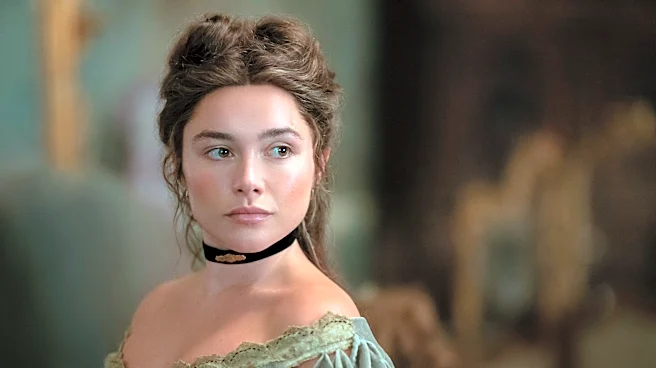
But the “Midsommar” star may give her most astonishing performance yet in “East of Eden,” a sprawling, seven-episode adaptation of John Steinbeck’s 1952 novel. Set in early 1900s California, the stunning new limited series was created by Zoe Kazan (“Wildlife”), who excavates the original story and finds a Cathy Ames (Pugh) that explodes off the screen with her fierce cunning and complexity.
Cathy has been taken advantage of by men, both physically and figuratively, ever since she was a young girl. She attempts to gain complete independence
through means that are violent and deceitful, yet also entirely empathetic – a credit to Pugh and Kazan’s thoughtfully considered work.
“The only true freedom in this world is economic freedom,” Cathy says at the top of the standout fourth episode, titled “Kate,” having just abandoned her husband, Adam (Christopher Abbott), and two infant sons. She changes her name and goes to work in a brothel, where she’s taken under the wing of the maternal madam Faye (Martha Plimpton). As the days and weeks go by, she steps up to help manage payouts and chores around the house.

Kazan first read “East of Eden” as a teenager and always loved the dynamic between the two characters.
In Steinbeck’s novel, “there’s this beautiful description of how the first things that came west were churches and brothels,” Kazan says. “If you stood outside a brothel, you might think it’s a church because it was so quiet. And if you stood outside a church, you might think it’s a brothel because it’s so raucous. I carried that with me all this time.
“I'm really interested in sex work. I find it fascinating,” Kazan, 43, continues. “The book is doing something really interesting around transactions with money and how money can stand in for love.” Before she arrives at the brothel, “Cathy does not have a lot of interactions with women and then she’s placed into this all-female environment. Her tool set around women is completely different and I found that very relatable.”
Florence Pugh, Zoe Kazan want you to find the 'human' in 'East of Eden'

In one of the series’ most heartrending scenes, Cathy comforts a fellow prostitute who has been brutally injured by a client. Her voice quavering, she tells the young woman about “Alice in Wonderland,” and how Alice would drink a potion to shrink herself.
“When I was a little girl, and I was afraid or hurt … I would think about Alice,” Cathy says. “And I’d feel myself growing so small; so small that nobody could find me.”
It’s a rare moment of vulnerability for Cathy, whose relationship with sex and men has been “forever warped” due to past trauma, Pugh says.
“When she’s in the brothel, it’s almost like she’s able to breathe,” Pugh, 30, explains. “What is so beautiful about that episode is you actually see her enjoying life for the first time: She is enjoying doing well at her job and looking after people. She feels success here and that is a lovely feeling for everybody to feel.”
By protecting and showing up for these women, “we can look at her say, ‘Oh, yeah, there’s the human. That’s where she is.’ ”
The Oscar-nominated actress has a knack for portraying women who might be repressed ("Lady Macbeth") or misunderstood ("Little Women"), and helping to give them a voice.
"Every time I play a character, I stretch what I know I'm capable of," Pugh says. "That's why I always lean towards the roles that terrify me; I don't personally find much interest in repeating the same thing again. ... I think all the roles that I've played in my career have led me to this. Not only because Zoe watched Dani from 'Midsommar' and thought that I was capable of playing Cathy, but the muscle of understanding characters ‒ and truly wanting to care for them ‒ gets greater and greater every time I'm allowed to play one."
Why Cathy's final moments with Faye are 'purposefully ambiguous'

Cathy’s relationship with Faye may seem innocent enough to start, as the wearied woman promises to make her an heir in her will. But there’s a heel turn midway through the episode, when a drunken Cathy begins to manipulate and rebuke the bewildered Faye.
“I’ll show you how to run a real whorehouse. We’ll give them pleasure, Mother dear,” Cathy hisses with delicious depravity, claiming that she’s responsible for all the brothel’s regulars. “They can’t go to anybody else. They don’t want anybody else. No one else will do.”
In the days and weeks to follow, Cathy slowly poisons Faye’s food and drinks, eventually killing her and inheriting the business for herself. Assuming her role as the vicious new madam, she orders for the house to be painted black. (Cue the pitch-perfect Rolling Stones needle drop.)
But first, we watch as Cathy sobs over Faye’s dead body, as the other prostitutes discover that their housemother has died. On a surface level, it may seem as if Cathy is merely faking grief to hide her tracks. But on the other hand, Faye was the first person to treat Cathy like she was more than mere property, and therefore, her mourning may be genuine.
“As a performer, I think that it is all real,” Pugh says. “I really do think that she has this undeniable fear of being trapped, and someone clinging onto her so tightly that she can't make her own decisions anymore. My mum read this episode and was actually out there when we were shooting. She was like, ‘But she's bad. She's got this home and this mum now. Why does she do this?’ I was trying to wrestle with it, too.”
Cathy feels as if “the world is closing in around her,” Pugh says. “I also wonder if there's a part of her that knows that she could stay and it might be fine, and that is terrifying to her. She could enjoy that life and she might feel love, so there's this fear of staying too long.”
Kazan references a passage of Steinbeck’s novel, where he writes that Cathy is always telling part of the truth and that’s why her lies are so powerful.
“Moments like that are purposefully ambiguous in terms of how much she is actually feeling,” Kazan says. “I’m not even sure Cathy knows how much is real for her and not.”
Ultimately, “I think both things can be true, and that’s the most exciting thing about this character,” Kazan adds. “She wants safety and security, but only on her own terms. There is a real desperate fear that if she lets someone love her or know her, she will not be in control. I find her very moving. We all wanted this to be a complicated portrait of all the characters – but she is definitely the thorniest one.”
This article originally appeared on USA TODAY: Netflix's 'East of Eden' has a standout episode. Florence Pugh, Zoe Kazan break it down