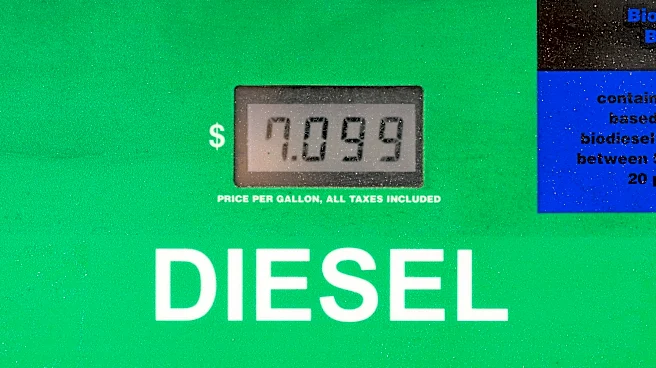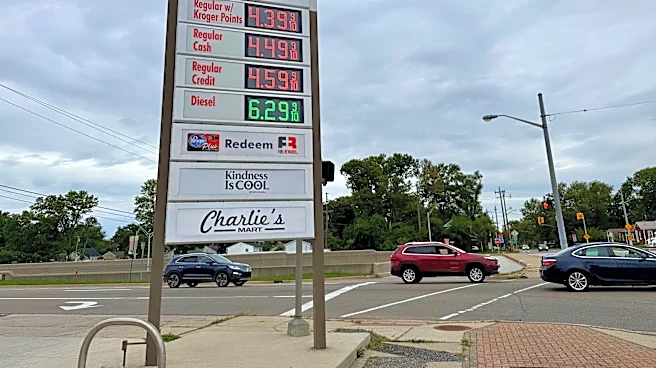









Rising gas prices have garnered a lot of attention, but diesel prices have also sharply increased in recent weeks amid mounting military tensions with Iran.
The average price of a gallon of diesel fuel in the U.S.
on Wednesday, Sept. 10, was $6.31, according to AAA. That's up from an average diesel price of $5.94 one week ago on Sept. 9, and $3.70 one year ago on Sept. 16, 2025, the group said. By comparison, the average price of a gallon of regular gas in the U.S. on Wednesday, Sept. 16, was $4.36.Oil prices have also spiked amid continued escalation in the war between the United States and Iran. Futures for Brent crude oil, the international benchmark, reached about $106 per barrel on Wednesday, Sept. 16. Futures for November delivery of West
Texas Intermediate, the U.S. benchmark, were trading at around $103 per barrel.
Patrick De Haan, Head of Petroleum Analysis at GasBuddy, said in post on X that gas and diesel prices are both expected to continue rising as the Iran war continues.
"We may set a new 2026 high for average gas prices by the weekend," he wrote. "Currently $4.371/gal and climbing, previous high $4.566/gal. diesel average at $6.315/gal and climbing, could hit $6.50/gal in the next 48 hours."
we've reached a new milestone- the U.S. average diesel price has hit $6.301/gal while gasoline is up to $4.355/gal. I expect both of these to jump noticeably over the next 48 hours. diesel could hit $6.60/gal in a few days, surpassing the inflation-adjusted peak seen in 2022. pic.twitter.com/WvhSM4YaHM
— Patrick De Haan (@GasBuddyGuy) September 16, 2026
With that in mind, the USA TODAY Cars team took a look at what is causing diesel fuel to cost more than gas and what could realistically be done to lower prices.
Why does diesel fuel cost more than regular gas?
Diesel fuel was historically cheaper than regular gasoline, except during exceptionally cold winters when there was greater demand for diesel and other heating oils, but that trend started reversing around September 2004, according to the U.S. Energy Information Agency.
The agency attributed the higher diesel costs to these three factors:
- Higher demand for diesel fuel, especially in Europe, China, India, and the United States.
- Increased diesel production and distribution costs due to the transition to less-polluting, lower-sulfur diesel fuels in the United States.
- Higher federal gas taxes for on-highway diesel fuel (24.40 cents per gallon), which is 6 cents per gallon higher than the 18.4 cents per gallon federal gas tax.
What are the impacts to consumers of higher diesel fuel costs?
Higher diesel costs have translated to increased grocery prices for many consumers, because shipping companies usually make deliveries to stores in diesel-powered trucks. Higher shipping costs are passed on to consumers rather than being absorbed by grocery chains.
According to American Trucking Associations, which lobbies in Washington for major trucking companies, nearly 73% of the nation's cargo freight was moved by diesel trucks in 2024, which is the most recent data the group has made publicly available. That translated to 1.27 billion tons of freight that was transported by trucks that now cost shipping companies a lot more to fill up.
Big rigs have tanks that can range in capacity from 120 to 150 gallons, according to the FreightWaves.com website. Such trucks average about 6 miles per gallon, according to the site.
Consumer advocates say customers were already being squeezed by higher prices caused by other factors like inflation before diesel prices started spiking this year.
“Since early 2021, American consumers have seen their family budgets getting squeezed more and more," David Holt, president of the Houston, Texas-based Consumer Energy Alliance, which lobbies for energy policies that benefit consumers, said in a statement.
"On top of the direct impact of excessively high gasoline and diesel prices, family budgets are crushed by the inflationary impact those fuel prices have on essential, everyday commodities like eggs, bread, milk, and clothing – all of which require diesel fuel to get to our markets or homes," Holt continued. "Simply put, when gasoline and diesel costs go up, the cost of everything goes up."
What type of cars use diesel fuels?
Carmakers don't sell as many diesel-powered models as they once did. Most of the currently available diesel vehicles are large SUVs and pickup trucks.
Here are some popular vehicles that still use the more expensive fuel, according to Carfax:
- Chevrolet Tahoe Diesel
- Chevrolet Suburban Diesel
- GMC Yukon Diesel
Here are some additional models that were recently available in diesel formats that have since been discontinued, but might still be for sale on used-car lots:
- Cadillac Escalade Diesel
- Jeep Wrangler Diesel
- Land Rover Range Rover Diesel
- Mazda CX-5 Diesel
Keith Laing is an automotive reporter on the National Trending Desk at USA TODAY. Contact Keith at klaing@usatodayco.com.
This article originally appeared on USA TODAY: Why are diesel prices so much higher than regular gas?