






In a world where parents are increasingly worried about kids glued to screens, one mom is letting her child draw all over the walls.
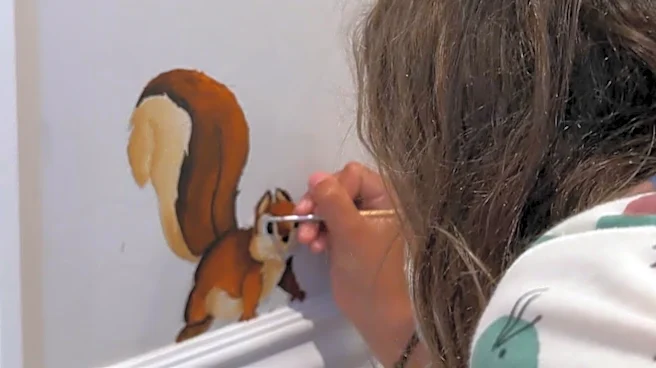
“My 10 year old whimsymaxxing all around our house,” Kasey Moore wrote over a TikTok of her daughter painting an assortment of characters on her walls.
Moore has let Graylee, now 11, draw everything from squirrels and birds inspired by “Snow White” in her bedroom, to Lighting McQueen in her brother’s room, and Remy from “Ratatouille” in the kitchen.

Moore is embracing “whimsymaxxing,” a word the social media world is using to describe bringing more imagination and spontaneity into everyday life. Whether it’s having glitter in a morning cup of coffee, embracing maximalist outfits or rewatching a nostalgic favorite
movie, the trend has become a way to nurture one’s inner child and tap into low-tech or analog activities. And parents are getting in on the action.
The videos on Moore’s page have garnered millions of views and comments from fascinated parents and onlookers.
“You’re doing parenting the right way!!!” ❤️one person commented. “This genuinely make me emotional she’s so talented and ipad free,” remarked another. Others remarked on the contrast from their own childhood: “My parents would have had a fit. Love when parents let their child create.”
What is ‘whimsymaxxing?’
Parents online have described whimsy in all sorts of ways, from spending time outside painting rocks to embracing simple rituals like having dessert after dinner. It’s having a picnic in the front yard, playing dress up and adding rhinestones to shampoo bottles.
Many of these ideas are about repurposing everyday activities to make them more exciting. Some parents share that they push their couches together for an occasional family living room sleepover, while others say they create a homework cafe with relaxing music, candles and snacks in the kitchen.
Others have shared visually creative ideas for meals, creating peanut butter toast with bananas cut out like stars and Mickey Mouse ears, hosting orange-color themed meals and eating spaghetti dinners directly off the table over aluminum foil.
@girlydiarybystar Sequins, glitter, ribbon & gems please!🎀🌸🦋🌈🫧🐞#whimsy #whimsymaxxing #girlmom #whimsykids #whimsychildhood girly room | whimsy room for little girls | fancy Nancy | storybook childhood | fairytale childhood | whimsy toddler fashion | whimsy toddler girl hair styles | whimsy hair styles for little girls
♬ original sound - femme fatale .
Adding spontaneity and creativity into parenting can be an effective way to engage with children and build relationships with them, according to Jenny Radesky, a developmental pediatrician at the University of Michigan.
“I love the playful motivation behind whimsymaxxing,” Radesky says. “Playfulness by design is not perfect. It's actually kind of messy and experimental, and it shouldn't have an end product.”
To Moore, who shares Graylee, along with Nola, 9, and Marino, 7, with her husband, Lance, whimsy is about incorporating “carefree magic” into childhood. She says that as a child, she was exposed to theater, Disney movies and classic books, and that’s something she wants to recreate for her kids.

Moore says her children are allowed to use iPads when they travel, and have a Nintendo that the family shares, but otherwise, technology in the household mainly takes the form of family movie nights.
Her kids are reading books like “Where the Red Fern Grows,” “Bridge to Terabithia” and the “Harry Potter” series. They made a “creation room” in their home with paper, scissors and paints for their kids to make art projects with.
“She literally will go in there for an hour and come out a different child,” Moore says of Graylee. “I just feel like that is her creative outlet for her mental health.”
The science behind open-ended play
Radesky says that mental flexibility helps develop children’s executive functioning, problem solving and information processing. When kids can imagine that their stuffed animals are having a tea party or view a set of blocks as meatballs, it helps them become outside-the-box thinkers who see situations in a multitude of ways.
“In early childhood specifically if you get a lot of practice being a flexible thinker … that is exercising your frontal lobe in terms of this mental flexibility,” Radesky says.
Radesky, who is an author of the forthcoming book "CONNECTING: Raising Kids in the Digital World," says that focusing on “human connection” and “being OK with the mess” and “creative” aspects of play is especially important in the age of artificial intelligence.
A May advisory from the U.S. surgeon general's office warned that screen use now begins in infancy. More experts are talking about iPad babies – those toddlers you might see glued to a screen at a restaurant, the grocery store or airplane – and the rise of chatbot companions, which have come under scrutiny after high-profile lawsuits involving children's mental health.
Radesky says that parents should strive for multisensory play involving more than one sense. While tablets keep kids inside and quiet and don’t require any cleanup, she says the kind of play that contributes to children’s creativity may sometimes involve getting messy, and that’s OK.
Beyond practicing her creative skills, Moore says the practice has been helpful for building her daughter’s self-esteem and trust.
“Her self confidence of, ‘oh my gosh, my mom is going to let me permanently paint these walls … she just glows after, and she can see how proud I am of her,” Moore says.
Embracing whimsy in parenting
For parents looking for where to start, Radesky recommends trying to pause and get back into a childlike mindset.
“Be like, ‘Oh my gosh, what did I love to do when I was 10?’ And it might be painting, it might have been playing library … so go back into your own memory vaults and think of that freedom of play,” Radesky says.
And getting creative doesn’t mean throwing rules out the window – Radesky recommends outlining boundaries for children about, for example, when they can and can’t draw on walls or which objects they’re allowed to take apart.
Radesky cautions that while social media can be a place to find fun ideas, parenting trends run the risk of oversimplifying the complexity of parenting.
“Social media can amplify this idea of picture-perfect parenting, where we're just kind of showing the highlights, and there's lots of lowlights of parenting that feel embarrassing,” Radesky says.
Instead, she recommends trusting one’s own parenting instincts.
“Your relationship with your kids can really be a guide, rather than feeling like you need to conform to some sort of picture perfect camp of parenting.”
Rachel Hale’s role covering Youth Mental Health at USA TODAY is supported by a partnership with Pivotal and Journalism Funding Partners. Funders do not provide editorial input. Reach her at rhale@usatoday.com and@rachelleighhale on X.
This article originally appeared on USA TODAY: Parents are embracing ‘whimsymaxxing.’ The results might surprise you