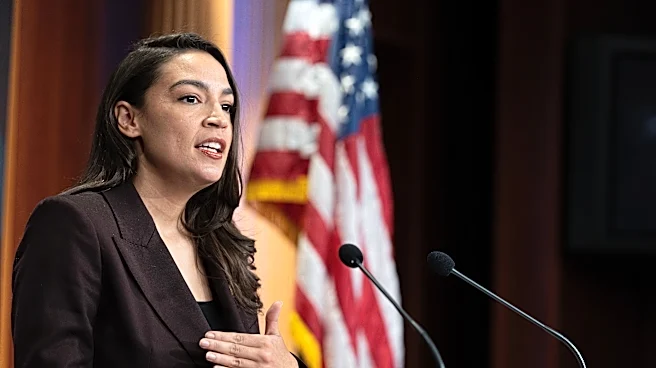









Rep. Alexandria Ocasio-Cortez revealed she's freezing her eggs, and her comments about the challenges women face when family planning are something many can relate to.
"There is so much negative messaging that is directed towards women around our family choices. Period. Kind of no matter what choice you make − if you have kids, when you have kids, whatever," the Democratic congresswoman from New York said on Instagram.
In the comment sections of news outlets sharing her story, people have been quick to chime in with such negativity − but also the opposite, including women sharing their appreciation for her transparency.
"It's sad to read so many negative comments," one person wrote. "@aoc is an inspiration to all women who are considering motherhood,
but are not ready now."
"Thank you for sharing your journey. I did this multiple times and now have two beautiful children. You got this!" another person commented.
"Thank you @aoc for bringing awareness to this process!! It is such a journey that most women have to deal with so alone!" another wrote.
Ocasio-Cortez added negativity around a women's decision about kids is designed to "put us in a place of fear or insecurity."
Her decision comes as women over 30 and even over 40 are becoming first-time moms. While birth rates are down in the United States and across the globe, fertility rates have risen among American women 40 and older. From 2023 to 2024, birth rates declined for women ages 15 to 34, were unchanged for women ages 35 to 39 and rose 2% for women ages 40 to 44, according to the most recent data released in July 2025.
Ocasio-Cortez isn't alone in using egg freezing as a fertility tool. More women are choosing to freeze their eggs than ever before, Danielle Melfi, CEO of Resolve, a fertility patient advocacy group, previously told USA TODAY.
"While egg freezing isn't a guarantee, it does help women feel like they have more time to make some of these decisions," Melfi said.
In addition to varying success rates of pregnancy later on, other potential downsides to egg freezing include financial barriers and some minor procedural risks.
Dr. Ilana Ressler, a reproductive endocrinologist at Illume Fertility, said a few things have contributed to the increase in egg freezing, including technological advancements, improved insurance and employer coverage as well as people wanting families later than previous generations did.
"Egg quantity and quality decline with age no matter how healthy or fit someone is," Ressler added. "More women understand that now, and a growing number of them want to do something about it while they still have the option."
Why might someone freeze their eggs
AOC first revealed her egg freezing plan on social media before discussing the move on ABC News' "This Week" on Aug. 9, adding she has not ruled out a 2028 presidential run.
In addition to career moves, there are variety of reasons someone may choose to freeze their eggs.
A 2022 survey from the Institute for Family Studies found that among women ages 18 to 55 who want more children, 44% cited not finding the right partner as a barrier, 36% cited affordability and 25% cited lifestyle or career.
Ressler said the most common reason she hears has nothing to do with a career. Instead, it's all about timing and "keeping options open for the future."
"If a woman is 33 and isn't with a partner she wants to raise children with, she doesn't want a biological clock dictating who she picks or how quickly," she said. "Some aren’t sure if they ever wish to have children, but don’t want to lose the option to build a family in the future."
Medical need is another important category, Ressler added, from preserving eggs forpatients before chemotherapy or radiation, before certain surgeries for endometriosis or women who carry a BRCA mutation or have a family history of early menopause.
Some transgender patients also choose to freeze eggs before beginning gender-affirming hormone therapy, she added.
Some women opt to freeze eggs after discovering something unexpected. For example, if after a routine fertility assessment, a 29-year-old finds out her egg quantity is lower than expected at her age, she may decide to take action now, Ressler explained.
"Other women are in the middle of medical residency, a military deployment, a cross-country move or they know they want three children and they're starting the process at 36," Ressler said.
"None of these women are avoiding motherhood," she added. "They're protecting the version of it they still hope to achieve in the future."
Contributing: Madeline Mitchell, USA TODAY
This article originally appeared on USA TODAY: AOC reveals details of her egg freezing decision. Many women can relate