

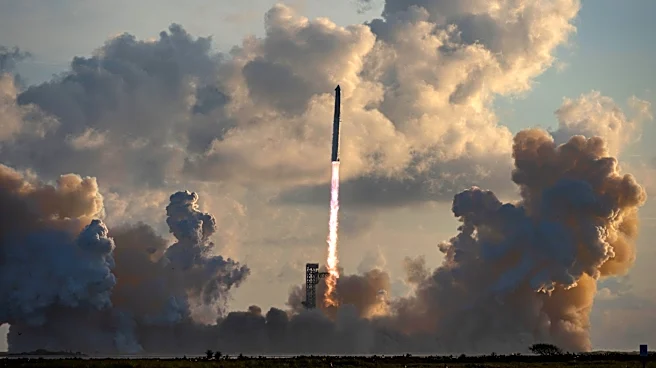

A powerful rocket equipped with extra boosters mounted to the side is about to put on a show across much of the East Coast of the United States.
Nine months have elapsed since the United Launch Alliance's Vulcan rocket has gotten off the ground from Florida.
Now, the Colorado-based launch service provider is hoping for a triumphant return on Friday the 13th. That's when the heavy-lift launch vehicle plans to conduct its first mission since it was sidelined in February after an "anomaly" was observed mid-flight.
The mission should mark two major firsts for Vulcan's fifth overall flight: the first time deploying to space a batch of satellites for Amazon's fledgling broadband internet network. And the first launch with the maximum six solid rocket
boosters affixed to Vulcan as it lifts off.
The stakes are high both for the ULA – a joint venture between Boeing and Lockheed Martin – which wants Vulcan to become its main workhorse; as well as billionaire Jeff Bezos' e-commerce giant, which is relying on the rocket for the future of its satellite service.
Here's everything to know about the Vulcan rocket, its first flight since February and the United Launch Alliance's future plans for the spacecraft.
What is the ULA Vulcan rocket, Centaur V?
Vulcan stands at 215 feet tall when fully stacked and is designed to fly with anywhere from zero to six solid rocket boosters – in addition to the main 109-foot-tall booster.
What sets Vulcan apart from its ULA predecessors is its 35-foot Centaur V upper stage, which is equipped with two engines of its own to make more complex missions to extreme orbital heights possible.
When, where is the Vulcan rocket launch in Florida?
The ULA is working toward a Nov. 13 launch of its Vulcan rocket, with a 29-minute launch window opening at 12:54 p.m. ET, according to its website. The rocket will get off the ground at Launch Complex-41 at the Cape Canaveral Space Force Station in Florida.
ULA to deploy Amazon Leo satellites to orbit
As for the mission itself, it will mark the first time that the Vulcan is being used to deliver a batch of Amazon Leo – previously known as Project Kuiper – satellites to Earth orbit.
The rocket will have a payload fairing mounted to the top carrying 40 of the satellites, which will bolster Amazon's growing satellite network envisioned as a direct competitor to SpaceX's Starlink service. Since April 2024, Amazon has contracted with various launch providers to so far deploy nearly 400 of a planned 3,200 satellites to low-Earth orbit – a region closer to the planet's atmosphere.
How to watch livestream of ULA Vulcan rocket launch
The United Launch Alliance will provide live video coverage of liftoff beginning about 20 minutes before the launch window opens. The livestream will be available on YouTube and is also embedded above.
The ULA will also begin posting live reports around 7:30 a.m. ET on launch day on its blog.
Which cities in US will see the launch? See visibility map

Of course, many people in Florida and even in other states have a chance to see the rocket in person.
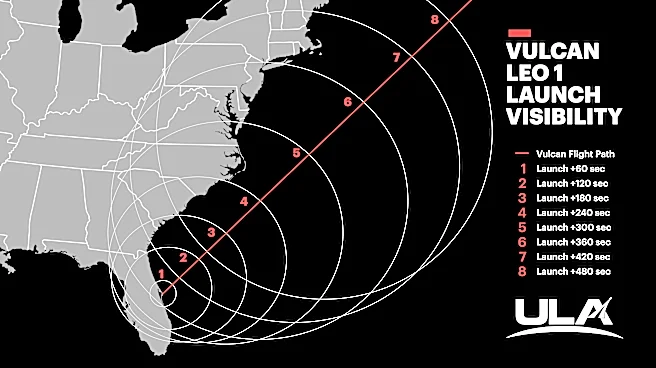
Because it will have the maximum six solid rocket boosters mounted to the side, the Vulcan will launch atop 3.9 million pounds of thrust – a measure of the amount of force used to push the vehicle off the ground. That amount of power should make both the launch and the powerful spacecraft itself bright and widely visible in Florida and beyond as it flies on a northeast trajectory.
The United Launch Alliance shared a visibility map that should provide spectators along the East Coast with a rough idea of when they might see the Vulcan soar overhead if it launches as scheduled.
When did the Vulcan last launch? 'Anomaly' in February grounds rocket
The launch would mark the first time Vulcan has gotten off the ground since a Feb. 12 flight that sidelined the rocket for about nine months. While the Vulcan was able to carry out the national security mission and deliver its payload for the U.S. Space Force, sparks were observed coming off the rocket mid-flight in what the United Launch Alliance confirmed was an anomaly.
How many times has Vulcan launched?
The Vulcan's most recent flight marked its fourth from Cape Canaveral, and itssecond national security mission since August 2025. The United Launch Alliance’s Vulcan rocket launched on two missions in 2024, both of which set the rocket on the path to certification by the United States Space Force to fly such national security missions.
Vulcan to replace Delta IV, Atlas V
Ultimately, the United Launch Alliance is planning for the Vulcan to replace both its Atlas V and the now-retired Delta IV – becoming the company's main workhorse for both commercial and national security missions.
The Delta IV was retired in April 2024 after its final national security mission for the National Reconnaissance Office. The flight was not only the last Delta IV Heavy launch, but the final mission in ULA’s Delta family of rockets.
The Atlas V, though, is still in service and has been the launch provider for eight of 14 satellite deployment missions for the Amazon Leo constellation.
What is the United Launch Alliance's plan for Vulcan?
In the years ahead, the U.S. Space Force has big plans for the Vulcan rocket at both Cape Canaveral andthe Vandenberg Space Force Base in Southern California.
In addition to national security spaceflights, the United Launch Alliance is aiming to price missions low enough that Vulcan attracts both civil and commercial customers. Amazon, for instance, has hired ULA to use its Vulcan rocket for 38 future Amazon Leo missions, according to the company.
Eric Lagatta is the Space Connect reporter for the USA TODAY Network. Reach him at elagatta@usatodayco.com
This article originally appeared on USA TODAY: Powerful Vulcan rocket with 6 boosters set to light up East Coast