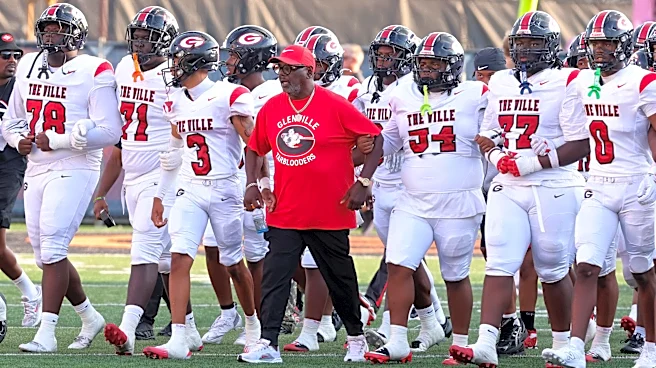



The latest chapter of the Glenville (OH) eligibility saga has added a new chapter as Judge Andrew J. Santoli of the Cuyahoga County Court of Common Pleas ruled for the school in its battle for postseason eligibility against the Ohio High School Athletic Association.
WKYC reported Tuesday that Santoli ruled the OHSAA arbitrarily removed the Cleveland-area school before its investigation into player eligibility was complete. The decision comes after two days arguments heard from Glenville and the OHSAA.
Last Thursday, the OHSAA ruled that the defending Division IV state champions had been using ineligible playerswho attend Ginn Academy (OH), a non-OHSAA-member magnet school, and should be playing at other area schools.
Two days later, a court order
overturned that decision as the program was given a temporary restraining order allowing them back into the postseason. Santoli also granted that motion.
The Tarblooders' opening postseason game against University School (OH) was rescheduled for noon on Oct. 31, but University issued a statement saying it would not play that game and was instead focused on its second-round game against Salem (OH).
According to the report, the OHSAA's summary report from Nov. 1 stated that the Cleveland Metropolitan School District had not provided documentation to verify where 10 players on the team live. They also said the district did not have a reliable process for determining where students from Ginn Academy should participate in athletics.
However, Santoli noted that the OHSAA's report was incomplete, as both sides agreed that additional documentation was needed to complete the review. With that, Santoli ruled that none of the players were ineligible given the OHSAA's own bylaws.
By the time the OHSAA decided to ban Glenville from the postseason, the investigation was still ongoing, and no findings had declared any player on the roster ineligible.
Given Glenville's success this year, as the Tarblooders finished the regular season with an 8-2 record, Santoli said the players would be stripped of the opportunity to compete in the postseason despite doing nothing wrong.
However, if the OHSAA's continued investigation determines later that Glenville used ineligible players, the organization will be allowed to take corrective action.
In a statement to USA TODAY Sports, the OHSAA said two Glenville players brought the lawsuit, not Glenville High or the Cleveland Metropolitan School District.
On Wednesday in Cleveland, the OHSAA said it plans to challenge additional findings in appellate court.
The OHSAA also noted that since the middle of last week, both Cleveland Metro and Glenville submitted documentation regarding residence, and much of it conflicted. Of the 64 players on Glenville's roster, the OHSAA states that 63 do not attend the school and that Cleveland Metro has not proven that the 63 should be playing for Glenville.
This is the second time Glenville has been hit with these violations: the program was removed from the 2018 playoffs, given a $5,000 fine, and put on probation for three years.
While Santoli's ruling allows Glenville back into the postseason, he left the decision of which team should advance up to the OHSAA.
“The Court emphasizes that it is not asked, nor permitted, to determine who is entitled to play in the Playoffs," the OHSAA statement reads. "It is beyond the scope of this Court’s authority to order that one team be entered into the Playoffs over another, or that one team advance in the Playoffs over another.”
The association will determine the Glenville and University result by declaring that University forfeited the game by not competing, rescheduling the game, or another option not yet discussed. The OHSAA will release more information on who will play Salem on Wednesday.
Follow Sports Reporter Joe Spears on X at @joe_spears7 or via email: JSpears@usatodayco.com. For additional high school sports coverage, be sure to follow USA TODAY High School Sports on Instagram and X.
This article originally appeared on USA TODAY: Ohio high school football powerhouse wins court ruling, but playoff future uncertain