



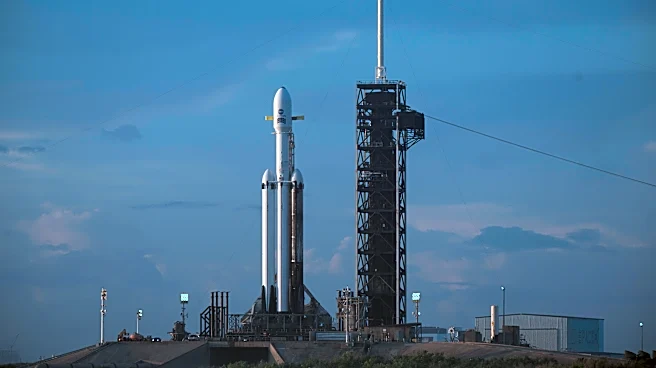


In the next few months, NASA's latest astronomical observatory is expected to return its first images of the cosmos as it begins a mission that will shed light on some of the darkest corners of the universe.
The Nancy Grace Roman Space Telescope hitched a ride to space Sunday, Aug. 30, atop a SpaceX rocket, which launched over blue Florida skies after sunrise.
The culmination of a $4 billion project, the observatory is now on its way to a distant orbit beyond the moon. For the next 90 days, NASA teams will ready the Roman telescope for its five-year mission to study enigmatic phenomena like dark matter while hunting for habitable worlds beyond our solar system.
"Roman will give us a new atlas of the universe, push the boundaries of discovery, and
demonstrate what is possible when America’s space program pairs bold ambition with disciplined execution," NASA Administrator Jared Isaacman said in a statement.
Here's what to know about the launch of the Nancy Grace Roman Space Telescope, as well as what's next for NASA's observatory.
SpaceX Falcon Heavy launches NASA telescope to space
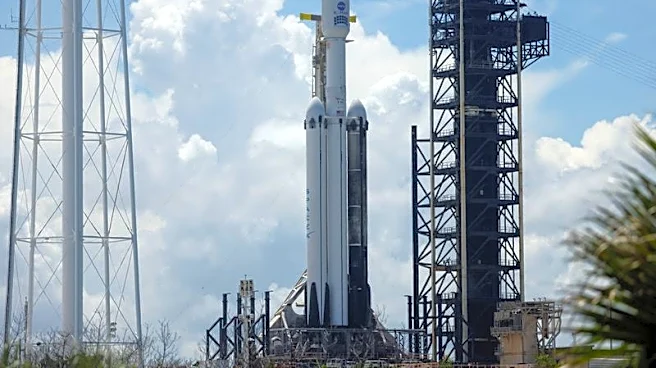
NASA's Nancy Grace Roman Space Telescope was launched right on time at 7:26 a.m. ET Aug. 30 aboard a SpaceX Falcon Heavy rocket, which got off the ground from Launch Complex 39A at the Kennedy Space Center in Florida.
Similar to SpaceX's well-known Falcon 9, the 230-foot-tall Falcon Heavy rocket is composed of not one, but three reusable core boosters – each powered by nine engines in the company's Merlin family. Those 27 Merlin engines generated more than 5 million pounds of thrust at liftoff to provide the initial burst of power to push the rocket rapidly through the atmosphere.
The two side boosters separated from the rest of the rocket's first-stage and landed about eight minutes after liftoff at separate landing zones at the Cape Canaveral Space Force Station, located southeast of the Kennedy Space Center along Florida's Atlantic Coast. Returning the boosters to land allows SpaceX to recover and refurbish them to be reused on a future launch.
Falcon Heavy launches @NASA’s Nancy Grace Roman Space Telescope from pad 39A in Florida, beginning its more than three-month journey to its destination where it will generate never-before-seen photos of the universe pic.twitter.com/L3gHrBiQ08
— SpaceX (@SpaceX) August 30, 2026
The expendable core stage then separated about four minutes into the flight, followed by the payload fairing protecting the Roman telescope from the heat of the lower atmosphere, which returned to Earth to be recovered. That left the upper-stage section of the Falcon Heavy to carry the observatory farther into space before it then separated at 7:57 a.m. ET, leaving the observatory to fly on its own, according to NASA.
Nancy Grace Roman Telescope begins 1 million-mile journey
The Roman telescope is now on a three-month, one million-mile journey to its final orbit at a region of space known as the second Sun-Earth Lagrange point, or L2, NASA said.
The observatory will orbit at the same location as NASA's James Webb Space Telescope while facing away from Earth on the side opposite the sun. At that region – about four times farther from Earth than the moon – the combined gravity of the sun and Earth provide a stable orbit where minimal fuel needs to be used for course corrections to maintain an unobstructed view of deep space, according to SpaceX.
Shortly after launch, NASA reported that the ground control team at NASA’s Goddard Space Flight Center in Greenbelt, Maryland, began receiving telemetry data from Roman. More than an hour after liftoff, NASA further confirmed that the observatory's solar panels had deployed.
What is NASA's Nancy Grace Roman Space Telescope?
The Nancy Grace Roman Space Telescope represents NASA's next flagship astrophysics mission. Managed by NASA’s Goddard Space Flight Center in Greenbelt, Maryland, the observatory is designed to explore the outer solar system and beyond – prying into the previously unobservable far reaches of the universe to study dark energy and search for exoplanets.
Roman is on her way. 🚀
— NASA Administrator Jared Isaacman (@NASAAdmin) August 30, 2026
Years of work, extraordinary engineering, and one incredible launch.
Congratulations to the entire @NASA team and our partners who made this mission possible. The Nancy Grace Roman Space Telescope is about to open an entirely new window into our… https://t.co/eD0vyrhB1S
Named for the first female executive at NASA who served as the agency's first chief of astronomy, the Roman telescope spans 42 feet long and more than 14 feet wide. Outfitted with two primary instruments, the observatory provides a large field of view with crisp infrared vision to explore vast swaths of the sky.
What will the Roman telescope do?
All told, the Roman telescope is due to spend years exploring more than a billion galaxies beyond the Milky Way and potentially discovering thousands of new worlds beyond our solar system.
In the coming days, the observatory's coronagraph instrument is due to power on. The most powerful coronograph to date, the instrument is designed to reduce the glare from distant stars so it can photograph distant worlds that are could be nearly billion times fainter than their host star, as well as the debris disks orbiting them.
A few weeks into Roman’s voyage, its primary instrument, the Wide Field Instrument, will activate. This wide multi-band 300-megapixel near-infrared camera will allow scientists to look far back in cosmic history and survey exoplanets.
When will NASA release the first images from Roman?
But don't expect to see any images from the Nancy Grace Roman Space Telescope for some time.
Because the observatory is due to be run through a series of calibrations and tests during a three-month commissioning period, NASA does not anticipate releasing Roman's first images until early 2027, according to an Aug. 27 news release.
However, agency officials indicated at a post-launch news conference that Roman's first high-resolution images could be released as early as December 2026, according to FLORIDA TODAY, part of the USA TODAY Network.
How long will the Roman telescope be in space?
The Roman telescope's mission is planned for five years, though NASA said the telescope may have enough fuel for five additional years.
What makes the Roman telescope different from Hubble, Webb?

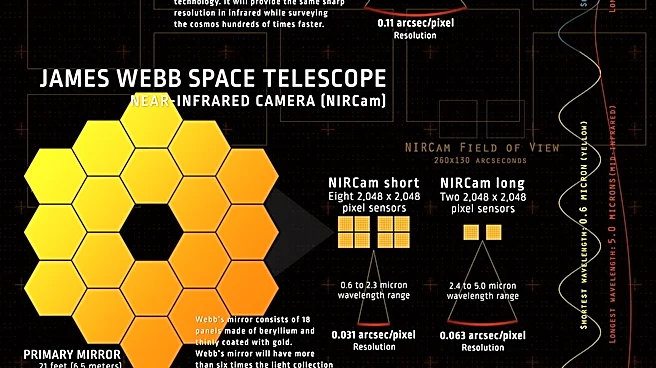
NASA leaders envision that the Nancy Grace Roman Space Telescope will build on the capabilities of other orbiting observatories such as the James Webb Space Telescope, launched in 2021, and the Hubble Space Telescope, launched in 1990.
Compared to its predecessors, though, Roman will be able to capture large portions of the universe without losing much detail.
The Roman telescope's field of view is 100 times wider than Hubble's, meaning every image it captures and beams back to Earth is equivalent in scope to 100 photos from its predecessor. Roman is also designed to survey the universe a thousand times faster than Hubble, according to NASA.
Because it can image more of the sky in less observing time than Hubble, Roman is expected to capture more than 50 times as much sky during its five-year mission as Hubble covered in three decades.
Contributing: Jennifer Borresen, USA TODAY; Brooke Edwards, Florida Today; Reuters
Eric Lagatta is the Space Connect reporter for the USA TODAY Network. Reach him at elagatta@usatodayco.com
This article originally appeared on USA TODAY: NASA's Roman telescope is in space. But don't expect photos until 2027