
In the 25 years I have been studying emerging infectious diseases, the essentials haven’t changed.
Whenever there is an outbreak in a country without total transparency or full health disclosure, the world
worries and public health officials struggle to determine the real facts, a process that causes us to worry more.
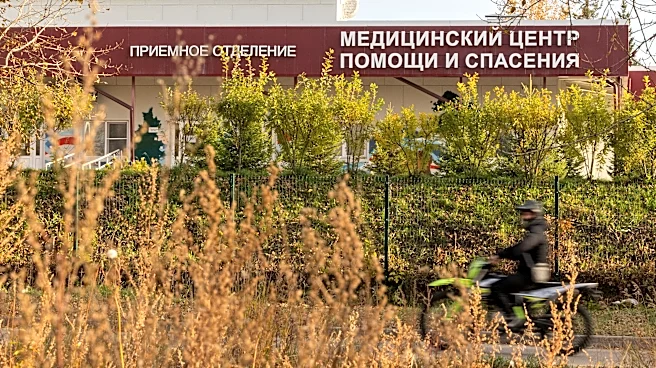
We don’t know exactly what is happening in Russia regarding the current risks surrounding lab worker Darya Shipilova, who reportedly died of severe pneumonia at the Irkutsk Anti-Plague Research Institute of Siberia and the Far East on Oct. 2.
Is it the pneumonic plague, which is generally treatable with antibiotics if diagnosed quickly and which also generally spreads slowly, if at all? Did she receive a vaccine, as Russian health authorities have said, and when did she receive it?

The fact that several hospitals in Irkutsk have reportedly been shut down with 200 people quarantined and that no other case has been confirmed could mean that either it wasn’t plague or that the Russian health authorities are simply being overly cautious or not disclosing the full truth. We don’t know.
Meanwhile, Russian health officials have denied reports of a second plague death, and haven’t even confirmed that Shipilova’s death was due to plague.
And it is that lack of knowing that scares us. It makes our minds jump to the worst-case scenario right away.
What we don't know hurts us in plagues and public health
Could Shipilova’s untimely death be due to a bioweapon experiment that accidentally infected her? Russia has been reported by our State Department to be continuing its bioweapon program since disbanding the Soviet Union.
Plague has been engineered to be more resistant to bacteria and more contagious. Could this be a manufactured strain of plague or something else? Again, we don’t know.
How can we not remember Dr. Li Wenliang, an ophthalmologist in Wuhan, China, who tried to warn his colleagues in December 2019, before being visited by police in the middle of the night and then dying of the new disease?
Here in the United States, we were caught flat-footed with COVID-19 as we struggled to treat all the pulmonary problems and blood clots we weren’t anticipating.
In my new book, "The Angels Among Us," I take us back to June 2020, “when emergency rooms are filled with cases, and public officials are telling people not to come in if there’s any chance they can manage at home.”
For those like the patient in my book, Evie Rodriguez, who was on the verge of death even with the help of a new antiviral and steroids, it was faith and prayer and angels from heaven who stepped in to save her while so many others were not so lucky.
It is the memory of this global fear and helplessness that infects us now and fuels our worry. More recently, this past May, the ship from Argentina, the MV Hondius, became infected with the Andes strain of the hantavirus. A retired oncologist on the ship named Dr. Stephen Kornfeld stepped in selflessly and helped calm the passengers.
The plague is an ancient scourge that has scared us for centuries, culminating in the Black Death in the 14th century, which killed close to half of Europe’s population at the time. We could all use a Dr. Kornfeld right now against our new plague fears, because even with all our effective treatments and vaccines, we still lack the global health network of scientists and public health officials we need to inform and protect us.
Once again, we are in the dark, wondering if Darya Shipilova is the next Li Wenliang, and if she isn’t this time, she could well be the next time.
Marc Siegel, MD, is a clinical professor of medicine and medical director of "Doctor Radio" at New York University Langone Health. He is a Fox News senior medical analyst and author of the No. 1 New York Times bestseller "The Miracles Among Us." "The Angels Among Us" will be released next month.
This article originally appeared on USA TODAY: Our Russian plague fears are fueled by the same old unknowns | Opinion