







Every year, California experiences thousands of small tremors that residents usually don't notice, but as massive seismic activity continues worldwide, California officials want to remind residents that the state is not immune to a massive earthquake at a moment's notice.
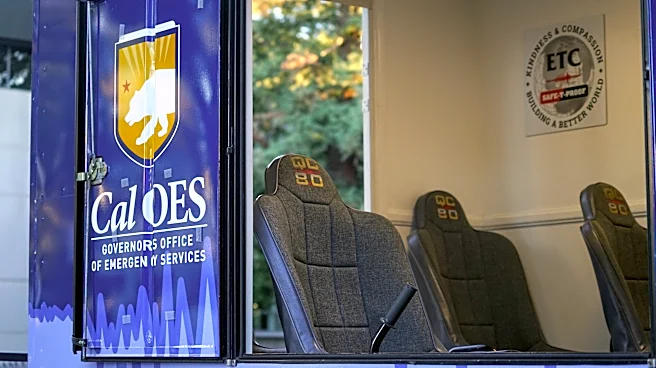
That's why officials have been traveling across the state, educating residents in earthquake preparedness tactics and promoting this year's Great California ShakeOut, an earthquake drill that millions of Californians participate in on Thursday, Oct. 15 at 10:15 a.m.
Do you know what to do when the next earthquake happens? Join millions of Californians in practicing how to Drop, Cover, and Hold On. Register now for the Great California ShakeOut Drill this month. https://t.co/FZgadpBn2m
pic.twitter.com/VvTXBFuHI9
— California Governor's Office of Emergency Services (@Cal_OES) October 11, 2026
For most, this drill will be a reminder of the basics of earthquake protocol: drop to the floor, take cover under a sturdy table, and hold on as the tremors end.
But for many Californians, this drill is a chance to make sure their homes and families are ready for the next potentially destructive 7.0 magnitude earthquake.
"We live in earthquake country, so it's good to know we're always prepared for the next big one," said Phillip Labra, program manager for the California Governor's Office of Emergency Services' earthquake, tsunami, and volcano program.

California's last major earthquake was in 2019, when Ridgecrest was hit by a magnitude-6.4 quake. Although the quake shook the region, the state reported no deaths or serious injuries.
However, that wasn't the case in the 1994 Northridge Earthquake and the 1989 Loma Prieta Earthquake, which killed dozens of people, injured thousands, and heavily damaged regions.
To avoid future tragedies, the California Governor's Office of Emergency Services wants to ensure families know how to reduce injury risk if the "next big one" hits their region.
One preparedness method the state heavily promoted on its Great California ShakeOut Tour was urging folks to download its "MyShake" app, an earthquake early-warning alert app it developed with the University of California, Berkeley.

Specifically, when four of the thousand seismic stations detect an active tremor, it sends an immediate alert to folks near the earthquake, hoping to give them a few seconds to prepare for the incoming shakes.
"Depending on where you are from the epicenter, you can get a few seconds or up to 10 seconds depending on where the earthquake is," Labra said.
"Those seconds can be super important because it gives you time to get to safety. Whether you're sitting at home, at school, in an office building - Say you're in the kitchen- it gives you time to put the knife down and get down on the ground."
Although these few seconds may seem minuscule, Labra emphasized their importance in ensuring someone's safety, as research has found that most people trying to find cover during an earthquake is what ultimately "leads to most people getting injured."

"The number one impact that we are seeing throughout the years is that the nonstructural elements within a building are falling onto people and causing injuries," Labra said. "It's important that people take the steps to secure items like furniture down in your space. It helps in the long run during and after an earthquake."
Officials with the California Governor's Office of Emergency Services emphasized the importance of having a "Go-Bag" and "Stay-Box" ready in case a major earthquake hits.
Families creating Go-Bags should keep a pre-packed emergency kit with essentials to stay safe during evacuation or immediate crises. The state recommends these bags contain copies of important documents, some cash, medication, a first aid kit, and other essentials.
In the case that an earthquake causes significant infrastructure damage and ultimately prevents folks from evacuating, the state recommends families prepare a container with essential supplies like non-perishable food, water, and a source of electricity or gas to use for several days.
How to participate in the Great ShakeOut
- Register as a participant atShakeOut.org/california/register/.
- VisitShakeOut.org/california for resources to help families, businesses, schools, faith-based organizations, community groups, and others participate in the ShakeOut.
- VisitShakeOut.org/california/resources for additional information.
- Practice theDrop, Cover, and Hold On drill.
What have been the biggest earthquakes in recorded California history?
California's largest recorded earthquakes since 1800, ranked by magnitude, according to the California Department of Conservation.
The Largest Recorded Earthquakes in California History
Historical seismic records from the U.S. Geological Survey and the California Department of Conservation highlight the state’s most powerful earthquakes since 1800, ranked by magnitude:
- 7.9: Jan. 9, 1857 — Fort Tejon
- Details: The largest recorded earthquake in California history ruptured a 220-mile stretch of the San Andreas Fault. It killed two people, altered regional terrain, and was felt from Sacramento down to San Diego. Modern estimates place it between magnitude 7.9 and 8.25.
- 7.8: April 18, 1906 — San Francisco
- Details: Striking early in the morning, this quake ruptured nearly 300 miles of the San Andreas Fault. Severe shaking and a subsequent three-day firestorm destroyed over 80% of the city, leaving an estimated 3,000 dead and 225,000 displaced.
- 7.4: March 26, 1872 — Owens Valley
- Details: Centered along the eastern Sierra Nevada, this massive tremor leveled the town of Lone Pine, killing 27 people. The main shock triggered three major aftershocks above magnitude 6.0 and permanently shifted local waterways.
- 7.4: Nov. 8, 1980 — West of Eureka
- Details: This magnitude 7.4 quake occurred offshore near Humboldt County and injured six people, causing roughly $2 million in damage. Its offshore epicenter helped limit severe inland damage.
- 7.3: July 21, 1952 — Kern County
- Details: Striking the White Wolf Fault near Bakersfield, this earthquake killed 12 people, derailed trains, and caused widespread property damage. It generated three aftershocks greater than magnitude 6.0 within five days.
- 7.3: June 28, 1992 — Landers
- Details: This tremor ruptured multiple fault lines across the Mojave Desert, killing one person, injuring 400, and causing $9.1 million in damage. It triggered a secondary magnitude 6.5 earthquake in Big Bear just hours later.
- 7.2: Jan. 22, 1923 — Mendocino
- Details: Off the Humboldt County coast, this powerful offshore event damaged homes and cracked chimneys across several nearby towns, though no fatalities were recorded.
- 7.2: April 25, 1992 — Cape Mendocino
- Details: Centered near Petrolia, this quake injured 356 people, caused $48.3 million in damage, and generated a localized tsunami. It kicked off a sequence that included two magnitude 6.5 aftershocks within 12 hours.
- 7.1: Nov. 4, 1927 — Southwest of Lompoc
- Details: Off Point Arguello, this offshore tremor caused slight structural damage in Santa Barbara and San Luis Obispo counties and produced a modest tsunami, but caused no major injuries.
- 7.1: Oct. 16, 1999 — Hector Mine (Ludlow)
- Details: Striking a remote area of the Mojave Desert, this quake caused minimal overall damage because of its isolated location, though intense shaking derailed an Amtrak train and caused minor injuries.
Daily Press reporter Rene Ray De La Cruz's reporting contributed to this article.
Noe Padilla is a Northern California Reporter for USA Today. Contact him at npadilla@usatodayco.com, follow him on X @1NoePadilla or on Bluesky @noepadilla.bsky.social. Sign up for the TODAY Californian newsletter or follow us on Facebook at TODAY Californian.
This article originally appeared on USA TODAY: Great California ShakeOut: How residents can prepare for an earthquake