






The Sunday after Thanksgiving is already the most crowded day of the year to fly. This year, a storm is coming along for the ride.
A fast-strengthening system is sweeping across the middle of the country with heavy rain, strong winds and the chance of a few severe thunderstorms, just as millions of people pack airports and highways to head home. Behind it, a pair of Pacific storms is lining up to soak the West Coast.
It's not expected to be as punishing as the storm that hit the East on Thanksgiving, which left nearly one million homes and businesses without power, triggered widespread coastal flooding and forced Macy's to postpone its parade for the first time in its history. But it could still mean wet roads, slow drives and delays at some of
the country's biggest airports.
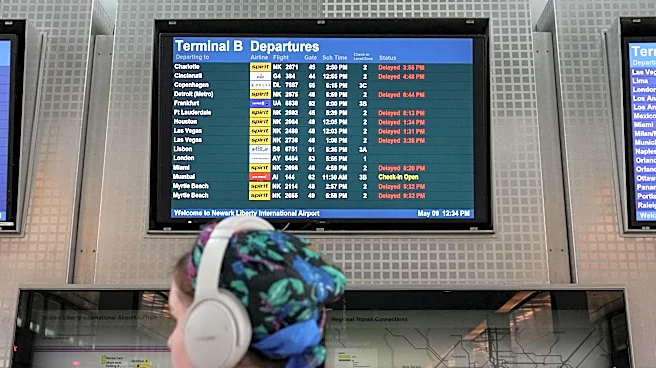
By mid-morning, those headaches had already started, with more than 1,500 flights delayed and dozens canceled nationwide.
Here's what to know before you leave.
Where is the storm hitting?
The trouble is mostly in the middle of the country and the South. Cold air pouring south through the Plains is slamming into warm, humid air from the Gulf, the National Weather Service said early Nov. 29, setting off showers and thunderstorms from the Deep South to the Tennessee Valley. Before dawn, forecasters reported hurricane-force gusts on the south-central High Plains.
Farther north, a corridor of steady rain from Arkansas to Maine will reduce visibility and create road spray across dozens of states, according to AccuWeather, with rain falling much of the day from St. Louis to Chicago to Cleveland. Heavy rain and gusty winds "can lead to reduced visibility and slower travel, both by vehicle and by air," said AccuWeather meteorologist Haley Taylor.
The roughest weather should hit Nov. 29 in the afternoon and into the evening across Tennessee and northern Alabama, where storms could pack wind gusts of 50 to 65 mph, strong enough to knock out power. The National Weather Service's Storm Prediction Center said "perhaps a tornado" is possible too, and it bumped northern Alabama up to a level 2 risk on its 5-point scale. A few storms could also turn severe from western Kentucky down to the Gulf Coast.
What about the East Coast?
If you're driving the I-95 corridor today, try to get home before dark. Taylor said the East "looks to be largely dry until Sunday night into Monday," when the storm races through the eastern United States.
The Mid-Atlantic could get heavy showers and a few thunderstorms overnight and into early Nov. 30 morning, which is bad news for red-eye flights and anyone on the road at dawn.
New England gets the tail end. Rain is expected to linger in Maine into Nov. 30 in the afternoon, and cold air rushing in behind the storm could turn the rain to wet snow that night, with blustery winds into Dec. 1.
What's happening out West?
The West Coast is next in line. The first of two back-to-back Pacific storms is bringing high winds and rain to the Pacific Northwest and northern California, where heavy rain is possible from the night of Nov. 29 into the next morning.
The storm is expected to come ashore on the Washington coast Nov. 30 with gale-force winds. Before the region can dry out, a second storm is forecast to reach southern California by the morning of Dec. 1. Weather Channel forecasters said the Pacific system could bring rain and mountain snow, possibly delaying flights from San Francisco.
Will my flight be delayed?
Possibly, depending on where you're flying through.
Some travelers are already feeling it. By mid-morning Nov. 30, FlightAware had tracked 1,506 delays and 61 cancellations for flights within, into or out of the United States, with the biggest backups at three of the country's busiest connecting hubs, Chicago's O'Hare with 39 delays, Dallas-Fort Worth with 36 and Atlanta with 32. Because so many travelers change planes in those cities, a late departure in Chicago or Atlanta can ripple out to flights hundreds of miles away.

The National Oceanic and Atmospheric Administration predicted moderate to high aviation impacts across much of the country. A flight weather impact map from The Weather Company shows the highest risk Nov. 29 in Oklahoma City and Spokane, Washington, with elevated risk in Dallas-Fort Worth, New Orleans, Memphis, Nashville, St. Louis, Indianapolis, Detroit, San Francisco and Phoenix.
Airports, however, will be packed whatever the weather does. And the system has had little breathing room lately, with an equipment failure causing the longest nationwide ground stop in 25 years earlier this month and a Delta tech glitchdelaying about 2,000 flights at the start of Thanksgiving week.
The Transportation Security Administration has said there's "the potential to screen more than 3 million passengers nationwide on Sunday, Nov. 29," which would put the day close to the TSA's single-day record of 3,133,924 screenings, set on the Sunday after Thanksgiving last year.
The rush won't end today, either. The Federal Aviation Administration, which expects more than 417,000 flights over the nine-day holiday period, is projecting more flights Nov. 30 than Nov. 29. "The growing demand for air travel makes it more important than ever to continue modernizing our air traffic control system," FAA Administrator Bryan Bedford said this week.
I'm driving. When should I leave?
You'll have plenty of company. AAA expects 81.5 million Americans will travel at least 50 miles from home over the holiday period. Nearly 90% of Thanksgiving travelers are expected to drive.
AAA advises avoiding the roads around noon and 8 p.m. when traffic peaks. If you can wait, Nov. 30 won't be much quieter, since the traffic analytics firm INRIX expects it to be one of the busiest post-Thanksgiving travel days, along with Nov. 29.
Any good news?
Some, for the middle of the country.
Pressure is expected to settle over the central and eastern United States on Nov. 30, bringing calmer skies and a mild start to December, with high temperatures in the 50s across the central Plains and in the 60s and 70s in Texas and Oklahoma.
This article originally appeared on USA TODAY: Heading home after Thanksgiving? Storms could slow you down