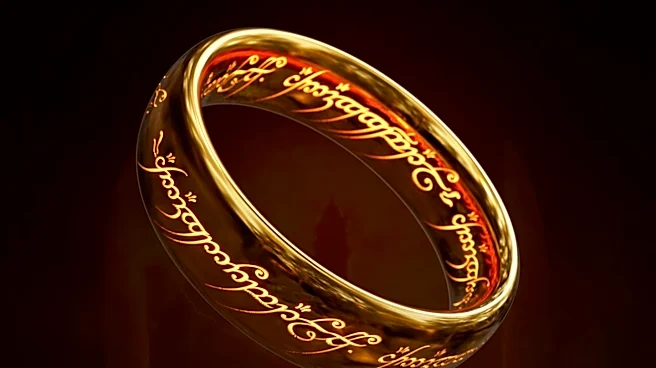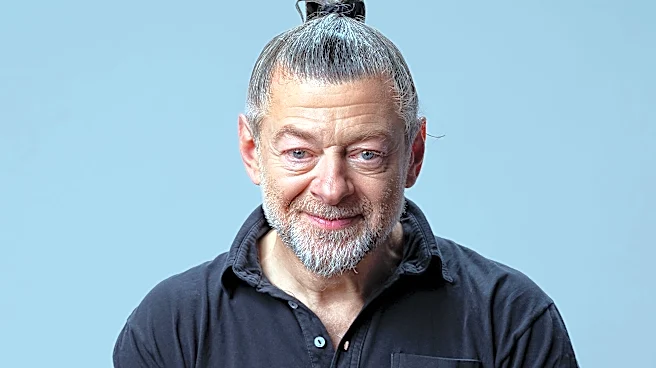






The first time Andy Serkis met Gollum, he was a schoolboy reading J.R.R. Tolkien's “The Hobbit” on the bus.
He remembers feeling marveled by the character and the vivid descriptions of the way he spoke. He remembers feeling swept into Middle-earth. By the time Serkis played him in Peter Jackson's Lord of the Rings movies, he knew the creature inside and out.
But in his latest project, 62-year-old Serkis and Gollum aren’t on great terms.
“My Pressures” (out now from Mariner) is clever in name and format, a memoir written with some fictional, fantastical flair. Rather than a chronological life retelling, “My Pressures” puts Serkis face-to-face in a tense roundtable with his most iconic characters, including Caesar from “Rise of the Planet of the Apes”
and Ulysses Klaue from the Marvel Cinematic Universe. Serkis opens by voicing his anxieties. His manager wants him to write a memoir, but will anyone care? Does anyone want to hear about anything more than Gollum?
“Whingeing and whining. Who cares about him?” Gollum tells Serkis in a fictional conversation. Just 50 pages in, he’s already verbally abusing Serkis. By the end, he’s trying to strangle him: “No one cares about its boring life. No one cares about its other characters, does they?”
The unique format was the only way he could fathom writing about his life, Serkis says, calling USA TODAY mid-journey home from New Zealand where he was filming “The Hunt for Gollum,” a new Lord of the Rings film scheduled for a December 2027 release. He revisits his early career, relationships and growing up between England and Baghdad, but also picks up a fictitious, magic script featuring a mediation between him and his characters.
“Time is a big theme in the book. And it’s like, why would I spend the time that I've got left on this planet reliving a life that I’ve already lived?” he says. “If there was a way of telling a version of my story, it would probably be best if it was seen through the eyes of the characters that I’ve played, because they define a lot of my life. So then it became an interesting proposition … it doesn’t just have to be stories of being on set and ramblings of an older actor.”
This interview has been edited and condensed for length and clarity.
Question: Which characters were you eager to bring back and “meet” and which did you dread having a fictional conversation with?
Serkis: Oh, that's a good question. I suppose, obviously, everyone associates me perhaps most with Gollum. I wanted to bring Gollum back, but sort of as an antagonist and as someone I could rub up against. But the character I think I really wanted to give voice to was the one that I really loved the most, which was Caesar. I really do miss him as a character and he sort of became the voice of reason and compassion and sanity in a kind of crazy world.
The character I suppose I least wanted to go back into was a character called Ian Brady (from “Longford”) who was a serial killer. That was a very dark character to have to climb into in the first place.

It gets pretty physical. I mean, Gollum tries to kill you.
A lot of the characters that I've played are very physical characters, so I wanted there to be this constant wrangling between them, that they were vying for supremacy.
And having me caught in the middle of this sort of discussion about how they were going to voice Andy Serkis. Who was going to own me?
Going back in time and reflecting on your childhood and early career, what foreshadowed the character actor you’d one day become?
As an actor, you spend so much time constructing a backstory, constructing a life for a character. I had to almost treat it as doing that for myself in a way, and kind of go back and go, well, what are the salient points here? What are the touchstone moments? What are the sliding doors moments?
I do remember it clearly (when I was 5 years old), our neighbors, these two elderly ladies, who had this dog, Shandy, and me asking them to take me for a walk on a lead with their dog. I can't quite believe I did that, but I did.
Seeing a young Andy Serkis walking around your neighborhood on all fours – I can imagine that’s someone’s dinner party story.
I'm sure there are people out there that witnessed that and thought, what a little strange boy. I don't know if I mentioned this … it was about the doggy treats, because they gave these little chocolate buttons to their dog, Shandy, after the walk. And I think that was probably part of what I was after, really.
Your character research has since turned more sophisticated, even if it was just frightening hikers while you practiced your Gollum in New Zealand caves. But you’ve also observed gorillas in Rwanda and learned knife techniques from chefs. Is there anything you’re dying to research that you haven’t gotten to yet?
I've never really played a political character. I've never really played someone whose job it is to be in government.
I would love to spend time in government or in a particular party being around a table, a cabinet. Being around government and really, really spending a lot of time in that world, I think, would be fascinating.
With so much preparation into the physical, emotional and mental state of these characters, do you ever have a hard time getting out of their heads?
I've always believed and I still do believe that you're always altered by the characters that you played as an actor, that you learn something either about yourself or the world that changes your worldview. Sometimes decompressing from a character can take a long time.
I think you are kind of chemically changed in some way. You are tricking your body and your mind and your head and your psyche to fit this other being. I have to say, as I've got older and I've got more responsibilities and I'm doing other things I'm able to drop out of it much quicker because you have to.
But I still believe that you don't entirely shed them, that you are sort of a receptacle for all of these different ideologies and ways of thinking and ways of being and the most random things will come back years later and actually affect another character that you don't like.
Can you share an example?
The character of DogBoy (in April de Angelis’ stage play “Hush”), which really was a very close cousin of Gollum. He was one of the characters that I did a huge deep dive into and so kind of the schizophrenic nature of that character that I played on stage really did inform the early stages of getting back into thinking about how we would work on Gollum.
You’re fresh off of filming “The Hunt for Gollum.” What was it like getting back into him?
He's probably a character that will never, ever leave me and has never left me over the course of the last 26 years or whatever. That's certainly what I wanted to bring out in the book, that there are some characters that will keep returning, and I don't suspect that Gollum will ever leave me, quite frankly.
But obviously this was a different journey. This was not just playing that character, but also directing the movie. So it was a huge number.
People always want you to talk about Gollum. You hint at this a few times in the book. Your characters say it to you, your wife says it to you. You have this funny anecdote where a cab driver says he feels bad that people will only ever know you for Gollum. How does that make you feel?
I adore that character, obviously, you know, he's been a huge part of my life and so it’s a love-hate relationship.
He's a huge source of rediscovery, actually. That's what's been so interesting. He's a huge source of kind of going back in and thinking you know what you're doing and then actually finding something new and fresh.
Without going into it, because I don’t want to talk too much about “The Hunt for Gollum” because that’ll be next year, but it has been really exciting this time around. It's really exciting to go back in and revisit him in more depth. I do love and hate him.
You write that you initially felt othered on the “Lord of the Rings” set because you were motion capture acting. These types of performances are historically left out of award runs. Where do you feel we are about it now?
What I love about performance capture is the fact that any actor can play anything and you are driving that character, you're physically driving that character. You've created the emotional center of the character. There’s no doubt that there are a whole team of artists who also work on that character. But then filmmaking is a collaborative endeavor, and any actor in any film isn't just their performance, it's the way that they're lit, it's the way that they're costumed. It's the way that they're made up with makeup.
If you have prosthetic makeup and you look entirely different somehow, that's still acting, but performance capture still isn't accepted as acting. My beef is that people don't accept performance capture as acting. I mean, it's a basic thing. It couldn't be a more pure form of acting.
So it is still sort of discriminated against. There is definitely a greater understanding of it, but it's still not… I mean, it's a simple request. It's acting. That's all it is.
That's all I wish – not it be anything special or require special awards or it require special treatment. I just want actors on set, whether you're wearing a motion capture suit or a costume, to be treated exactly the same because we are doing exactly the same job.
Clare Mulroy is USA TODAY’s Books Reporter, covering buzzy releases, chatting with authors and diving into the culture of reading. Find heron Instagram, subscribe to our weeklyBooks newsletter or tell her what you’re reading at cmulroy@usatoday.com.
This article originally appeared on USA TODAY: Andy Serkis is Gollum again, but not in the way you'd expect