







A NASA lunar orbiter has caught a glimpse of a crater the size of a six-story building left on the surface of the moon after a chunk of a SpaceX rocket careened into it earlier in August.

For days, the Lunar Reconnaissance Orbiter had searched for the aftermath of the crash as it orbited the moon. Then, between Aug. 11 and 12, the spacecraft was able to capture a series of images of the crash site from 60 miles high as it circled about once every two hours.
The images, released Tuesday, Aug. 18, show the aftermath where the upper section of a SpaceX Falcon 9 rocket slammed into the moon.
Here's a look at what NASA's lunar orbiter captured.
NASA images crater left by SpaceX rocket
NASA had for days been
on the hunt for the site where a portion of a SpaceX Falcon 9 rocket slammed into the moon Aug. 5 at a whopping 5,400 mph.
Now, the agency is releasing photos its Lunar Reconnaissance Orbiter captured of a 60-foot-wide, 10-foot-deep crater left by the rocket's upper-stage, the section of the vehicle designed to fly in space after the lower-stage booster separates.
Finding the impact site was no easy feat. In a press release, NASA said it required "global coordination among experts and hobbyists" who tracked the rocket's trajectory through space to locate its predicted crash landing location.
Imaging the site was even more difficult. Engineers on Earth had to remotely order the orbiter to tilt its cameras to point toward the area, which it had to photograph while traveling at a dizzying one mile per second.
Falcon 9 rocket crashes into moon
The upper-stage was part of a Falcon 9 rocket manufactured by Elon Musk's SpaceX, which is the most active rocket in the world. Standing 230 feet tall, the two-stage rocket is classified as a medium-lift launch vehicle capable of carrying about 50,000 pounds of cargo to orbit.
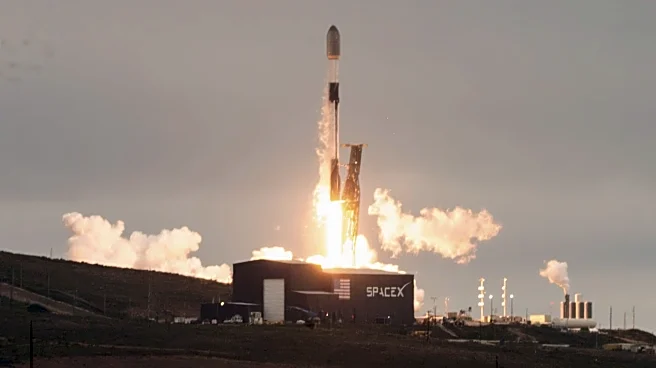
The Falcon 9 upper-stage that crashed into the moon was used in a mission to propel Firefly Aerospace's uncrewed commercial lunar lander to the moon in a January 2025 launch from Florida.
Most upper stages typically fall back to Earth's atmosphere, where they burn up or plunge into the ocean, after they help deliver a rocket payload to a precise spot in orbit. Because this upper stage had to use more thrust to get the lander into an orbit that could reach the moon, it instead got stuck in a sort of orbital limbo, SpaceX previously said.
Orbiting high above Earth once every 26 days, the object was pulled uncontrollably toward the moon by a combination of solar activity and gravitational forces after exhausting all of its fuel, according to astronomers and SpaceX.
See photos of SpaceX rocket crash on the moon
NASA's lunar orbiter managed to observe the crater from a variety of angles and lighting conditions that revealed different features, the agency said.
Take a look at what NASA released:


Korean lunar orbiter previously observed crash site
NASA was not the first space agency to image the crash site.
South Korea's lunar orbit was able to begin observations almost right away. The Korea Pathfinder Lunar Orbiter, known as Danuri, began observations about 30 minutes before the crash and continued to monitor the site afterward, making "a total of 8 imaging sessions," the Korea Aerospace Research Institute (KARI) said in a translated post on social media site X.
Eric Lagatta is the Space Connect reporter for the USA TODAY Network. Reach him at elagatta@usatodayco.com
This article originally appeared on USA TODAY: A SpaceX rocket slammed into the moon. NASA's new photos show aftermath