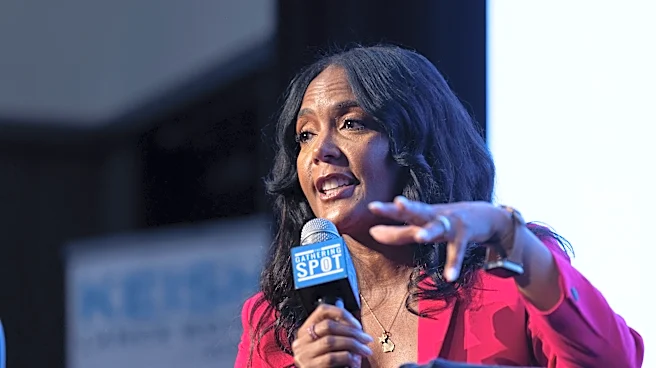

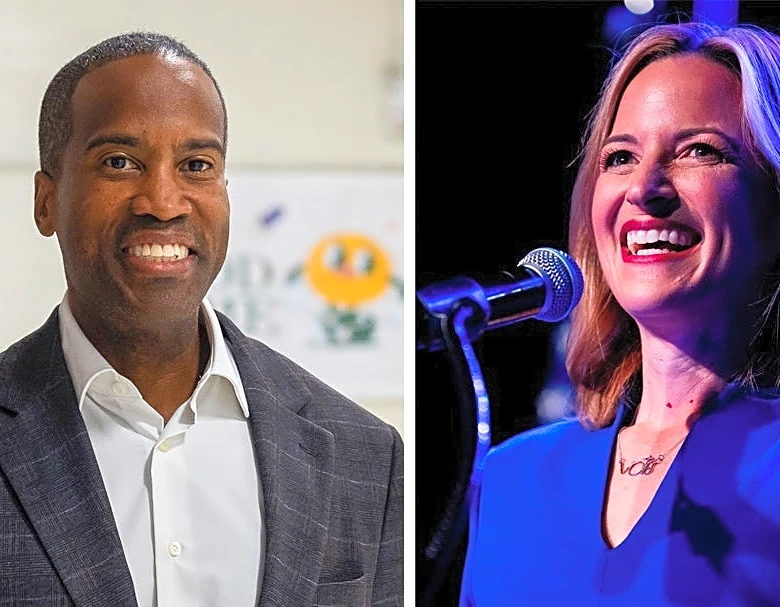




Keisha Lance Bottoms, the former mayor of Atlanta, and Rick Jackson, a healthcare CEO, are locked in a battle for the governor's mansion in Georgia.
Bottoms clearly won her Democratic primary in May, while Jackson had to fight it out with Lt. Gov. Burt Jones in a Republican primary runoff in June.
One a career public servant, the other a self-made billionaire, Bottoms and Jackson could not be more diametrically opposed, not only in policy but in life experience and professional trajectory.
But they both could be "firsts." If elected, Bottoms would be the first Black female governor, and Jackson would be the first governor in recent history to have grown up in the state's foster care system.
Jackson is 72 years old and has never held elected office,
prompting him to regularly refer to himself as a "political outsider" who can bring a businessman's acumen to the state house.
Bottoms is now arguing, however, that Jackson's attempts to align himself with President Trump, going as far as to say he would be "Trump's favorite governor," means he's not an outsider at all.
'The Ultimate Insider'
In the first attack ad on behalf of the Bottoms campaign, Jackson is accused of flattering, donating to and emulating Trump in an attempt to win the governor's seat.
The ad describes "how one insider gets the support of another" and quotes Jackson saying he would "be like Trump with a Southern tongue."
The clips include Trump saying Jackson donated to him during Jackson's primary campaign, to the tune of "I think a couple of a million dollars."
Jackson and Trump appeared together publicly for the first time in a recent event at a Marietta high school, where Trump was scheduled to speak about the newly launched Trump Accounts. While some of his remarks talked about the investment accounts for America's youth, he also formally endorsed Jackson after previously endorsing his opponent, Jones, in the primary race.
Jackson has tied his cart to Trump's horse at a time when the president's approval ratings have been on a steady decline in Georgia.
At the time of his inauguration for a second term, Trump was polling at 54% support. Just before July 4 of this year, that number was down to 38%, according to Civiqs. Other polling shows him with approvals ranging from 39% to as low as 33%, as of July.
Bottoms focuses message on healthcare against healthcare CEO
Up to this point, Bottoms has largely focused her message on policy, meeting with interest groups across the state and key voting blocs she will need to bring home the win in November.
Last week, Bottoms campaigned in Statesboro, Jesup, Woodbine, Brunswick, and Richmond Hill to talk about healthcare, a topic she has made key to her campaign against the longtime healthcare executive.
"The state of Georgia is one of 10 states that has not expanded Medicaid in this country," Bottoms said during a roundtable with healthcare workers in Statesboro. "What that has meant for us is that there are nine rural hospitals that have closed. There are birthing centers and ICU units that have closed. Our emergency rooms are being used as primary care offices, often making them overrun with people who otherwise may have been able to be treated by their doctors. And since the beginning of the year with the Big Ugly Bill, 500,000 Georgians have dropped their health care insurance. So, a bad situation has gotten much, much worse."
During the Democratic primary, all of the candidates supported varying degrees of Medicaid expansion, and cited federal action like the "Big Beautiful Bill" as part of the reason millions of Georgians live without healthcare today. The message has also been shared by Democratic Senator Jon Ossoff, who is running for reelection beside Bottoms on the top of the Georgia ticket.
Jackson, on the other hand, has addressed health access and costs from a business perspective, praising TrumpRx for lower prescription drug prices and saying "affordability is a business problem." He has also focused on thephysician shortage, as his company includes one of the largest healthcare staffing agencies in the country.
This key group could decide next governor
The focus on healthcare and prescription costs may prove to be a good strategy for either candidate, as data shows older voters could be the deciding factor in the race.
According to AARP polling, the vast majority of 50-plus voters, 88%, rated their motivation to vote this year at a ten out of ten. This is compared to 62% of younger voters with the same level of motivation.
"Among voters 50-plus, the top voting issues include rising prices and affordability, immigration and border security, threats to democracy, taxes/government spending/debt, Social Security and Medicare and health care," pollsters said.
The AARP poll also found older Georgians support reforming Georgia's Pathways to Coverage program, a Medicaid program for low-income adults who are not eligible for traditional Medicaid. The cohort supports keeping a work requirement but also making the reporting process easier.
Across all likely voters, Bottoms leads Jackson 48% to 46%, which is within the AARP report's margin of error. If you only poll voters older than 50, the lead switches and Jackson comes out on top 55% to 42%.
The AARP poll was conducted from July 13 to 16 among 1,060 random likely voters statewide. The margin of error is +/- 3%.
Irene Wright covers Georgia politics as the Atlanta Connect reporter with USA TODAY’s Deep South Connect team. Find her on X @IreneEWright or email her at ismith@usatodayco.com.
This article originally appeared on USA TODAY: Bottoms calls Jackson 'ultimate insider' in first attack ad of campaign