








How do we ensure our kid doesn’t get overlooked in sports?
What do we say to our son or daughter, or to a player on our team, when they’re struggling to keep up with other kids?
Sometimes, we can be at a loss.
"Not every 12 year old is the same, not every 15 year old is the same, and you're trying to understand, especially at a very young age, what this player will be in the future," says Haniff Brown, founder and CEO of a company known as Fit:match that seeks to quickly generate data that simplifies such questions. "A lot of the times the struggle is, as a coach, you're not only being asked to assess performance, but you're also being asked to assess puberty."
Brown, who has a background on Wall Street and a fascination with how clothes fit, started
Fit:match in 2018 with the idea to give people more of an understanding of their body profiles. The concept applied with fashion, but he thought we could use AI technology for young athletes.
How are their bodies developing? When is their fastest phase of growth? How much more might they grow?
He thought of how we could give parents better information at their fingertips, instead of by undergoing a more time-consuming and costly DEXA (Dual-Energy X-ray Absorptiometry) scan. He hired a medical director, orthopedist Kirk McCullough, who has worked with kids as well as professional athletes, to help validate the science.
"Everybody's on a trip," says McCullough, the chief medical officer for Sporting Kansas City of Major League Soccer (MLS) who has been Fit:match’s medical director since February. He’s also a father of four.
"They're trying to make it to a destination, whatever it may be: I want my kid to play high level high school, I want my kid to play college, I want my kid to go beyond that," he says, "and the problem is they're all driving on a trip and they see the miles on the odometer, but they don't necessarily have an idea or an understanding of the direction in which they're going. They have nothing that's necessarily helping them to navigate."
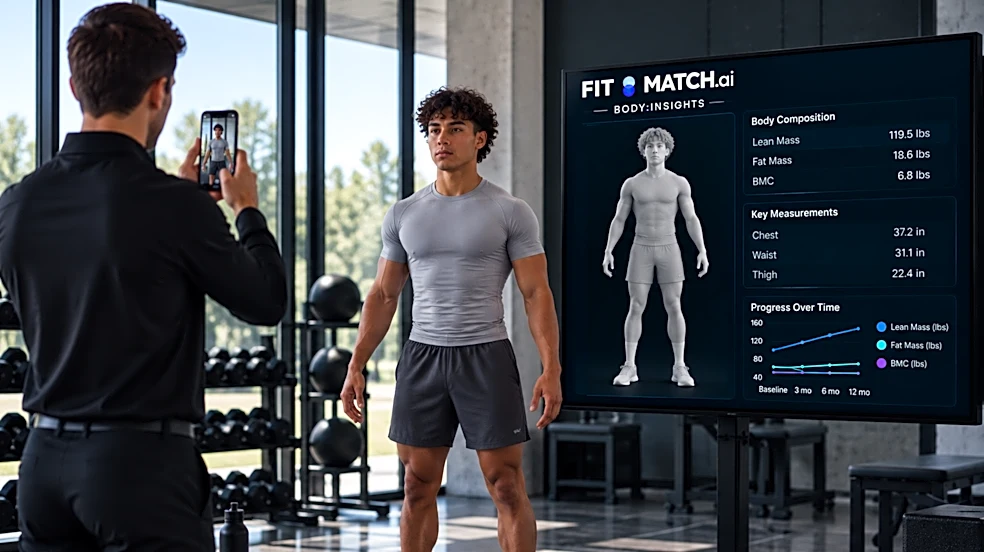
Brown and McCullough are providing answers at a rapid rate – about 20 seconds for what it takes to generate a QuadraScan through a phone to provide body insight for athletes. Brown says Fit:match has scanned tens of thousands of youth athletes since July 2025, most between ages 12 and 17.

MLS NEXT, the organization’s youth platform, uses the technology to help determine players’ growth and maturity as part of its player development approach. So do Major League Baseball organizations, according to Brown.
"I think the reality now in sports, it's keeping up with the Jameses," McCullough says. "Who's the next LeBron James? How are we gonna be able to find him?"
But how is Fit:match helpful to all young athletes and their parents? We spoke with Brown and McCullough for insight into the technology.
What is Fit:match and what can it determine?
Fit:match uses AI to help provide information about a person’s biological development, which includes growth trajectory and body composition and when he or she might hit a peak growth spurt.
Brown and McCullough say they are finding Fit:match’s QuadraScan comes within a 2% error rate of a DEXA scan, which is considered the standard for the industry.
QuadraScan uses four photos taken with a smart phone – frontal, rear, and one from each side – to generate a 3D rendering of the individual.
It applies the Mirwald method to estimate an athlete’s timing relative to peak height velocity – which McCullough defined as "the fastest phase of adolescent growth" – and the maturity-based cumulative height-velocity method published by Lauren Sherar of the University of Saskatchewan College of Kinesiology and colleagues in 2005 to estimate adult height. Its measurement outputs have been validated against traditional methods.
QuadraScan is also radiation-free.
"We like to call ourselves the chat GPT of the human body," Brown says.
McCullough says the more data is collected through scans, the more accurate predictions become and fewer biases they include.
"We can take the Lidar (light detection and ranging) technology of your phone to be able to then do what we would otherwise have to do with measuring tapes and kind of different devices to be able to have to manually and laboriously go through and get some of these calculations and measurements done," says McCullough, who has been a team physician for the Kansas City Chiefs and chief medical officer for the KC Current of the National Women’s Soccer League (NWSL).
He also has applied the technology to three of his four kids, two of whom are high school basketball players.
"When we look at the old skeletal atlas and bone age determinations, those formulas that were used in the patient population – if you look at the high level basketball, high level volleyball patient populations, you've got these concentrations of gene pools that were probably not represented very well in those initial studies that we kind of use as our gold standard," he says. "We are actively working toward establishing a new gold standard for height estimation compared to historical considerations as well as a new gold standard for peak height velocity across diverse populations.
"The amazing power and benefit of working with AI in our QuadraScan technology is the more measurement inputs we collect and analyze, the 'smarter' it gets. Ever increasing the number of observations and data collected ultimately powers the AI technology to become even more accurate and precise with predictions and the fewer biases they include."
Who are some of the major sports partners with whom Fit:match has worked?
MLS NEXT, Major League Soccer’s competitive structure that begins at the under-13 level, has started using Fit:match as part of a pilot program through Major League Soccer’s innovation lab. The lab, according to MLS, is "focused on identifying, deploying and scaling the next generation of sports technology."
According to Brown, a half-dozen major league baseball clubs use Fit:match’s QuadraScan technology in their scouting of players. McCullough says Fit:match also is working with global soccer academies and various teams in the NFL.
Several MLB clubs, Brown says, have tested the QuadraScan technology against their own calculations.
He wouldn’t disclose the names of the teams for competitive reasons but, he says "it is the top clubs in baseball."
QuadraScan provides an estimated adult-height range that accounts for an athlete’s current height and biological maturity to estimate remaining growth, recognizing that early-, average- and late-maturing athletes follow different growth timelines.
"If you have your kids in basketball (and) they'll top out at 5-11, you probably want to know that as a parent," Brown says. "You won't have to wait three to four years and spend thousands of dollars on basketball camp. Or you kind of want to know, 'Hey, my kid is more suited to be in this position' because now when you have that wealth of data, you can control a little bit more of your destiny, your conversations with your kid, your conversations with your kid's coach."
How can Fit:match help youth athletes and their parents understand their growth?
A child complains his heel hurts or her knees are bothering her. But what’s their weekly routine?
If you’re a youth sports parent, you know how the response might go: They play soccer on Mondays, Thursdays and Saturdays; do strength training on Tuesdays and Sundays and play games on Wednesdays.
"You think about all the stresses that are going into that developing child and young teen as to what their body's trying to go through growing wise," McCullough says. "Do they need rest? Are they getting enough sleep? Are they getting enough nutrition? Are they getting enough stretching?
"And even if they aren’t getting enough of those things, are you still asking too much because they're right in a period of time of growth and development. I think it's important to understand when it's OK to step on the gas as far as some of their muscle and their skill development and when is it give their body a chance to focus on itself rather than a certain sports athletic output measure."
McCullough says QuadraScans provide parents with a snapshot of a kid’s growth and when to train at the right time to get the maximum gain, which also helps avoid overuse injuries.
"You have a technology that can then give (parents) some type of glimpse into, 'Hey, I'm doing all this intense training but gosh, they're in a peak of their peak height velocity right now; we actually need to be training less,'" he says. "You're robbing the potential growth that you could get because you're overstressing the body.
"That's where this technology I think is gonna to be tremendously valuable. If you can nurture that child in that situation where you can maximize potential, not overtrain them, give them everything that they need from the nutritional and the rest aspect to maximize their growth potential and then once they're on the downhill slope of that peak height velocity, now it's time to really pour into them from a muscular development. You're gonna see more return without the risk of hampering their ability to physically grow."
In simpler terms, Brown says, the scans offer reassurance. Instead of sitting at the dinner table, or in the car, trying to console your child for not getting playing time or struggling at a sport, he says, you can own the conversation about why they may be underperforming.
"The way youth leagues are structured today, coaches are always incentivized to play the best players at that point in time," Brown says. "But the best players tend to be early developers. If I hit my growth spurt at 12, then I'm going to get played. And the person who hits his growth spurt at 15 will not get played. So what tends to happen across these leagues is that that kid who's a late developer, he gets left behind. And he drops out of the ecosystem.
"We've had many parents tell us that this has changed how they view their relationship with kids in sports because they're better able to now understand where their kids sit and have that benchmark and analysis tell them exactly why it matters and where they should focus on."
What can Fit:match technology teach us about the potential of late-developing athletes?
While Fit:match can serve to curb expectations on a young athlete’s development, it can also open up a parents eyes to see a young athlete’s full sports journey and potential. Biological and chronological ages are not the same.
Brown points to a longitudinal study conducted in 2025 by researchers in Spain, which included 47 male players (24 in the U16 category and 23 in the U14 category) involved during the 2010–2011 season in what was described as a "top-tier" Spanish soccer academy and followed their careers through the 2024–25 season.
Every player who reached one of Europe’s top five leagues had been classified as a late maturer.
"Biological maturation is not a decisive predictor of success in professional football," the study concluded. "Although early-maturing players have initial physical advantages, late-maturing players may compensate with other types of skills."
What you see as your kid is trying to keep his or her head above water at a younger age might be a situation that’s hardening them for athletic success when they get older.
"They developed skills and other kind of IQ to their game that allowed them to compete, but then once their body made them as developed as the others, they shot past all the (early) developers," McCullough says, speaking to the development of international soccer players. "So that's not something to be ashamed of. You want the smoke early on because if you can compete, and you can stay alive, but you can also understand that you’ve still got room to grow, in the end you're gonna be a better asset than the ones that peaked physiologically early and just dominated because of physical ability."
How much do QuadraScans cost and how can parents be assured they are private and safe?
While Fit:match has pricing models for leagues, parents can get started on their own at fitmatch.ai/parentsubscription, with a one-time QuadraScan report for $25 or monthly subscription plans to choose from. Parents can also email cs@fitmatch.ai with any questions.
Fit:match’s peak height velocity (PHV) validation has demonstrated approximately 0.3-year average variance between the automated calculation and manually calculated estimates. The idea, the organization says, is for parents to understand general maturation stages and longitudinal trends rather than an exact date of PHV.

"We publish our error rates so parents have full visibility and sometimes it differs from boys to girls as well," Brown says. "But everything we do is about trust. We want them to trust our privacy. We don't store photos. So when the photos are taken in the app, they're instantaneously deleted. We take privacy very seriously. We're not just some AI bot that is a buzzword."
Instead, McCullough says, Fit:match is growing into an entity where people can return for more scans to gain further knowledge of their changing bodies.
"It’s not just a one-trick pony (that will) tell you where you're at as far as your peak height velocity," he says. "We’re gonna give you that with a lot of validation and credibility but there's a lot of other things that you're able to get from this besides just understanding where you're at with your development. It’s gonna give you a lot of other understandings of your body composition and then that over time, to be able to say, 'Here's what I've been doing. Here's how my body composition has changed. How do I tweak what I'm doing?' Eating, sleeping and training to make that body comp change rather than hey, 'I gained 3 pounds.' Well, but where, of what, and why?
"There's a whole lot of other ancillary benefits that you're gonna have that are gonna help make you be the most that you can be."
Steve Borelli, aka Coach Steve, has been an editor and writer with USA TODAY since 1999. He played baseball in high school, rowed in college and spent 10 years coaching his two sons’ baseball and basketball teams. He and his wife, Colleen, are now sports parents to a college and high school baseball player. For his past columns, click here.
Got a question for Coach Steve you want answered in a column? Email him at sborelli@usatoday.com.
This article originally appeared on USA TODAY: App shares insight about athletic potential. What it means for parents