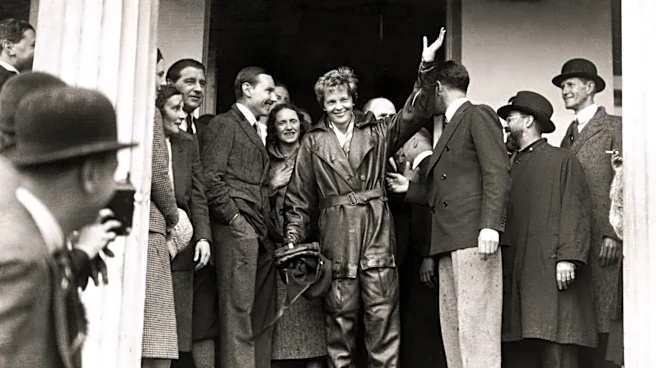








A fall 2026 mission to find Amelia Earhart's plane came up empty, but researchers aren't giving up hope.
At least one exploration company is already planning its next expedition in the hopes of discovering evidence of the famed aviator's lost plane on the ocean floor. They believe radio transmissions show Earhart crashed in the ocean close to her intended destination, a different theory than the one probed in the high-profile expedition in October.
David Jourdan, the president of Nauticos, told USA TODAY he is currently raising funds for what will be his fourth and final expedition in search of the plane carrying Earhart and her navigator, Fred Noonan, when they disappeared during an ambitious round-the-world flight in 1937.
The team says they
will use newer, more accurate information about where the plane likely crashed. A recent analysis of the lost plane's final transmissions will allow for a more targeted search, according to Jourdan.
He said his team can now tell precisely where she was at 8 a.m. on the day of her disappearance. They believe she was approaching Howland Island, where Earhart and Noonan were expected to land before they vanished on July 2, 1937.
“She was extremely close," Jourdan said. "Heartbreakingly close – just out of visual range.”
Jourdan hopes to test the theory soon. “I hope that within a year we will have the means to launch our expedition,” Jourdan said. “We’re very hopeful.”
Jourdan’s mission could be the first expedition since a different research team investigated another theory. In October, a group traveled to a remote Pacific island to see whether an object spotted by satellites was the missing aircraft. After several days on the island, researchers announced that the object was a "collection of large trees,” not Earhart’s Lockheed Electra 10E.
Now, it seems Earhart enthusiasts won't have to wait too long before the next group of explorers attempts to solve perhaps the most enduring mystery of the 20th century.
"The sooner we get funding, the sooner we'll get started," Jourdan said.
New information brings fresh hope
Jourdan, a former U.S. Navy submarine officer, said his team will build on their three previous expeditions, which took place between 2002 and 2017, as well as new research that he says has pinpointed Earhart’s location shortly before she disappeared.
Since his first mission, Jourdan said he has focused his search efforts on the waters surrounding Howland Island.
During his last three expeditions, Jourdan's team used sonar technology to map out an area of the ocean floor about the size of Connecticut. But while nothing has so far resembled the missing plane, new information has dramatically narrowed the search area ahead of the upcoming mission.
Jourdan said engineers have managed to recreate the exact radio and transmission equipment aboard the Electra 10E, as well as the receivers on board the Coast Guard cutter waiting for her and Noonan near Howland Island. On the day of her disappearance, Earhart sent roughly a half dozen transmissions to the Coast Guard. Research shows that her signal had improved as she sent more messages, indicating that she was moving closer to the island.
In 2020, Jourdan and his team took a boat and a plane hundreds of miles out into the open ocean and measured signal strength and distances, gathering data on how close Earhart must have been when she began receiving transmissions from the Coast Guard cutter.
“We had always used simulations and computer models to try and figure out how far she was at each of those transmissions,” Jourdan said. “Once we had all the equipment, we could actually take this equipment out in the field and measure those ranges.”
Like the previous missions, the planned expedition will use sonar technology to scan the sea floor, looking for objects resembling the Electra aircraft. The research team, Jourdan added, will search where they believe Earhart last transmitted a message.

“We can cover all the area that we have left to look, and we have reason to believe that this will lead to success,” Jourdan said. “I’m pretty confident.”
Dozens of expeditions, no proof
The planned expedition was being organized as other high-profile missions tried and failed to locate Earhart's plane.
In October, a team backed by Purdue University, where Earhart worked as a visiting professor, traveled to Nikumaroro, a small Pacific island between Australia and Hawaii where a popular theory suggested Earhart and Noonan landed during their ill-fated attempt to circumnavigate the globe.
The theory is largely based on images of the "Taraia Object," a visual anomaly in the island's lagoon that some believed to be Earhart's plane. But after several days, researchers determined it was likely a collection of large trees and other debris deposited along a sandspit on the island.

Two years earlier, an exploration company announced that what some believed was Earhart’s plane on the ocean floor was just a rock formation.
For decades, crews have spent millions of dollars on high-profile expeditions that have taken researchers from remote islands to the depths of the ocean floor. Despite the challenges and high costs, explorers are determined to keep searching for the missing plane.
Among them is Jourdan, who said the mystery surrounding Earhart's disappearance has endured because she remains an inspiration to millions of people across the globe.
“I wouldn’t be doing this if I wasn’t inspired by Amelia,” he said.
Christopher Cann is a national correspondent for USA TODAY. Reach him by email at ccann@usatoday.com.
This article originally appeared on USA TODAY: New Amelia Earhart expedition wants to test a heartbreaking theory