






Harper Hartman was exhausted, but she chalked it up to the usual demands of college life. She figured it was a lack of sleep, too much caffeine, and perhaps not enough protein that was giving her stomach pain and migraines.
But one morning in February, the 20-year-old microbiology student at Montana State University-Bozeman found herself struggling to walk.
Her vision blurred as she called two friends to help get her to urgent care. There, an electrocardiogram revealed something far more serious was going on, and she needed to go to the emergency room immediately.
There, a bedside monitor beeped as her heart rate plummeted into the 20s. Doctors diagnosed Hartman with third-degree heart block, a condition that blocks electrical signals from traveling
between the heart’s upper and lower chambers.
The kicker? She needed a pacemaker immediately.
“The day that I went to the hospital, that's when everything clicked,” Hartman says. “Looking back on myself, there's a lot of things that I should have known that were my heart block that I didn't.”
Studies place the average age of a pacemaker recipient at 75 or 76. The small devices, which are typically placed under the skin near the collarbone, provide a potentially life-saving service by keeping the beat of a heart at a steady speed. The device is often associated with elderly people, not college students.
Hartman, an otherwise active 20-year-old, certainly never imagined she’d need one. Now back at school with a leadless pacemaker, Hartman hopes her experience can help challenge perceptions around pacemakers and spread awareness about cardiovascular health in young people.
‘I felt hopeless and defeated’
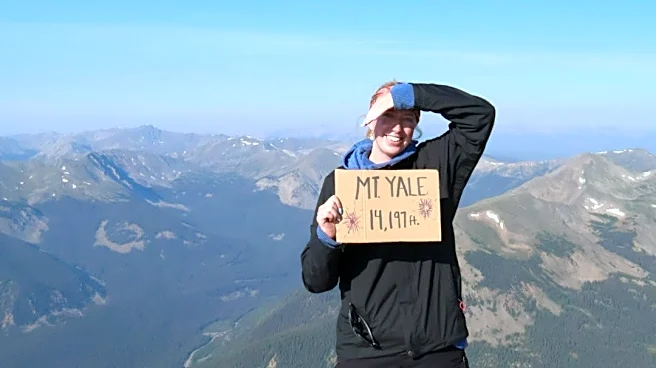
Hartman grew up in Salida, a “little tiny ghost town” in the heart of Colorado’s Rockies where she was raised on a steady rotation of mountain biking, hiking, rafting and skiing. It’s part of why she chose to attend college at Montana State University-Bozeman, where she’s studying Microbiology on a pre-med track.
Her parents took her to a cardiologist at age 13 after she continually felt like she was going to pass out. But at the time, the condition wasn’t affecting her daily life, and doctors said it was something to monitor for the future.
Yet even before college, there were signs something was wrong. Her heart would occasionally skip a beat, and she constantly compared herself to her peers on the ski and race hill, wondering why she was working so hard without getting the same results.
“I feel a sense of mourning for the person I was because I didn’t understand what was really happening to me,” Hartman says. “I had no idea how much my heart condition was affecting not only my physical health, but my mental health as well.”
The news that Hartman needed a pacemaker felt devastating. It was the middle of ski season, and midterms were right around the corner. She worried about the logistics and cosmetics of what she imagined would be a “bulging metal box” implanted in her chest.

She had never met someone her age with a pacemaker. She feared she would never be able to wear certain outfits again, or that she'd be unable to return to skiing or rafting.
“I was very shocked and very devastated,” Hartman. “I felt hopeless and defeated, and that my life was genuinely just going to be over after that.”
A cardiologist in Billings, Montana, explained to her that didn’t have to be the case.
For years, traditional pacemakers have sat in the chest wall with wires, called leads, that travel through blood vessels into the heart. But the increased efficiency of leadless pacemakers, which were introduced in the 2010s, offer an alternative where the entire device is solely within the heart.
For patients who qualify, the technology can mean a less invasive procedure and a shorter recovery time. For young patients who may need a pacemaker for decades, avoiding leads could reduce complications.
While early leadless pacemakers could only regulate the heartbeat in one chamber, Hartman received Abbott's AVEIR DR system, the first FDA-approved dual-chamber leadless pacemaker system. The device uses two implants to coordinate the heart's upper and lower chambers.
Dr. Leonard I. Ganz, chief medical officer of Abbott’s Cardiac Rhythm Management division, says that doctors implement the devices via catheters to the heart through a tiny incision in the groin.
Ganz says that Hartman’s story, while unusual, isn’t unique.
While pacemakers are generally needed as a result of the natural aging of the heart’s electrical system, Ganz says there are a variety of reasons younger adults need pacemakers. The most common causes are congenital heart blocks, which are usually present at birth, or the results of surgery to address other congenital cardiac issues.
“While we're not seeing a sharp rise in young adults needing pacemakers, we are getting better at finding out why some younger hearts beat too slowly through improved testing and monitoring,” Ganz says.
Leadless pacemakers are changing the game
A common misconception is that individuals with a pacemaker have to give up an active lifestyle. Ganz says that’s "absolutely not the case.”
“Whatever their age, most adults can return to their usual routines after receiving a pacemaker, though recovery time and specific activity guidance depend on the type of device, how it’s implanted and the individual,” Ganz says.
Now, when Hartman tells people about the pacemaker, they often give her a confused look, asking, “Where is it? Why can’t I see it?”
At first, she was "embarrassed" and “ashamed” about having a pacemaker at her age. But she says having such an intense medical experience has made her reflective. Now, she thinks of the device as a second chance.
“I still get the privilege to ride my bike, hike in Colorado ... and ski every chance I can get,” Hartman says. “As someone who has the rest of my life with the reliance of a pacemaker, it has made me reflect on who I was before, who I am now, who I want to become, and how a pacemaker changed that for me.”
Rachel Hale’s role covering Youth Mental Health at USA TODAY is supported by a partnership with Pivotal and Journalism Funding Partners. Funders do not provide editorial input. Reach her at rhale@usatoday.com and @rachelleighhale on X.
This article originally appeared on USA TODAY: She chalked it up to burnout. Doctors found a serious heart condition