






Halloween is next month, but these creepy crawlies are getting an early start to the spooky season.
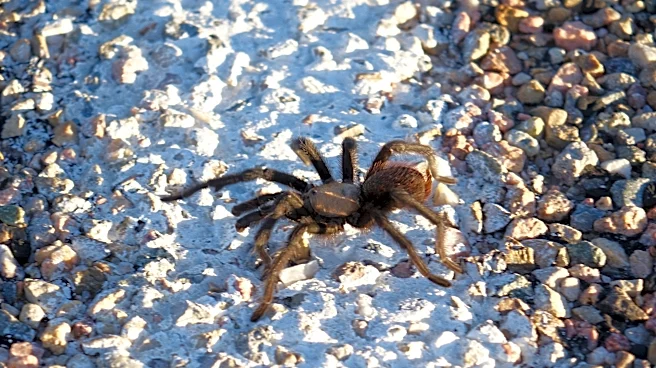
Several states may start noticing tarantulas popping up. But this isn't a sign of the apocalypse or even Armageddon. These arachnids are just looking for new mates, and they need to leave their burrow to find them.
Between the end of summer and the start of fall, usually from the end of August to October, male tarantulas in North America go out in search of eight-legged females to get ready to have babies, according to the National Park Service. There are around 30 species of tarantula in the U.S. and nearly all of them will begin mating around this time, according to A-Z Animals.
Male spiders can mate over 100 times during the season with over 100 female
tarantulas, per Oklahoma State University. The female tarantulas can also lay anywhere from 300 to 350 eggs during the season.
"Eggs take up to three months to emerge, but the survival rate for spiderlings to adulthood is pretty low due to predation and environmental factors," Andrine Shufran, Oklahoma State University Extension specialist and the director of the university's Insect Adventure, said in an article from the university.
Here's what to know about tarantula mating season.
Love hurts, and tarantulas know that

Despite their capacity to mate with over 100 other spiders, the male tarantula might not ever find a mate, and hungry predators, like snakes and coyotes if they're in the desert, might find him before he ever does meet a match, according to a video posted to the Smithsonian Channel's YouTube.
When a male does get lucky and find a mate, he will tap on her burrow, and if she's ready, she'll come out and they'll begin to do a courtship dance.
But the mood can switch from romantic to lethal at a moment's notice. So male tarantulas have hook-like appendages to help them keep the females' fangs away, which are positioned directly above them as they deposit sperm into the underside of the female's body, per the University of California. The female will then store the sperm until she's ready to lay her eggs.
If something were to go awry, and the female decides she's in more of a killing mood than a frisky one, fangs can strike the male and inject venom into his body that will liquify his insides.
Which states do tarantulas call home?
Multiple species live across 15 states in the continental U.S., per World Population Review. They can be spotted in the following states:
- Arizona
- Arkansas
- California
- Colorado
- Florida
- Kansas
- Louisiana
- Missouri
- Nevada
- New Mexico
- Oklahoma
- South Carolina
- Texas
- Utah
- Washington
Do tarantulas bite?

American tarantulas can bite, but they're very shy and are more likely to run away then try to fight you. And while their bites are venomous, they don't pose a huge threat to humans.
According to the park service, a tarantula's bite is like a bee sting and isn't deadly to humans. The truth is, unless you're a rat, frog, or other small creature, you should be fine.
"Bites are rare," Lauren Davidson, an entomologist and the director of Houston Museum of Natural Science's Cockrell Butterfly Center, previously told USA TODAY. "If it did bite you, it would hurt, but you could just put some ice on it. It doesn't require medical attention in most cases."
What should you do if you come across a tarantula?
Nothing. If you see one outside, it's best just to leave it alone.
"They're just out looking for love," Davidson said. "Let them go find a girlfriend."
They can't really creep into houses because they're too big to fit through the cracks and crevices that regular house spiders can.
But if they do manage to find their way into your home, do not chase them down.
They have little hairs on their abdomen that they rub off when they're trying to escape a big predator, and it acts sort of like fiberglass. The hairs stay in the air and stick to whatever may come in contact with them. It can make whatever unfortunate creature they stick to "really itchy," said Davidson.
Instead of chasing a tarantula with a broom or fly swatter, she recommended sneaking up on it and, without grabbing it, coaxing it into a bucket, taking it outside and releasing it back into the wild.
Where are tarantulas when it's not mating season?
If you live in a state with tarantulas, you likely won't see them outside of mating season.
Tarantulas live underground in burrows they build, where they spend their time hunting prey via ambush, according to the Natural History Museum in Los Angeles County. They usually aren't spotted outside of mating season because they try to avoid being preyed upon by other animals.
While some female tarantulas can live up to 40 years, male tarantulas will usually die shortly after the mating season, according to Oklahoma State University.
During the season, female tarantulas remain underground and begin emitting strong pheromones to attract males, who leave their burrows in hopes of finding mates, per the University of California. Females won't leave their burrows because it is more dangerous for them to travel while they have hundreds of eggs that need to be laid.
Julia Gomez is a Trending reporter for USA TODAY and covers space phenomena, scientific studies and natural disasters. Connect with her on LinkedIn, X, Instagram, and TikTok: @juliamariegz, or email her at jgomez@gannett.com.
This article originally appeared on USA TODAY: Tarantula mating season is here. These states may see more giant spiders