






Eighteen years ago on Nov. 13, Southern Californians imagined that a magnitude-7.8 earthquake struck. It was for a drill that’s since evolved into an annual observance to practice preparedness for the ever-looming Big One.
The drill was focused on drop, cover and hold on, a mantra that should — ideally — feel ingrained in Californians in the event of a tremor. The decision to focus it on this guidance, as renowned seismologist Lucy Jones told the USA TODAY Network, was in response to an earthquake in Southern California that year.
She was in a room full of emergency managers at the time of the tremor.
They all went underneath a table.
But news reports captured people running out of buildings, the very response officials say not to do.
It’s just one
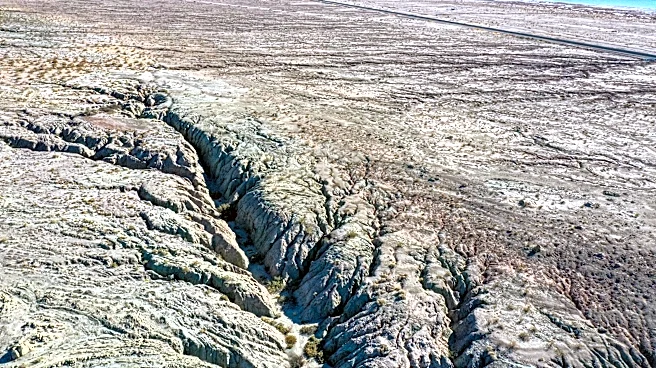
factor that informed the major earthquake drill held that November, a drill that came out of the ShakeOut Scenario. It was a project led by Jones that modeled a magnitude-7.8 earthquake on the southern San Andreas Fault, predicted to cause about 1,800 deaths and $213 billion in economic losses. It had been unveiled earlier that year, right around the time of a devastating earthquake in China, Jones said.
Yet the ShakeOut Scenario is a “bit out of date,” Jones said during the launch of the Caltech Center for Disaster Resilience on Nov. 11. It comes as the drill, the Great ShakeOut, returned just this past October.
Enter the ShakeOut Scenario 2.0, which is underway and aims to be done in 2028.
It’ll be used to model what the damage will be, like its predecessor. But researchers also want to see what mitigation has done for us in the past 20 years, Jones said.
They want to be able to show how this comprehensive look at a major earthquake striking Southern California would change if officials did something different, Jones said to the USA TODAY Network. For instance, if there were widespread adoptions related to retrofitting or if earthquake early warnings were broadly implemented.
Why update the ShakeOut Scenario? What are researchers looking at?
Years ago, Jones told the USA TODAY Network, they were dealing with a more “basic problem.” What is a big earthquake?
“And that’s where the drill and 'drop, cover, hold on' became a way of focusing attention and just what it is,” Jones said.
This time around, researchers are working to present not only what’s going to happen, but how officials can change what’s going to happen. Jones said she’s focusing more on policymakers.
There’s been a lot that’s happened since the ShakeOut Scenario was unveiled in 2008. Unsurprisingly, that means this original scenario and “the conditions it assumed no longer fully describe Southern California,” Jones said in a document provided by Caltech to the USA TODAY Network.
Society has changed, Jones said. Remote work, which boomed during the COVID-19 pandemic, has changed the nature of business disruption impacts under a major tremor, and we’re far more dependent on electricity because of the internet, she said.
We’ve also amassed “incredible data sets” in Southern California that’ll aid in making the “best prediction of what the shaking would be.” And there’s been new data, like a major earthquake that occurred in Turkey in 2023. It’s “a very close analog to the San Andreas,” Jones said. Among the information officials got from it are about ground motion and the impact of a large aftershock on a separate fault.
The destructive Los Angeles County wildfires in 2025, and the cold storage warehouse fire in Boyle Heights that burned for days earlier this year, have “provided new insights about the impacts” of large, disastrous fires in urban areas as well, according to the document.
The ShakeOut Scenario 2.0 will evaluate a number of impacts:
- Deaths and mental health
- Building and infrastructure damage, especially regarding tall buildings
- Disasters triggered by the tremor including landslides, fires, flooding and chemical spills
- Business interruption and national economic impacts
- “Social disruption, including impact on hospitals, schools and population”
The original scenario helped put together a picture of what awaited the region after an 7.8-magnitude earthquake. It helped agencies prioritize their investments for mitigation, informed emergency planning and provided a common reference to use when talking about risk, Jones said in the document.
The goals of the updated model include revised impact estimates, information for policymakers and guidance for officials to update emergency plans, public drills and their priorities for investments.
One aspect Jones said she wants to come out of this is for people to “understand that just because you got through that first week and you’re not feeling an earthquake every day or every hour doesn’t mean the risk is gone.”
Paris Barraza covers Los Angeles and Southern California for the USA TODAY Network. Reach her at pbarraza@usatodayco.com.
This article originally appeared on USA TODAY: Research modeling a major earthquake in SoCal is being updated. Why?