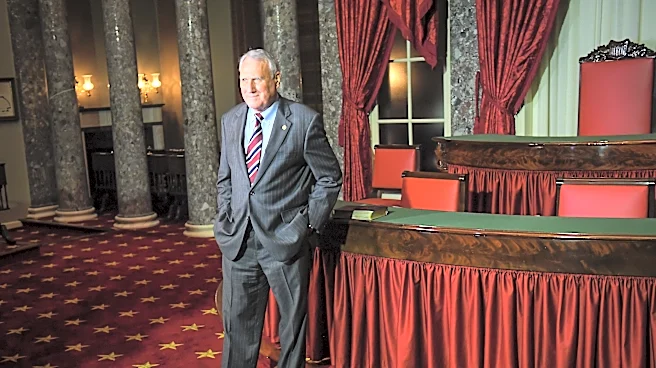

Jon Kyl, the conservative workhorse U.S. senator who emerged from the shadow of John McCain to become one of Arizona's most powerful Capitol Hill leaders, has died at age 84.
Kyl served four terms in the
U.S. House of Representatives, from 1987 to 1995, three terms in the U.S. Senate from 1995 to 2013, and made an unexpected four-month Senate comeback in 2018 after McCain’s death.
In late 2007, his Republican colleagues elected Kyl to the rank of minority whip, making him the highest-ranking Arizonan on the Hill since Rep. John Rhodes was House Republican leader from 1973 to 1981.
Kyl's family announced his death in a written statement on Sept. 17, 2026. The cause of death was complications from a neurological disease, but a date of death was not disclosed.
"Serving his state and nation in Congress was a privilege and responsibility he honored and respected," the Kyl family said in the statement. "We are grateful for his full and meaningful public life. We are grateful, too, for his full and meaningful family life, guided by his faith and endowed with honor, warmth, and love."
Kyl's initial 18-year Senate career spanned a turbulent period in the nation's history that included the 1999 Senate impeachment trial of President Bill Clinton, the Sept. 11, 2001, terrorist attacks on New York and Washington, the Afghanistan and Iraq wars and a serious economic downturn that forced the government to bail out the financial sector.
“Sen. Jon Kyl served the people of Arizona with distinction,” former President George W. Bush said upon Kyl’s retirement. “He is a highly intelligent man who was well-briefed on the key issues of our time. He earned respect not only in the Senate, but in the White House during my presidency.”
At then-Arizona Gov. Doug Ducey’s request, Kyl went back to the Senate to fill the seat vacated when McCain died on Aug. 25, 2018.
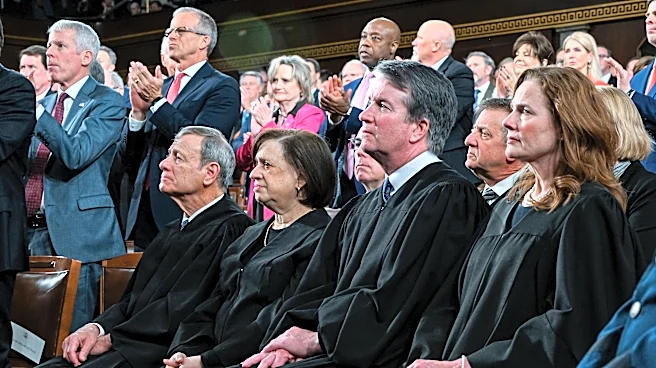
During his brief return to the chamber, Kyl voted to confirm President Donald Trump’s controversial nomination of Brett Kavanaugh to the Supreme Court. Before his appointment, Kyl had served as Kavanaugh’s “sherpa,” helping him navigate the Senate’s confirmation process. He performed the same role in 2017 for Sen. Jeff Sessions, R-Alabama, who Trump had nominated to be attorney general.
"Jon Kyl gave Arizona nearly three decades of principled, thoughtful leadership – and he gave me something just as valuable: his mentorship and friendship," Ducey said Sept. 17 on X.com. "I'll miss him deeply. Rest in peace, Senator Kyl."
In 2006, Time named Kyl one of “America's Best Senators,” hailing his behind-the-scenes mastery of the Senate process. In 2010, Time put him on the magazine's “Time 100” list of the world's most influential people, and the Capitol Hill newspaper The Hill included him among the “25 Hardest Working Lawmakers.”

Kyl, known for his intellectual curiosity, also sat on the influential Senate Finance and Judiciary committees, where he was able to influence tax issues and judicial nominations. A former attorney specializing in water law, Kyl had experience arguing before the U.S. Supreme Court. Once in Congress, he helped negotiate and facilitate several landmark Indian water-rights settlements, including the historic Arizona Water Settlements Act that Bush signed into law in 2004.
“Kyl was widely respected in his caucus and Democrats came to trust him as well,” Larry Sabato, director of the Center for Politics at the University of Virginia, said in 2011 upon Kyl's announcement that he would not seek re-election in 2012. “They don't agree with him on the issues, but he was somebody they could work with and negotiate in good faith with.”
Jon Llewellyn Kyl was born April 25, 1942, in Oakland, Nebraska. The son of an Iowa congressman, Kyl had politics in his blood and was active in Arizona GOP circles dating back to the 1960s. A University of Arizona graduate, he married Caryll Collins in 1964 and had two children.
Kyl first won a seat in Congress in 1986, succeeding U.S. Rep. Eldon Rudd, R-Arizona. He had defeated former U.S. Rep. John Conlan in that year’s Republican primary.
In 1994, Kyl beat Democratic Rep. Sam Coppersmith to win the Arizona Senate seat vacated by retiring three-term Sen. Dennis DeConcini.
Despite a low profile, Kyl faced only nominal opposition in 2000 after the Democrats failed to even field a candidate against him. But in 2006, Kyl found himself in an all-out re-election fight against former Arizona Democratic Party Chairman Jim Pederson, an independently wealthy retail developer who largely self-funded his campaign. Nationally, 2006 was an anti-Republican year, but Kyl managed to beat the trend, winning his third term by nearly 10 percentage points.
In 2000, Kyl was considered as a possible running mate for Bush. Dick Cheney, a friend of Kyl’s from the House, oversaw the search process and ultimately selected himself as vice-presidential candidate.
"I'd have been very happy with Jon Kyl as the president of the United States," Cheney, who died in 2025, told The Arizona Republic in 2012. "I think he was that good."
Kyl started and finished his first three terms as Arizona's junior senator. McCain, the better-known senior senator, eclipsed him in terms of name recognition and publicity. It was during the mid-1990s when McCain emerged as a major player on the national political scene. Kyl was content to focus on Arizona issues. Their relationship was sometimes compared to that of their predecessors Sens. Barry Goldwater and Paul Fannin. However, by the 2000s, Kyl had made a national name for himself as he started up the Senate GOP leadership ladder.
Kyl was fiercely loyal to McCain. He worked hard for McCain's 2008 presidential and 2010 re-election campaigns.
“He ranks right up there with the very, very best that we have ever had,” McCain said of Kyl in late 2012.
Dan Nowicki is The Arizona Republic's national politics editor. Follow him on X.com at @dannowicki.
This article originally appeared on Arizona Republic: Jon Kyl, influential conservative senator from Arizona, dead at 84