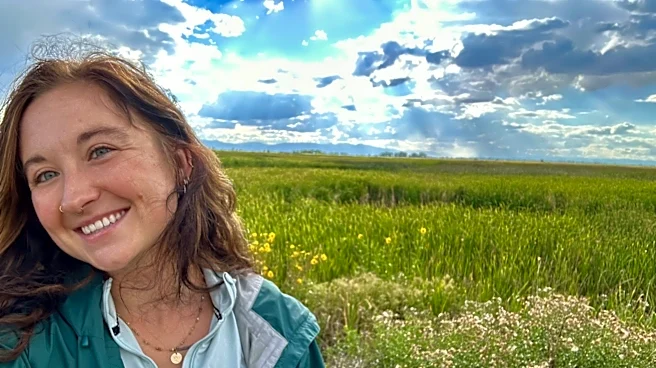

BOULDER − Maddison Schink remembers getting her grandmother's phone call as hurricane force winds whipped a wildfire through their Colorado neighborhood: What would you like me to save from our house?
Flustered, the college student rattled off the first three things that came to mind. A camera. A childhood blanket. A backpack covered in patches.
Her grandmother grabbed Schink's belongings, tossed them into her truck and drove to safety. The Marshall Fire ultimately spared their home just outside Boulder, but many of their neighbors fared far worse. The Dec. 30, 2021, fire was Colorado's most destructive in history. It burned more than 1,100 homes and a hotel, and killed two people, along with multiple pets.
Experts say climate change is drying out areas that were once wetter and snowier, raising the risk that embers from burning dry grasses whipped by stronger windstorms can blow into suburban areas, triggering a catastrophic fire where houses themselves become the fuel to spread it.

Now, the U.S. Supreme Court is deciding whether communities like Boulder can sue fossil fuel companies for contributing to climate change. The city and county argue taxpayers can't − and shouldn't have to − pay all of the millions of dollars in extra costs local governments are incurring from wildfires, severe storms, extreme heat and flooding.
Schink and other Boulder-area residents have filed a friend-of-the-court brief supporting the lawsuit against ExxonMobil and Suncor − oil companies the county says are among the world’s largest contributors to climate change and have worked closely together in Colorado.
"It really just brought climate change home," Schink, now a 26-year-old graduate student at the University of Denver, said of the fire. "It's here. It's here to stay, and we need to do something about it."
Case is one of the biggest of the term
The case, the first the Supreme Court will hear when the justices return from their summer break on Oct. 5, is also one of the biggest it will consider this term. Dozens of similar suits have been filed across the country. Billions of dollars are potentially at stake. And climate change is one of the most significant issues facing not just the nation, but the world.
The case also comes at a time when the Trump administration – which is backing the appeal from Exxon and Suncor – has been dismantlingfederal climate regulations, withdrawingfrom international climate agreements and promoting fossil fuel production.
The lack of action by the federal government to address climate change has increased the potential role of litigation and the courts.
This isn’t the first time the Supreme Court has gotten involved.
In 2011, a unanimous court saidcities and states could not force major electric utilities to reduce their greenhouse gas emissions because that’s a decision for the federal government – a ruling that largely ended the first major wave of lawsuits.
'They deceived the public for decades'
Switching tactics, state and local governments shifted their focus from the emitters of greenhouse gases to the fossil fuel industry.
The suits are modeled after the successful challenges to tobacco and opioid companies and rely on consumer protection statutes and public-nuisance claims.
Boulder argues that oil companies have intentionally misled the public for decades about the impacts of climate change and the role that fossil fuels have played in exacerbating those impacts while knowingly contributing to the problem.

Among other evidence, Boulder points to an internal 1979 Exxon memo that lists the effects of increasing carbon dioxide levels, including that southwest states would become hotter and drier, the Colorado River would diminish and the southwest water shortage would become more acute.
But in a 2000 advertisement in the New York Times titled “Unsettled Science,” ExxonMobil said "fundamental gaps in knowledge leave scientists unable to make reliable predictions about future changes.”
“This case is about the big oil companies’ deception,” said Corey Riday-White, legal director of the Center for Climate Integrity. “They deceived the public for decades about the harms they knew their products were going to cause. And this case is about holding them accountable for that deception.”
'A bunch of rich hippies in Boulder County'
Attorneys for the oil companies said in filings that Exxon and Suncor recognize that greenhouse gas emissions contribute to climate change. They also said the appropriate policy approach is "balancing risk reduction with affordable energy."
The Supreme Court is not deciding whether oil companies share responsibility for climate change, but whether Boulder can even make that argument.
Exxon and Suncor argue such suits are barred because a Colorado jury shouldn’t get to regulate the global atmosphere.
“This is about whether a bunch of rich hippies in Boulder County are allowed to dictate environment and energy policy to the entire rest of the world,” said Todd Zywicki, a professor at George Mason University Antonin Scalia Law School who filed a brief supporting the oil companies’ position.
Attorneys for Boulder argue in court filings that even when federal law regulates a product, states have been allowed to bring deceptive marketing claims – such as suits alleging tobacco companies misled consumers about the safety of “light” cigarettes.
Zywicki said the lawsuits aren’t comparable. While someone may have quit smoking if they’d been aware of the health risks, people are not going to stop using fossil fuels, he said.
“What are they saying here? 'If I had known there could be a potential link between jet fuel and the environment, I wouldn’t have flown on a plane over the last twenty years?’” Zywicki said. “It’s absurd.”
'More of a vibes case'
Fordham Law School Professor Adam Orford, an expert on environmental law, said that if the lawsuit is allowed to go forward, the oil companies won’t necessarily be forced to pay damages. A court could conclude, for example, that Boulder residents drive cars and do other things that have contributed to climate change to such a degree that no one is responsible.
But if the Supreme Court agrees with Suncor and Exxon that Boulder can’t even sue, that would be a huge change in how the law usually works, he said.
“It is just one of those very important, fundamental precepts in the U.S. legal system that if someone hurts you, you should be able to bring them into court and at least ask them to compensate you for the harm,” Orford said. “That is really what these cases are trying to accomplish.”

Bridget Fahey, an expert at the University of Chicago Law School on the ways federal government and states interact, likewise said the oil companies are making a “striking and very novel argument” about how federal law blocks such suits.
Rather than being able to point to specific language in a federal law or the Constitution, Fahey said, Suncor and Exxon are pushing more of a general sense that it’s better for Congress to regulate climate change than to let states sue.
“I think it’s more of a vibes case than a law case,” she said.
Potential off-ramp
Will the Supreme Court see the case as an interstate pollution issue governed by federal law rather than a suit about corporate conduct that can be tried under state law?
Other courts that have taken up this issue have reached different conclusions.
If the Supreme Court finds the issue too difficult to resolve, the justices have an off-ramp. They’re also deciding whether they should be involved at this stage of the litigation.
Justice Samuel Alito, one of the most conservative of the court's six Republican-appointed justices, recusedhimself from the case. That raises the possibility that the court could split 4-4, which would allow the suit to continue.

Schink, the Marshall Fire survivor, said she still struggles with the fire's aftermath. While she'd always been interested in environmental issues, she decided to get a graduate degree focused on international climate diplomacy because she feels necessary change must happen on a large scale. She's also signed up for air quality alerts from the Suncor refinery in Colorado.
And earlier this year when a small grass fire broke out near her home, she canceled her plans and recorded a video of all her belongings for insurance purposes – just in case.
"I have a really hard time not watching fire alerts, air quality alerts," she said. "It was windy, I heard firetrucks and it was like, 'time to prepare for the worst.'"
This article originally appeared on USA TODAY: 'Rich hippies' versus big oil. Supreme Court hears landmark climate change case