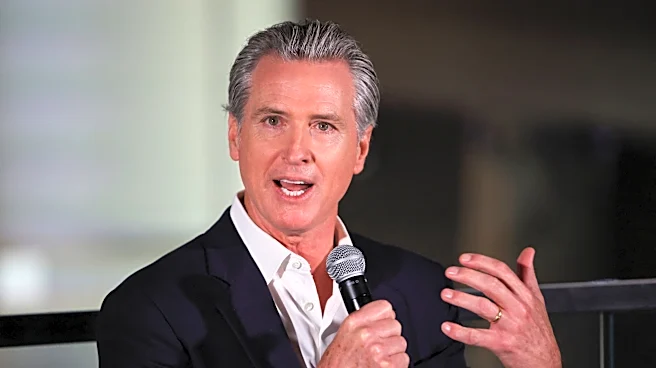



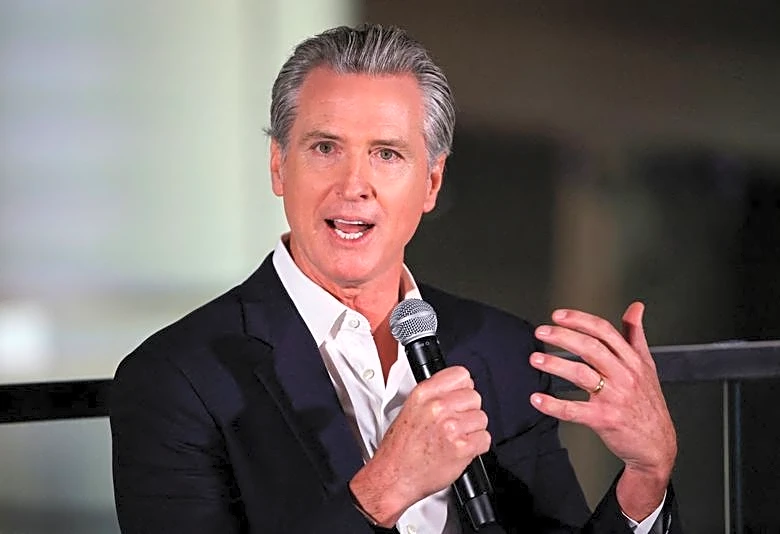



Gov. Gavin Newsom announced Thursday that he is commuting all of California’s death sentences to life in prison without the possibility of parole, an extraordinary use of his clemency authority affecting 548 people currently sentenced to death in the state.
In an open letter, Newsom argues that the state's death penalty is unjust, error-prone, and incompatible with the state's values.
"After nearly 30 years in public office, I have come to understand the limits of what government can justly accomplish. I take this action because I firmly believe that state-sanctioned killing is incompatible with California's values, undermines the foundations of our legal system, and diminishes each of us," Newsomwrote in his open letter to Californians. "I know
we cannot execute people in our imperfect legal system and remain true to our core values, first among them justice and human decency."
Newsom, who imposed a moratorium on executions shortly after taking office in 2019, said the action does not repeal California’s death penalty and applies only to current death sentences. Some commutations will require review by the California Supreme Court under the state Constitution.
Newsom called the decision "among the most difficult" of his career not because it's the wrong course but because of memories it may evoke for victims' families.
"I deeply respect the views of those who will strongly disagree with my decision, including some families of victims who have suffered the worst possible loss. I hold this painful truth along with the belief that this is a righteous action. Today I am acting on my long and deeply held conviction that individually and collectively we are stronger as a society when we reject state-sanctioned killing," Newsom said.
California and the death penalty
A year after California officially became the nation's 31st state, it authorized capital punishment, according to the California Department of Corrections and Rehabilitation. At the time, executions were carried out by county sheriffs.
Over time, however, the state transitioned to executions at state prisons and moved from hanging to the gas chamber, then later lethal injection, the CDCR says. The death penalty has faced major legal and voter actions that have led to periods in the Golden State when capital punishment was halted and later reinstated.
California reinstated its current death penalty statute when voters overwhelmingly approved 1978's Proposition 7, according to the CDCR. Since then, California has carried out 13 executions, a small fraction of the 602 executions carried out in Texas, the nation's leading state for executions, according to the Death Penalty Information Center.
Voters weigh in on death penalty, then comes governor moratorium
In November 2016, California voters voted against Proposition 62, which sought to abolish the death penalty. Instead, voters approved Proposition 66, which was meant to speed up the execution process.
However, shortly after taking office in 2019, Newsom signed an executive order establishing a moratorium on the death penalty.
“The intentional killing of another person is wrong, and as Governor, I will not oversee the execution of any individual,” Newsom said in a March 2019 statement. “Our death penalty system has been, by all measures, a failure. It has discriminated against defendants who are mentally ill, black and brown, or can’t afford expensive legal representation. It has provided no public safety benefit or value as a deterrent. It has wasted billions of taxpayer dollars. Most of all, the death penalty is absolute. It’s irreversible and irreparable in the event of human error.”
When was California's most recent execution?
The most recent execution in California was in 2006, when the state put Clarence Ray Allen, 76, to death by lethal injection at San Quentin State Prison, according to the CDCR. Allen was sentenced to death in 1982 after he was convicted of orchestrating a 1980 triple murder when he was already serving a life sentence inside Folsom Prison.
How many inmates are on death row in California?
California currently has 564 inmates (546 men and 18 women) awaiting execution, CDCR records show.
The Golden State has the largest death row population of any state, according to the Death Penalty Information Center.
Notable inmates on California death row
Some of the notable inmates on California's death row include:
- Randy Kraft, 81, known as the "Scorecard Killer," was convicted of 16 murders and sentenced to death in 1989, according to the Orange County Sheriff's Department. Kraft is believed to be responsible for more than 60 murders, according to investigators.
- Richard Allen Davis, 72,was sentenced to death after being convicted in 1996 in the kidnapping and murder of 12-year-old Polly Klaas, which "received nationwide media attention and led to increased penalties for repeat offenders under the Three Strikes Law," according to the Sonoma County District Attorney.
- Charles Ng, 65, is a convicted serial killer who is accused, alongside an accomplice, of torturing, raping and murdering 11 victims in Northern California in the 1980s, according to the Associated Press. He was sentenced to death in 1999.
- Cary Stayner, 65, known as the Yosemite killer, was sentenced to death after he was convicted in the murders of four women near Yosemite National Park in 1999, according to Courthouse News Service.
This story has been updated with new information.
This article originally appeared on USA TODAY: Newsom commutes California death sentences for 548 people