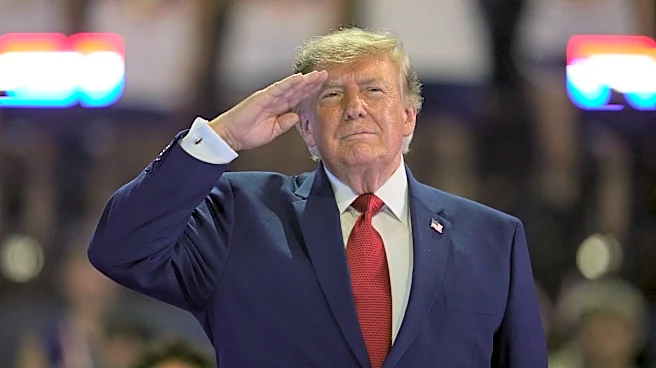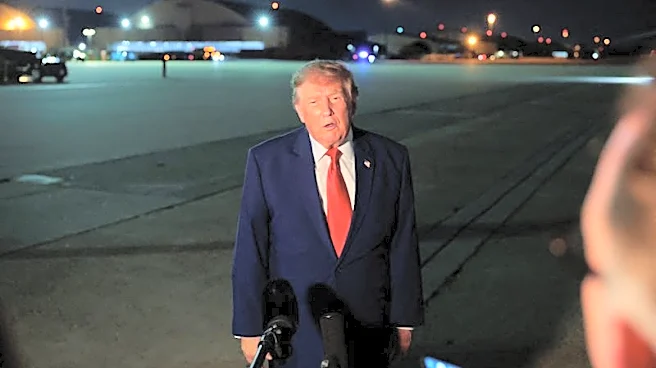




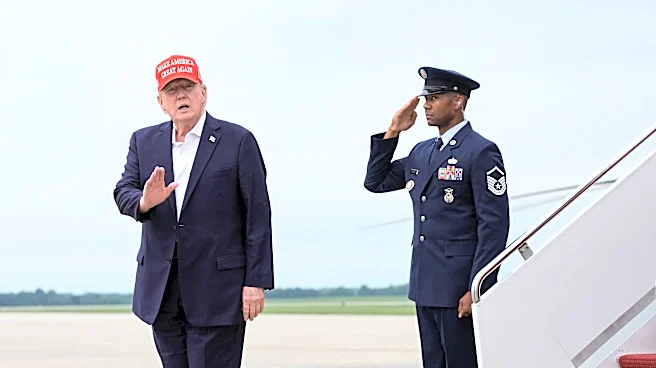


President Donald Trump’s late-night Truth Social post against the Center for American Progress exposes an administration deeply threatened by an inconvenient truth: His signature domestic military deployments are a multibillion dollar failure.
After we went through the evidence and detailed the staggering costs of Trump’s National Guard deployments on C-SPAN on Aug. 10, the president slammed our report as a “Radical Left SCAM” and threatened a lawsuit.
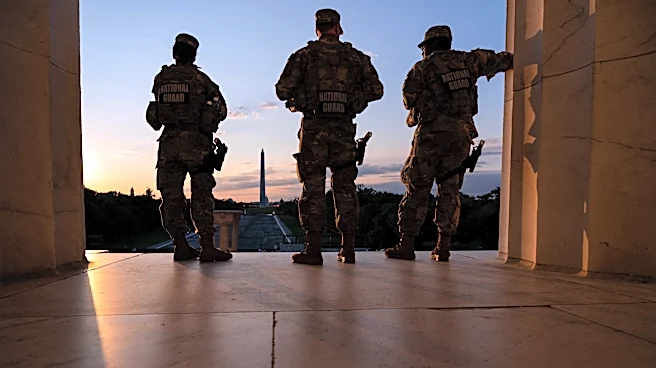
Yet no amount of legal intimidation or all-caps social media posts can erase the facts. The Pentagon’s recent extension of the controversial deployment in Washington, DC, through Inauguration Day 2029 proves what Trump sold to the public as a temporary response to a fabricated emergency has now
been codified into an open-ended, multiyear federal mobilization in our nation’s capital.
Crime was trending down before Trump's troop deployments

Trump capitalized on voter anxiety over crime to secure a second presidential term, promising to revive tough-on-crime policies of the past, even though those policies were largely ineffective.
More than a year into his second administration, however, emerging data on violent crime rates contradicts his strongman rhetoric. By cementing this deployment through the end of his term, Trump has tied his brand to a flawed strategy.
The very research Trump is threatening to sue over reveals American taxpayers could shell out over $1.7 billion by the end of 2026, and as much as $3 billion by Inauguration Day 2029 for Trump’s domestic National Guard deployments in Washington, Memphis, Los Angeles, Portland, Chicago and New Orleans – with no real impact on violent crime to show for it.
The statistics debunk Trump’s claims of lowering violent crime rates by clearly showing rates were trending downward before federal troops even arrived.
The data peels back the administration’s law-and-order rhetoric and reveals a public safety strategy that is expensive, deeply unpopular and, above all, ineffective in reducing violent crime. Instead of protecting law-abiding Americans, this heavy-handed approach, in combination with other federal law enforcement surges, has alienated local communities.
Local governments have strategies that are working
Behind the scenes, the second Trump administration is making it harder for mayors, police and prosecutors to do their jobs. In April 2025, Trump’s Department of Justice terminated $500 million in grants, including some aimed at improving policing, prosecuting criminals and protecting children.
Instead of propping up the agencies focused on combatting serious crimes, the administration fired career prosecutors and reassigned federal agents to conduct mass deportations. Federal drug prosecutions plummeted to their lowest levels since the late 1990s.
Trump’s DOJ even dissolved the Organized Crime Drug Enforcement Task Forces, stripping state and local law enforcement of vital resources needed to combat international cartels.
Murders spiked by about 30% year-over-year during the final year of Trump’s first term, but after he left office, it eventually dropped significantly. Under the Biden administration, the United States experienced record-breaking declines in homicides in both 2023 and 2024.
In fact, nearly two-thirds of the drop in the national murder rate by the end of 2025 and since a 2021 peak happened before Trump reentered the White House.
Today, many of the same blue cities Trump has attacked as crime-ridden are actually experiencing historic declines in homicides and other violent crimes based on policies they enacted before he took office – proving that targeted, local strategies outpace ineffective federal military interventions.
When Trump declared Washington to be in the middle of a “crime emergency,” the city had just recorded an eight-year-low homicide numbers and a 32% year-over-year drop in homicides by focusing policing resources on crime hot spots and investing in crime-solving technology.
These cities have succeeded by following a shared playbook. Building on their successes – and coupled with decades of evidence about how to stop crime and revitalize communities – federal lawmakers should pursue a comprehensive public safety strategy that delivers real results for everyday Americans.
Such a strategy can be built on three proven pillars:
- Enforce accountability by hiring more detectives to increase case clearance rates, delivering swift and certain consequences for lawbreakers, and recruiting more first responders to support local departments.
- Prevent crime before it happens by investing heavily in community-violence-intervention programs, funding youth-crime-prevention efforts and expanding initiatives that reduce recidivism.
- Disrupt illicit markets by refocusing federal agents away from political stunts and toward dismantling the criminal networks trafficking illegal drugs, firearms, human beings and stolen goods.
Americans want results, not political theatrics
Because cities across the country are already pursuing strategies like these, Americans are safer from violent crime and homicides. For example, New York City recently recorded the fewest first-quarter shooting incidents and victims in its history.
Similarly, Baltimore has achieved its lowest homicide count in nearly 50 years. And Detroit brought its annual homicide number under 200 for the first time in decades.
The American public is ready to reject Trump’s heavy-on-optics approach to public safety in favor of real results. Although there is a partisan divide on this issue, polling shows voters want an approach to violent crime reduction that actually protects their families and homes, not political theater.
It’s not enough to simply call out the administration’s $1.7 billion National Guard deployment for the failure it is. Lawmakers must refuse to be bullied by unhinged legal threats or social media tirades, and double down on the local strategies that are actually proven to work.
Chandler Hall is the associate director and Nick Wilson is the senior director of public safety policy at the Center for American Progress.
This article originally appeared on USA TODAY: Trump wastes billions deploying National Guard troops to DC | Opinion