



HARLINGEN, Texas – Chants of "Texas strong Tal-a-rico, Gi-na Hino-josa!" filled the still, 90-degree evening air as three meat pizzas and margaritas were ushered onto Mikey’s Pizza and Shots’ back patio.
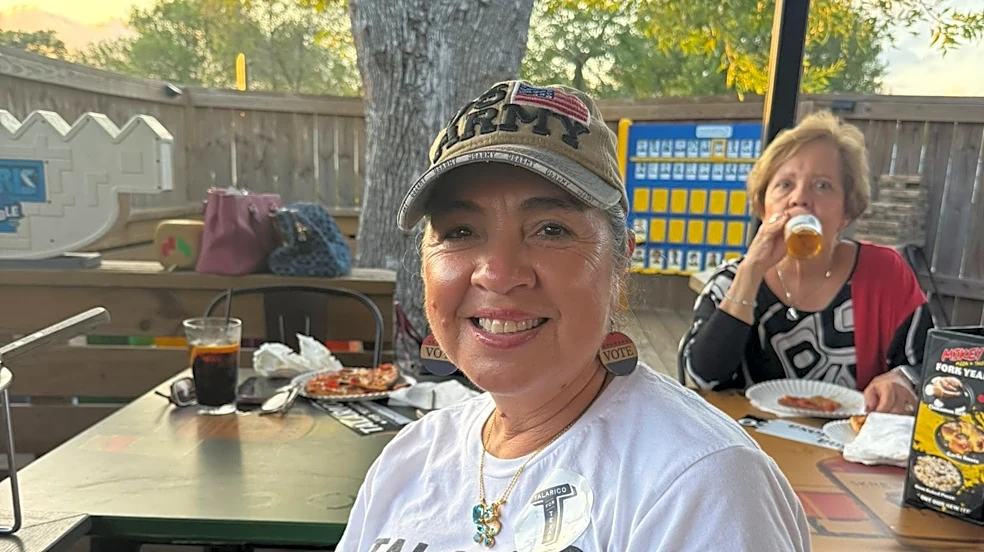
Maricela Alvarado, 63, wearing a U.S. Army cap, a "Talarico for Texas" shirt and earrings that simply said "VOTE," swirled around the patio clapping her hands and leading the cheer ahead of Democratic Senate nominee state Rep. James Talarico’s town hall on CNN on Oct. 14.
"I think he’s a godsend. He’s a blessing to the entire state of Texas. Not just Democrats, but Republicans too," Alvarado, who served in the Army for 28 years, said of the 37-year-old Democratic nominee, noting that he’s a candidate that even voters on the right can support because
they feel like "I’m not giving up my values."
"There’s always the right candidate at the right time and I think he’s the candidate at the right time," said Alvarado, who was one of nearly 30 people who attended a watch party hosted by Northern Cameron County Democrats and Talarico's campaign at the pizzeria.
Alvarado believes Talarico will lead Texas Democrats to a statewide victory for the first time since 1994. And she said, Hispanic voters are the ones who are going to push him across the finish line.
"We are actually the deciding factor," she said. "We have not really tied to one party or the other. The Hispanic community can vote this way, that way, just whatever the feeling they’re feeling."
Over the past several election cycles, Hispanic voters in Texas have slowly shifted away from the Democratic Party and toward Republicans. In 2022, Republicans flipped Texas’ 15th Congressional District, a majority Hispanic district that makes up parts of the Rio Grande Valley, after the GOP made heavy investments to expand outreach to that area.
It came to a head in 2024 when President Donald Trump won more than half– 55% – of the Latino vote in the state, a 13-percentage-point increase from 2020, a record high for a Republican presidential candidate and a 27-percentage-point increase over 2016, according to data from the Texas Politics Project.
But Republicans are now losing the gains they made with Latino voters as costs – from beef to gas prices – rise, coupled with the increased immigration enforcement that has plagued Latino communities across the nation. It’s thrown a typically safe red state into closely watched and hotly contested races for Senate and governor. Recent polls show the race between Talarico and Attorney General Ken Paxton tightening to 49% to 45.5%, according to an average of the latest five polls by 270 To Win. State Rep. Gina Hinojosa, the Democratic nominee for governor, is slightly trailing behind Republican incumbent Gov. Greg Abbott, 46.8%-49%, according to an average of the latest five polls by 270 To Win.
The Texas Republican Party and the campaigns for Paxton and Abbott did not respond to a request for comment.

"Latino voters are putting an exclamation, are underlining the fact, that they're a swing vote," said Clarissa Martinez, vice president of the Latino Vote Initiative at UnidosUS.
What the polls say
In the weeks to the Nov. 3 general election, recent polling on Hispanic voters in Texas shows that the Democratic candidates at the top of the ticket, including Talarico and Hinojosa, have seen a swing in their direction.
Talarico was leading Paxton among Hispanic voters by 63% to 30%, according to a Cook Political Report/TelevisaUnivision poll released in September. Of that, a whopping 73% of self-described independents said they were backing Talarico. In 2020, outgoing Texas Republican Sen. John Cornyn won 27% of the Hispanic vote, according to UnidosUS.
Hinojosa, a state representative, was leading against Republican Gov. Greg Abbott by 60% to 33% in the closely watched governor’s race, according to that same poll. In 2022, Abbott, who was first elected in 2014, won 40% of Hispanic voters in the state.
Hispanic voters account for more than a third of Texas electorate, the second largest portion of any state behind New Mexico.
In a poll released in October by Equis Research, a group focused on researching Latino voters, Talarico was leading 58% to 33%. Hinojoas had a lead of 59% over Abbott’s 35% in that same survey.
Among the top issues that are driving Latino voters to the Democratic Party: the economy and immigration enforcement.
Stephanie Valencia, co-founder of Equis Research, said for the first time in Texas or even national polling, immigration enforcement and deportations were the number two issue cited by Hispanic voters after grocery and gas prices.
"There's something afoot in Texas that is slightly different than what is happening in the rest of the country," she said, adding that health care issues are typically the number two issue chosen by voters.
Texas has been a locus of Trump’s crackdown on illegal immigration. According to an analysis by the Texas Tribune, one out of every four arrests by Immigration and Customs Enforcement happened in the state.
Several instances have also drawn national backlash. Earlier this year, Lorenzo Salgado Araujo, 52, was shot in Houston by an ICE officer. In Alamo, Texas, located in the Rio Grande Valley, two 17-year-olds were detained by ICE officers after they were pepper sprayed and handcuffed in a public intersection – a moment that was captured on video and went viral online. The teenagers, both American citizens, were on their way to a local Marine recruiter’s office.
Joshua Blank, director of research for the Texas Politics Project at University of Texas at Austin, said there’s been an "erosion" of Hispanic support for Trump in particular, as well as the Republican candidates.
Only 24% of Hispanic Americans approve of the president’s performance, the lowest share in either of Trump's two presidential terms, according to an October Reuters/Ipsos poll.
But the key is whether Democrats can turn out those voters.
While more than 30 million Latinos are eligible to vote, just roughly half – or 16.5 million – voted during the 2020 presidential elections.
Between the 2018 midterm election and the 2022 midterm election, Hispanic voter turnout dropped roughly 6 percentage points, according to research from NALEO Educational Fund, a nonprofit focused on getting Latinos out to vote.
"Hispanics look a lot more favorably disposed towards Democratic candidates in Texas today than they did in 2024. The question is whether Democratic support is still growing among that group, and whether Democrats are successful in their efforts to turn out those voters," Blank said. "And then, if so, are they successful enough to push one or more candidates over the finish line?
"Ultimately, we just don't know, right?" he added.
A 'perfect storm'
Democrats are hoping for a perfect storm.
Suburban voters and independent voters will also be a key deciding factor.
"The outcome is going to be determined by a lot of things," Blank said, adding that both parties are actively campaigning for Hispanic voters "in a way that they haven't in the past."
Hidalgo County Democrats Chairman Richard Gonzales said Talarico, a Presbyterian seminary student and former schoolteacher, is "checking all the boxes" for not just Democrats or Latino voters, but other key portions of the electorate like independent voters, young voters and even former Republicans.
"He's pulling from a lot of different areas, and I think that's going to be really, really important as this election takes place," Gonzales said.
But Republicans aren’t giving up the gains they made within the Latino community without a fight.
House Speaker Mike Johnson held a rally Oct. 13 in McAllen with several local Republican candidates, including Rep. Monica De La Cruz, who is running in the competitive 15th Congressional District that she first flipped in 2022. It’s one of many stops he’s making across the country to help galvanize Republicans ahead of the election.
Johnson’s rally came almost a week before early voting would begin in Texas on Oct. 19.
"South Texas will literally decide the majority of the Congress," he said, noting that the control of the House will rely on several key races in the heavily Hispanic area, including three seats that encompass the Rio Grande Valley.
And not every voter from South Texas is sold on Democrats.
Tammy Leal, a decades-long Republican living in McAllen, Texas, said she still has "hope" in her party to bring down high grocery and gas prices, even as her wallet has taken a hit. She said she is still supports De La Cruz, who is her representative, and is backing Paxton in the Senate race.
"I just support him. He's not perfect, just like he's a human being, just like anybody else," Leal, 67, said. While she doesn't like that Paxton cheated on his wife, she said she agrees with things he stood for as attorney general, such as combating human trafficking. Paxton has faced scrutiny over plea deals related to sex abuses cases.
"I'm still going to be with Paxton. I'm still voting for him," she said, noting that during the primary, she supported outgoing Sen. John Cornyn, who lost to Paxton in a runoff election. "But then I said, okay, he's our candidate. Once a decision is made of a candidate, you know, we're going to go with our party."
Locals cheer for Talarico
Back at Mikey’s, a silence fell over the back patio for the first time all evening. It was time to hear Talarico speak.

The crowd of mostly women wore "Talarico for Texas" stickers, while others donned "Gina for Texas" hats and shirts – a reference to the Rio Grande Valley native Hinojosa.
Cheers rang out sporadically throughout the night when Talarico would say something the group supported – from the Democrat saying that he’s tired of division between parties to calling on the wealthy to be taxed. The biggest applause of the evening came when Talarico advocated for a pay raise for Texas' "hard working educators."
Alvarado, the ringleader of the evening, said she thinks the energy for Talarico will help Democrats across the board.
"Someone told me once, it’s just like the perfect storm," she said. "We have a great candidate who everybody can vote (for), can really connect to."
As the night came to a close, volunteers for the Talarico campaign had a special announcement: 30 volunteers from across the country were descending on just Cameron County, a mostly Hispanic area in the southernmost region of Texas, encompassing Harlingen, Brownsville, the largest city in the county, and home to billionaire Elon Musk's SpaceX Starbase.
Cameron County, the Talarico campaign volunteers said, could decide the race.
Contributing: Terry Collins, USA TODAY
This article originally appeared on USA TODAY: Latino excitement for James Talarico could power Texas Senate upset