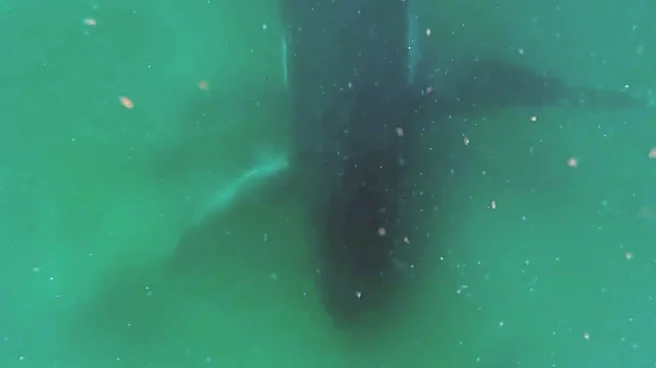






Researchers found that humpback whales may experience grief when their calves die after observing a female humpback whale stay with her presumed stillborn calf for an extended period of time.
"She remained close to the calf, maintaining eye contact and positioning herself next to her calf over several hours and maybe even days," Olaf Meynecke, part of Griffith University’s Whales and Climate Research Program in Australia, said in a statement. "These observed behaviors were consistent with care-giving or nurturing actions and post-mortem attentive responses documented in socially complex mammals, and indicated an inherent, strong maternal attachment to the calf."
The distressing video captured the moment the whale swam around her calf's body. According
to a news release, it was captured off the coast of Queensland, Australia, in 2025.
The scene is heartbreaking, and Meynecke says it is rare.
"This case study highlights the need for continued systematic documentation of rare neonatal mortality events to better understand the cognitive, emotional, and evolutionary significance of post-mortem behavior in large whales," said Meynecke.
A study on the moment has been published in Discover Animals by Springer Nature.
What is a humpback whale?
Humpback whales have fascinated people for generations.
They live in oceans worldwide and have one of the longest migrations among mammals, according to the National Oceanic and Atmospheric Administration Fisheries.
They can be 49 feet long and weigh up to 36 metric tons, per the World Wide Fund for Nature. A whale's pregnancy can also last for 11 to 12 months, and calves can grow up to 1.6 feet each month while they're nursing.
By 1985, some humpback populations had been reduced by over 95%, according to Shark Stewards, a nonprofit. However, after a final moratorium on commercial whaling, their populations have grown. While some populations remain threatened or depleted (which means the population is much lower and at risk of becoming endangered, per NOAA), most humpback whale populations are no longer endangered, the American Association for the Advancement of Science reported.
Julia Gomez is a Trending reporter for USA TODAY and covers space phenomena, scientific studies and natural disasters. Connect with her on LinkedIn, X, Instagram, and TikTok: @juliamariegz, or email her at jgomez@gannett.com.
This article originally appeared on USA TODAY: Video appears to capture moment female whale mourns stillborn calf