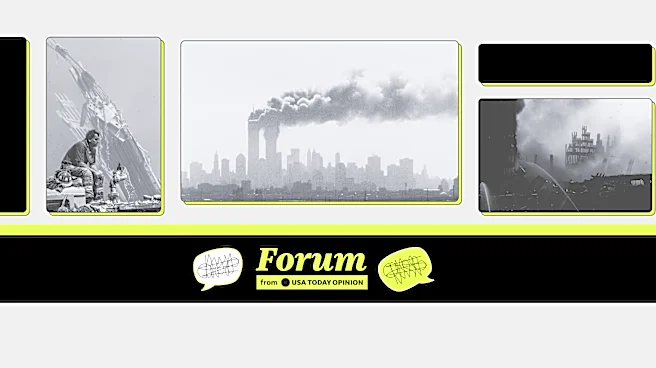





Claudia Szurkowski hadn't yet drawn her first breath when her father, Norbert Szurkowski, breathed his last on Sept. 11, 2001.
Matt Bocchi was 9 when his father, who worked for Cantor Fitzgerald, was killed. He spent years agonizing over his dad's final moments.
Melanie Winuk wasn't born yet when her uncle Glenn Winuk, a lawyer and volunteer firefighter, ran toward the danger on that clear Tuesday morning.
They − like so many other Americans shaped by 9/11 − are among those who have little or no memory of the events that forever changed their lives.
Here are their stories.
'It's being forgotten, and I hate to see that.'
Claudia Szurkowski's mother was still pregnant when her father, a member of the painters and wallpaper hangers union, went into the World Trade Center for a quick repair. He was supposed
to leave before office workers filed into the North Tower at 9 a.m. A plane struck the tower at 8:46 a.m.
"They never found anything but his wedding ring," Szurkowski said. "But we know he was there because he'd signed in."
Her mother, Ursula Andrus, was pregnant with Claudia, and her sister, Alexandra, was just 3.

"My mom is the most resilient person I've ever known," said Szurkowski, 24, who lives in Florida, where she works as a bartender while attending college. She plans to become a lawyer.
She looks very much like her father, but when she wants to know what her dad was like, Szurkowski said her mom tells her, "Be your sister's best friend," because Alexandra has their father's personality: fun, loving, kind, outdoorsy.
Szurkowski talks to her dad each night before she goes to sleep, looking in the mirror because she feels him looking back, given their physical resemblance.
"It’s a weird feeling, being younger than the event itself," she said. "It’s hard to wrap my brain around it, to be so heavily affected by it when I wasn’t alive when it happened. I'm affected by it, but it doesn't define who I am."

But Szurkowski, who's active on social media and grew up in Florida after her mother moved the family south in 2010, said she has noticed a shift in how 9/11 is remembered, a reflection of geography and time.
Her class would learn about the history of the day usually on the anniversary. But only then. Teachers would single her out as an example of the day's losses. Some classmates resented her and accused her of making up her family's loss ‒ or worse, made jokes about it, or engaged in conspiracy theories about what happened.
"It's being forgotten, and I hate to see that," she said. "Sometimes I didn’t want that to be part of the story. But he is a big part of my life."
The yearly commemoration of 9/11 can be painful, she said, especially when people make jokes or try to minimize what happened.
"When someone loses a parent to something like cancer, it's hard, but it's a private moment," she said. "This was nationally televised. The whole day is constantly picked apart. People are still affected by this day ‒ I wish more people understood that."
'Hard to tell a 9-year-old boy his dad isn't coming home'
Matt Bocchi was in school when his teachers pulled him and another student from their classroom. At first he thought he might be in trouble.
It was Sept. 11, 2001, and John Bocchi worked for Cantor Fitzgerald on the 105th floor of the World Trade Center. Matt knew something was wrong, but he was initially told his father was safe. "As the day went on, I started to feel like something was off," he remembered. "People were pulling their kids out of school," but he was kept there.

When he came home, the family's house in New Vernon, New Jersey, was filled with friends, neighbors and family members. Matt, the oldest of four boys, saw the news coverage of the terrorist attacks. Before someone changed the channel to spare Matt and his 7-year-old brother the trauma of seeing what had happened, Matt saw a man falling to his death. He knew the man had come from his father's building, from a high floor, like the one where John Bocchi worked.
"That image replayed in my mind," Matt Bocchi said, and he would become obsessed with trying to find out what his father's final moments had been like.

He recalled the "overwhelming uncertainty" of the day. "He wasn't coming home," he said. "That first week was hard. ... The reality wasn't setting in. It's hard to tell a 9-year-old boy his dad isn't coming home, and he was part of the biggest terrorist act in the country's history."
His two youngest brothers were just 3 years old and 3 months old.
He felt it was his duty, to his father and to his younger brothers, to keep his father's memory alive.
"He was an amazing father," Bocchi said. John Bocchi was devoted to his family, a man who "loved the simple things" and saw his home as a refuge from a high-pressure job. He was an avid fan of the New York Yankees, the New York Knicks, the New Jersey Devils and Juventus Milan, an Italian soccer team.
"You feel the loss," Matt Bocchi said.

A family member, Bocchi said, exploited his feelings of loss, grief and confusion in the worst way: He falsely told young Matt, searching desperately for answers in his father's death, that his father was one of the falling men. Then, as Matt reeled from anger and pain, he said the family member sexually abused him.
That, on top of the trauma of losing his father so suddenly and violently, tore young Matt apart for a time. He struggled with depression and suicidal thoughts and sank into drug abuse and alcoholism.
He's sober now, but watching news coverage of the anniversary each year is difficult. There's what he calls the "anticipatory anxiety" in the days before and an "emotional hangover" afterward.
Today, Matt Bocchi is an author and speaker who talks about his challenges and his recovery, "trying to make some light from the darkness in my life." He's also a father himself; his son was born on Christmas Day and is named for the grandfather he never had a chance to meet.
He has felt the loss of his father acutely during big moments in his life: his wedding, the birth of his son. He's now more able to understand how his mother, who remarried, tried to deal with her own grief while raising four boys without their father.
"The children (of 9/11) for many years were overlooked," he said. "The emphasis for a long time was on the first responders and the widows, rightly so.
"But there were a lot of kids who went through the same experience I did. So I try to show the world that it wasn't just one day. It defined the days and years for each and every one of us. People think we went through this loss and we got over it. You learn to live with it, but you never get over it. This had an effect that feels eternal."
'The gap my uncle left'
Glenn Winuk was a lawyer working near the Twin Towers when his office building was evacuated. But Winuk, a decorated volunteer firefighter, ran toward the danger like so many other first responders that day. He was killed when the South Tower fell, his medical bag beside him.
After the attacks, his brother Jay cofounded 9/11 Day, a nonprofit that promotes a day of service on the anniversary of the tragedy and year-round. Melanie Winuk, Jay's daughter and Glenn's niece, wasn't born when her uncle lost his life, but today she works for the nonprofit inspired by his service to others.

Now 24 and living in Boston, Melanie Winuk has always felt a personal connection to what happened months before she was born, knowing about how her father and grandparents tried calling Glenn over and over with no response. She has seen and felt "the gap my uncle left in them," and she has grown up with his memory very much a part of her consciousness.
"I really wish I’d met him and grown up with him in my life, but also in a way I have," she said. "I am reminded of him in the work my dad does and the work I do."
She's proud, too, of how her father turned his personal loss into a way to help and honor Glenn's dedication to serving others.

"He was enthralled with service and being a first responder," Winuk said. Growing up in Jericho, New York, Glenn would make first-aid kits to take to neighborhood football games, ready in case someone got hurt. He'd ride his bicycle behind fire trucks, and he got to know firefighters to learn about how they did their job.
Winuk knows many of her peers feel detached from the event, but she also thinks it's important they know about the people who were lost and the sacrifices so many people made.
"It really feels surreal, learning about such a horrific tragedy I wasn’t there to experience," she said. Her brother was 4 and loved their uncle, and she imagines how hard it must have been for her parents to explain the tragedy to him.
"I think of all the other families who had to do that," she said. "To hear people's last voicemails to their families, telling them they loved them. ... It's heartbreaking.
"I think when you move further and further away from any tragic event, that can be lost," she said. That's a goal of 9/11 Day, for which Winuk works in social media and marketing, "to remember the individuals, the people. They are not faceless statistics on a day in history. They were real people with real lives."
Phaedra Trethan is a national correspondent for USA TODAY, writing about history and Americana. Contact her by email at ptrethan@usatoday.com, on X @wordsbyphaedra, on BlueSky @byphaedra, or on Threads @by_phaedra.
This article originally appeared on USA TODAY: Their lives forever changed on 9/11. They were too young to know it