




Warning: We're discussing spoilers from the third episode of HBO’s “Lanterns” (streaming now on HBO Max).
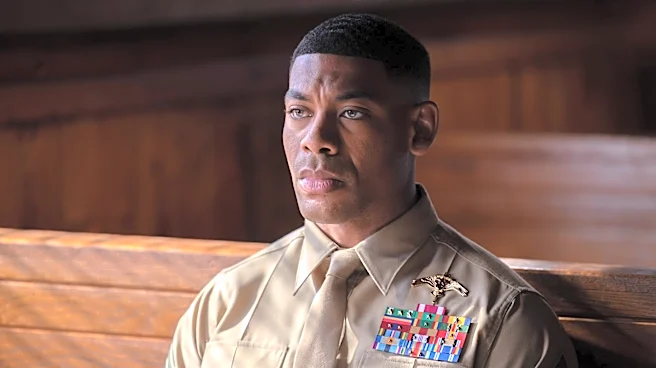
Comic-book fans have known about John Stewart since the 1970s as one of DC Comics’ most prominent Black superheroes. And the new episode of “Lanterns” finally gave new fans a powerful backstory for the rookie Green Lantern.
The opening scene of the pilot gave a little glimpse at Stewart's past (Aaron Pierre) by showing him as a little boy standing still and calm as his father John Sr. (J. Alphonse Nicholson) shoots an apple off the kid’s head with a gun. Written by Vanessa Baden Kelly, the third “Lanterns” episode digs more into John’s childhood while also exploring racial and parental themes.
Kelly tells USA TODAY it was "terrifying" to be
respectful of the DC Comics canon while also honoring the purpose of John's creation. "Stewart was intentionally crafted to be a Black man in America at a time when Black folks were fighting against respectability politics and were asking, as we still do, for the world to see us as fully formed beings: needs, flaws, quirks, etc. It was important to me to maintain that essence down to his family structure."

Setting the central murder mystery aside for an hour, the DC superhero series puts a spotlight on John, revealing the mission that led to his exit from the military, but also his first meeting with one of the Guardians of the Universe played by Laura Linney. They are the alien race responsible for policing the galaxy with their Green Lantern Corps, and the episode reveals that Hal Jordan (Kyle Chandler), Earth’s Green Lantern, wasn’t her first stop.
The episode flashes back to John as a baby when his dad is confronted with this otherworldly situation and asked the important interview question that determines a Green Lantern’s mettle: “Are you afraid?” He says yes and the Guardians move on to Hal. However, Linney’s Guardian visits the Stewart household later and gets an earful from John’s mother Bernadette: In the episode’s most potent scene, Bernadette asks the Guardian if she understands what it means to ask a Black man in America if he’s afraid.
"If John Sr. maybe knew the scope of what he was being asked to do and was approached in a humane way, I bet he would have said he wasn't afraid," Kelly says. "But he was pulled from his family bed with his children all around him and that's frightening. Is something going to happen to him? His children? He was raising little Black boys in the heart of Detroit in the '80s. They couldn't survive without him. That is not Hal's reality.
"Black people have to consider so much more than if they get to fly," she adds. "That was so important for us to remind audiences about. Hal can be a jerk, insubordinate, he cannot follow a single rule. It's different for the Stewarts."

The Guardian sees something in young John, however, and his parents go to extremes to prepare him to be the Green Lantern one day and raise him to have no fear. That means shooting apples off his head, but also dropping John off in the bad part of town and making him find his way home. Ultimately, it’s revealed that the Guardians have recruited John to not be Hal’s sidekick but his replacement.
Pierre says it’s “one of the most brilliantly written episodes of television that I've personally read,” capturing the social commentary “in such an eloquent [and] articulate way. It creates an immediate conversation, and it inspires people to want to find a solution and want to find a way to successfully defeat these troubles that are present in the world we live in today.”
“Lanterns” executive producer Damon Lindelof was really interested in the idea of presenting John "as a parable for Tiger Woods or the Williams sisters [Serena and Venus], who basically had been told, before he could remember, that he had this destiny, that he was going to be the greatest Green Lantern ever," he says. "And Vanessa very clearly said, ‘If you're talking about the idea of fear through the lens of Blackness, all due respect, but have a seat at the table and let us talk to you about a couple of things.’ ”
Adds Kelly: "Many people wouldn't agree with John's upbringing – we certainly believe the Stewarts took it to extremes – but it's a story I saw hundreds of times over growing up and one I didn't see much portrayed because people like me who saw that aren't often in these types of rooms."

He’s not in it a lot but Chandler was a big fan of the episode, which “was put in the deck at just the right spot,” he says. “There were questions like, 'Who is this dude?’ But then you see his childhood revealed in such a great way.”
Chandler was also stunned by Cephas Jones’ performance. “I have loved her arc in the show,” he adds. “She just nailed it. She goes from sweet to really spooky. She might be arrested these days for what she did to this kid. But it was great and that episode was really telling.”
One scene that's "super close" to Kelly's heart is when Bernadette is in John's room and reveals to him that they've been lying to him and the Guardians aren't watching his every move. "I'm a mom and there have been so many moments where I've overreacted or been too quick to judgment and watched it land on my kid and have to go back and say, 'Buddy, I'm sorry. I just messed up,' " she says.
It "hopefully allows audiences to see that even though they may be a little too much, the Stewarts – like the Woods and Williams and Jacksons and Balls and Brunsons before them – love their kids. Which is what makes it all so hard."
This article originally appeared on USA TODAY: Inside HBO's 'Lanterns' episode that created 'immediate conversation'