







Spoiler alert! We're discussing important plot points from the new documentary “You Can See Everything,” so beware if you haven’t seen it yet.
It’s been a week since I saw the Elizabeth Holmes documentary “You Can See Everything,” and I still don’t know what to do with myself.
I’m not the only one awestruck. This film has overtaken social media and the box office.
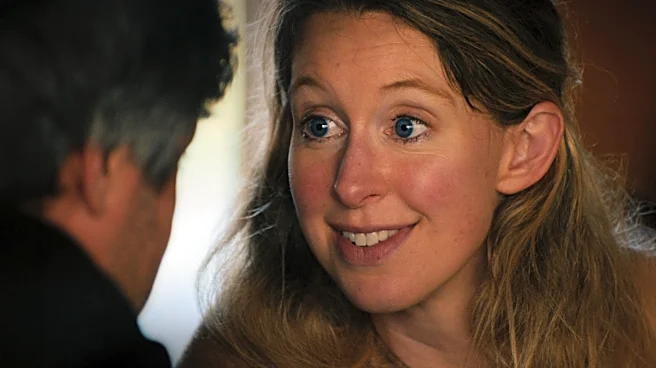
For three hours, we see the disgraced Theranos founder in a different light. She’s a sympathetic, devoted mother – her children are always conveniently in the shot. Her voice is lighter and more natural. She opts for beige sweaters and mom jeans over black turtlenecks and blazers.
Could this be the same woman who defrauded investors of hundreds of millions of dollars and put countless
patients’ health at risk with her faulty blood testing device?

Despite this new persona, the original Holmes remains. As I watched the nearly three-hour film (I opted out of concessions to avoid bathroom breaks), I found myself oscillating between sympathy for Holmes (believe it or not) and bewilderment at her refusal to see her wrongs or admit any personal faults outside of the ones that offer more sympathy (her insecurity about people seeing her cry).
The documentary exposes the contours of truth and reality, and questions how far one will go to maintain a ruse. Sure, we “saw” everything, but did our eyes deceive us?
Can we really 'see' Elizabeth Holmes?
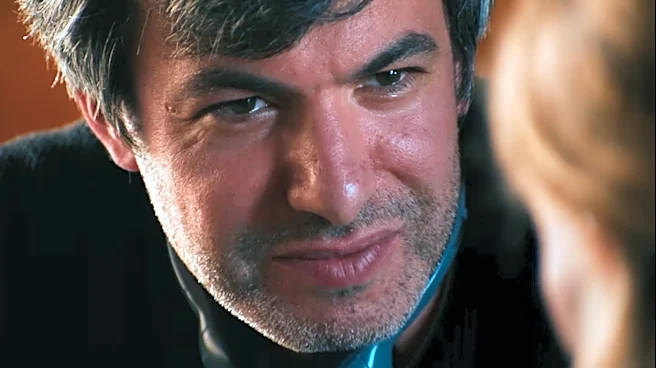
Directors Nathan Fielder and Lance Oppenheim strike a balance of humor, sincerity and skepticism that perfectly encapsulates the absurdity of this whole ordeal. Filmed over 34 days before Holmes surrendered to federal prison in 2023, Fielder’s stone-faced sarcasm exposes just how zany Holmes and her husband, Billy Evans, appear despite their manipulative appeals to innocence.
Through that piercing blue-eyed gaze, Holmes refuses to give clear answers about the Theranos scandal and how she ended up federal prison-bound.
Beyond flat-out denying responsibility, "I don't know" is her favorite answer. She repeatedly gets emotional about her impending prison time and how she’ll soon be separated from her two small children.
There are moments, though, that can be perceived as glimpses into Holmes’ psyche. One comes as a bit of tonal whiplash when Holmes’ father attributes an alleged rape at Stanford University to a permanent shift in his daughter’s behavior. Another comes when Holmes is unable (or claims to be unable) to get the central joke of Abbott and Costello’s classic comedy routine “Who’s on First?”
It’s clear that Holmes thinks, or wants us to think, that her brain operates differently than us mere mortals. Her husband uses this as justification for reaching out to Fielder, notably not a journalist, to conduct this documentary on his wife. This psychological “difference” also reduces her Theranos scammery to mere misinterpretation.
It's a clever way to blur Holmes' intentionally misleading decision-making. She either doesn't exist on the same plane of reality as the rest of us, or she’s so conniving that she knows she can hide behind a slight mushing of words.
When she claimed the Edison device could run hundreds of lab tests, she actually meant it was capable of running that many tests depending on the chemistries available – but the technology didn’t exist.
Who's behind the real Elizabeth?

The documentary especially boggles the mind in its second half, which focuses on Evans, the husband, and boasts a collaboration with actress Amanda Seyfried, who played Holmes in the Hulu miniseries "The Dropout."
Seyfried offers a more lucid view of Holmes than Fielder at this point. She interrogates claims that her role in the series is the reason for Holmes’ negative public perception and not, you know, the fact that she almost killed people.
Seyfried also reprises her role as Holmes to recreate conversations Fielder had with her before and during her prison sentence. Do the Seyfried-assisted dramatizations get us closer to the truth than Holmes would? Or does Fielder’s memory of these conversations elucidate reality even more?
While zooming in on Evans, we begin to question Holmes’ agency over this phase of her life. Her husband is clearly an ego maniac. The smirk on his face during a nude shower scene is our first indication that something is truly off about this guy.
It gets worse.
He allows some weirdo grifter to put the infamous image of Holmes holding a tiny blood cartridge on billboards around Los Angeles to promote his strip club theater production despite Holmes’ disapproval of said image (we watch him gaslight Fielder the director about this). Evans negotiated payment for the documentary without his wife’s knowledge, which confuses Fielder when Holmes reveals, on camera, that she’s not motivated by money.

Once Holmes is in prison, Evans, a Charlie Kirk fanatic, tweets from her X account and creates an unsettling artificial intelligence deepfake of her. When Fielder confronts Holmes about this, she simply shrugs it off and attributes it all to Evan’s unique way of doing things.
Fielder doesn’t read any duress or fawning, just a woman madly in love with her husband.
The Evans revelations left my jaw on the floor. I went into this thinking Holmes was using him for his money, but the documentary posits the exact opposite could be true.
The real 'Liz' remains unknown. That's the point
But whenever I’m inclined to extend an inch of sympathy to Holmes (she's clearly a victim of men in her life) I remember the lengths of her deception. This is a woman who, by all credible accounts, made strategic decisions to hide the ineffectiveness of her device, put hundreds of patients’ health at risk and whose legal threats might have led a whistleblower to suicide. To me, she knew what she was doing.
Holmes’ deception is not only underpinned by her compulsion to obfuscate truth, but also by her willingness to resign agency over her decision-making to avoid culpability. It’s what her defense team did with her ex-partner and Theranos executive Sunny Balwani during the trial and, if pattern recognition serves, it’s what she’s doing now with Evans. It’s not far-fetched to assume that she’s allowing her husband to run amok as a means of affording herself some victimhood later on. After all, the two are giving Theranos a second try.
As I wrote in my prior column, in a 2023 New York Times profile before heading to prison, Holmes adopted a new persona – a devoted mother named Liz. “You Can See Everything” exposes Liz's unintelligibility. She’s a master manipulator one second, but the ultimate victim of circumstance in the next.
Seyfried punctuates the film with my only concrete takeaway: "It's all so complicated."
Kofi Mframa is an entertainment and culture columnist at USA TODAY.
This article originally appeared on USA TODAY: Is Elizabeth Holmes a master manipulator or a victim? Yes | Opinion