





Outside the emergency room entrance, Katie Winschief floated above her body as paramedics put her in a wheelchair and rushed her toward the hospital doors.
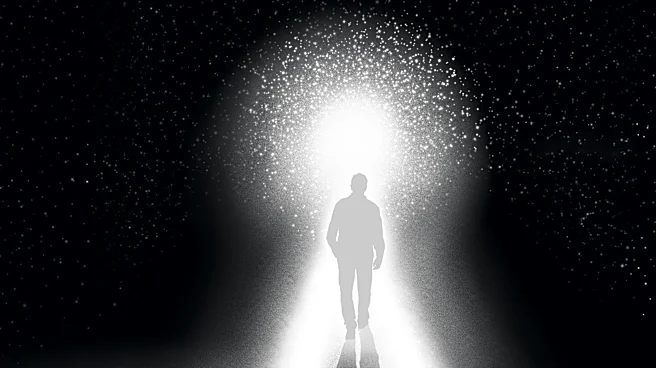
Everyone on the ground grew smaller as she drifted higher, until all she could see was their legs beneath the hospital awning. Within seconds, she could make out the top of the hospital and the mall next door. Off in the distance, she could see a glowing light that looked like a full moon.
“Where am I going?” she wondered.
In a flash, she was sucked upward, through the light and into an ethereal room without borders. She sat quietly, her knees pulled up to her chest. Across from her was a Jesus-like figure, with the most vibrant greenish-blue eyes she’d ever seen, sparkling like jewels. She’d
never felt such overwhelming joy. She never wanted to leave.
Then, disturbing scenes from her life started to appear. Her mother, crying after they’d had an argument. Anguish on her children’s faces. Then, the future: Her family broken by her absence, one of her children forced to live apart from the others because no one could care for all five of them. She knew she had to go back.

Instantly, she was jolted back into her body, lying on a gurney inside the trauma room at Sacred Heart Hospital in Pensacola, Florida, where the emergency room crew worked frantically to keep her alive.
“God help her,” she heard a nurse exclaim.
She drifted outside of her body again. She could see a small Indian man – a Catholic priest – at the head of her bed, rubbing oil on her and performing last rites. She could see her husband, Joe, in a different hospital room furnished with an artificial plant and ugly burgundy carpeting. He was bent over in a chair, crying.

Later, Winschief would come to understand what had happened. Her lungs had collapsed, and she had fallen into a coma. Her breathing stopped. Her heart quit beating.
She had seen, she was convinced, what happens when we die.
Does consciousness continue after death?
Everybody dies. And then?
For most of us, what happens next is a mystery. But millions of people like Winschief have returned from the precipice of death with remarkable tales of briefly entering an altered state of consciousness, one in which they existed outside their bodies and watched life around them unfold.
Researchers estimate that as many as one in 20 people have had a near-death experience. A study earlier this year suggested the number could be even higher. Nearly a quarter of American adults – more than 60 million people – reported having a near-death experience in a survey by the International Association For Near-Death Studies, a nonprofit based in Durham, North Carolina.
People can be reticent to talk about near-death experiences, but even some celebrities have discussedthese brushes with death. Elizabeth Taylor famously discussed having an out-of-body experience during a coma, while filming "Cleopatra." Jamie Foxx "saw the tunnel" during a medical emergency in 2023. And Jeremy Renner "could see everything all at once" while unconscious after being crushed by a snow plow in 2023, he wrote in his memoir.
Near-death experiences are frequently triggered by a life-threatening event, such as cardiac arrest, traumatic brain injury or a car accident. Every near-death experience is different. But many who’ve had them reported seeing an unearthly light or sensing they were floating through a tunnel. Some said they encountered dead relatives and friends or spiritual figures, like Jesus or Buddha. Often, they sensed their entire life flashing before them.
The phenomenon happens so often that some researchers say there is a growing body of evidence that consciousness continues at some level, for at least some period, after the body has died.

Dr. Bruce Greyson, a psychiatrist and pioneering researcher in the field, has studied more than a thousand cases of near-death experiences. Those cases “tell me enough to make me think that our consciousness does not end when our bodies die,” said Greyson, former director of the University of Virginia’s Division of Perceptual Studies.
More than 5,000 accounts of near-death experiences shared by people all over the world are published in a long-running registry maintained by the Near-Death Experience Research Foundation, a nonprofit founded in 1998 by husband-and-wife researchers Dr. Jeffrey Long and Jody Long to document and study such cases.
To be included in the registry, people volunteer a detailed summary of their experience and fill out a 64-question survey. The questionnaire asks, among other things, whether their experience was associated with a life-threatening event, whether they were separated from their body, whether time seemed to speed up or slow down and whether they seemed to enter some other unearthly dimension.
Their answers are analyzed and rated on a scale developed by Greyson in 1983 that has become the standard scientific tool to evaluate reports of near-death experiences. Scores of seven or higher out of a possible 32 points are considered credible.
Those who’ve had near-death experiences and some of the researchers who’ve studied them say that, while so much remains unknown, they strongly suggest the possibility of a post-death existence.
“We are now at a point in history where near-death experiences provide powerful enough evidence for the reality of a life after death,” said Long, a Kentucky radiation oncologist and author who has spent years studying near-death experiences.
Greyson said nearly five decades of studying near-death experiences has convinced him there is probably something after death.
“What it is,” he said, “I have no idea.”
'A light like I never saw again'
Nurit Niskala remembers every detail as clearly as the day it happened.
It was April 4, 1984. She was a young, healthy, expectant mother in Tel Aviv, Israel. But things went terribly wrong while giving birth to her daughter. She felt herself separate from her body and float away.
“I saw a light, a light like I never saw again, not even at sunset,” she recalled.
Niskala, who now lives in Southport, North Carolina, and other people who shared their near-death experiences with USA TODAY, provided copies of their medical records to support their accounts. While the documents don’t mention their near-death journey, they do confirm details of the medical crises they said triggered the experience.

Niskala’s labor pains started around midnight. She knew from a previous pregnancy how difficult childbirth could be, so she chose to have her delivery overseen by a gynecological surgeon.
When the doctor arrived, he injected her several times with Pitocin, a synthetic drug used to induce contractions. But the drug caused Niskala’s uterus to rupture in five places. The baby was delivered safely, but Niskala lost a dangerous amount of blood and was slipping into a coma when doctors wheeled her into surgery.
She felt as light as a butterfly as she separated from her body, “floating freely in an open space beyond time and place,” she said. “I was like air – something you can’t see or smell, only feel.”
She saw a cloudlike formation, a dark grey ball of energy that, like a magnet, pulled her toward it. Once inside, she saw other figures, which she assumed were souls of the deceased, moving together in a circle. She felt happier and more at peace than ever before.

But she said she felt she needed to return to her newborn and the 5-year-old daughter she’d left behind.
She awoke in her hospital bed, after her surgery at Assuta Hospital in Tel Aviv. She remained there for another two or three weeks. But she felt like she’d been born again.
More confident than before, she made several life changes. She ended an abusive relationship, left a good-paying bank job and started her own clothing company.
“God wants me here,” she believes. “Even the doctor told me, ‘It’s a miracle.’”
Science searches for an explanation
Near-death experiences seem so real that people who’ve had them often feel as if they’ve returned from the dead.
But being near death is not the same as actually being dead, said Dr. Kevin Nelson, a neuroscientist who has studied what happens to the body as it dies.
“Dead is irreversible,” said Nelson, a professor emeritus of neurology at the University of Kentucky.
Death occurs, Nelson said, “when the 100 billion neurons that constitute our brain trust – they burst. They burst like a balloon, like a water balloon bursting. If enough of those burst, then you are dead.”

During near-death experiences, he said, “people are lying there, and they look dead to most people. But they’re very much alive. They’re hearing. Most often, they’re seeing as well.”
Numerous studies have sought scientific explanations for what people experience during a near-death state.
A group of international scientists developed a model last year to analyze near-death experiences. They suggested what people have described during near-death experiences could be hallucinations caused by changes in oxygen, blood brain gases or other chemical or electrical activity in the brain.
The study was challenged by people who’ve had near-death experiences and by some researchers, including Greyson and his colleague, Marieta Pehlivanova, a research scientist at the University of Virginia.
The report’s conclusions, they wrote in their critique, fail to explain key components of the near-death experience. How, for example, some people report seeing deceased loved ones or people they’ve never met. Or how, unlike hallucinations, which are quickly forgotten, these encounters stay with survivors for decades.
Nelson said he accepts that, for many, near-death experiences are not a matter of science.
“Contemporary science has a pretty good idea of what’s going on with these experiences, but doesn’t address the why,” he said. “The ‘why’ is a matter of faith.”
'No way she could have known'
A frightened Joe Winschief waited for news from the trauma room where his wife was fighting for her life.
He had rushed her to Pensacola’s Sacred Heart Hospital after finding her unconscious on the kitchen floor that day, Jan. 20, 2015, and then had been taken to the waiting room, where he fought back tears.

Later, after his wife was out of danger, he was stunned to hear her “spot on” description of what she saw during her near-death experience.
She described what happened in the trauma room (the out-of-body experience, the medical team working frantically to save her, the priest rubbing oil on her body and performing last rites). She described how she said she saw him in the other room, even though she had never set foot there. She described the door with the small square window, the artificial plant, the burgundy carpet, the chair he was sitting in and how he had positioned his elbows on his knees as he wept.
“There’s no way she could have known the stuff I was doing and even what I was wearing,” he said. “We had changed clothes from when we were at the house, so I wasn’t wearing the same thing.”

A few months later, unable to shake the image of the priest performing last rites, Katie Winschief called the hospital and described him to the staff there. She learned he was Rev. George Thekku of St. Jude Thaddeus Parish in nearby Cantonment, Florida. She called him and thanked him for all he had done.
Father Thekku, who had been the hospital’s on-call priest that day, told USA TODAY he vaguely remembered attending to her at the hospital. But the passage of time and the fact that he saw multiple patients every day during his work there left him unable to recall specific details, he said.
Winchief’s ability to describe a room she hadn’t seen or events she could not have witnessed is not unusual among people who have a near-death experience.
Greyson, the psychiatrist and researcher, recalls trying to talk to an unconscious woman brought into the emergency room early in his career. He couldn’t rouse her. In another room, about 50 yards down the hall from the noisy, crowded ER, he interviewed her roommate.
The patient woke up the next morning and startled Greyson by saying she remembered him from the night before. He grew even more puzzled when the woman recounted the conversation he’d had with her roommate, what they were wearing and what the room looked like.
“There was no way she could have known about this stuff,” Greyson said. “She couldn’t have had any visitors or phone calls in ICU overnight. She had just woken up a little while before I talked to her.”
'It was real'
Sheila Boester was swimming among soft, beautiful clouds, surrounded by a soothing sound – like music, but not music. Something else. Something she’d never heard before or since.

Her sister Brenda, who had died years earlier of an epileptic seizure, when she was only 18, was waiting. Her uncle and grandparents – all dead – were there, too. They communicated without speaking. Sheila Boester’s son had been just a year old when her sister died. But Brenda told Boester how much she had enjoyed watching him grow.
Boester, a nurse, saw one of her former patients. They had grown close, and she had held his hands as he died a few years before. He told her she had more life to live, more things to do on earth.
“They all kept telling me, ‘You need to go back. It’s not your time yet,’” Boester said.
She slammed back into her body so hard it felt like she’d fallen from the top of a high-rise and landed on a concrete slab.
She was suddenly back at St. Anthony’s Hospital in St. Louis, where she’d had routine back surgery for a bulging disc. But during the operation, the surgeon lacerated her aorta. The bleeding was severe, her blood pressure plummeted, her breathing and heart function stopped. Doctors later told her they’d been unable to detect her pulse during the brief period she’d felt separated from her body.

Boester, who lives in Crystal City, Missouri, is still processing what happened to her that day, July 20, 2000. She’s not afraid of death. Not anymore. She even went skydiving.
She has heard the theories behind near-death experiences. She believes in science and has asked herself a million times if there’s a scientific explanation for what happened to her.
But science has yet to explain it, she said – it wasn’t a hallucination, a delusion or the distortion of an oxygen-deprived brain.
“It was real,” she said.
No one, she said, will ever convince her it wasn’t.
Michael Collins writes about the intersection of politics and culture. A veteran reporter, he has covered the White House and Congress. Follow him on X: @mcollinsNEWS
This article originally appeared on USA TODAY: Near death experiences are real, some experts say. What survivors saw