







This is the second column in USA TODAY Opinion columnist Rex Huppke’s ongoing series, America’s Looming Farm Crisis. To understand why what’s happening to farmers today matters to us all, it’s important to look back on the devastating 1980s farm crisis and the toll it took on farmers and the country as a whole.
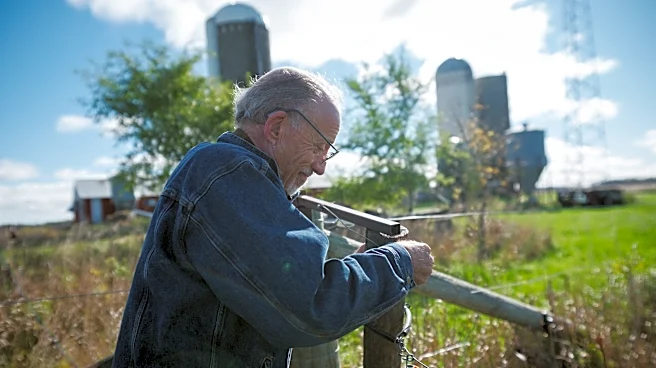
CLINTON, Minnesota — For Mike Jorgenson, a memory from the 1980s farm crisis remains vivid as a photograph. He had returned to his western Minnesota home in 1978 to partner with his parents on their dairy farm. For his portion of the operation, he took out loans, which were perilously easy to get then as the government encouraged farmers to borrow big and grow big.
But after a couple of years of drought in the early 1980s, trouble set in.
President Ronald Reagan signed a farm bill that cut government subsidies for dairy farmers. Interest rates jumped above 20%. By 1985, Jorgenson needed to borrow money to pay for seed and fertilizer to grow crops to feed the cows, but the rates were too high. He had no path forward.
“I came home, and I sat at the end of the driveway, trying to figure out a way to drive in and tell my parents that I couldn't do this anymore,” recalled Jorgenson, 68. “I went back to school, and dad and mom kept milking all those cows all by themselves, and that was really tough. Those were tough years for everybody.”

Tough doesn’t do the '80s farm crisis justice. It was a period of absolute devastation for American agriculture, one that wiped out farmers across the country and gutted large swaths of rural America.
Some farmers are recalling the 1980s crisis as warning signs flash
Farming recovered, but it and the once-vibrant small towns it supported have never been the same. Now, with farm bankruptcies hitting a six-year high in April, farm debt at an all-time high and the soaring costs of fuel and fertilizer making it near impossible for many farmers to break even, people like Jorgenson and his wife, Kathy Draeger – people who know and understand both farmers and farming – see warning signs of another crisis on the horizon.
While there are significant differences between the run-up to the 1980s farm crisis and what’s happening in farming today, understanding the history of that decade is crucial to recognizing the seriousness of the moment we’re in.
I know the state of agriculture won’t be high on most people’s lists of most important issues, but the families who farm the land in America are a vital-if-nearly-invisible part of our everyday lives.
Farmers don’t just provide the products that keep grocery store shelves and produce aisles stocked. They tend the land for future generations, and their ability to keep doing the work they love and ensuring we have a sound domestic food supply is key to our national security.
So let’s look back on what went wrong in the 1980s and the harm that followed, and use that as a historical reminder of why what’s happening today is of profound concern.
Few saw the 1980s farm crisis coming, as feds encouraged farms to grow
A full understanding of the collapse of the U.S. farm economy in the 1980s is complex, but this is a nuts-and-bolts summation: Through much of the 1970s, farming was booming and the federal government, under Agriculture Secretary Earl Butz, encouraged farmers to borrow money to expand so they could plant “fence row to fence row” and “get big or get out.”
Interest rates were low and land values were rising, so farmers felt they had solid collateral for their loans and a chance to expand their operations for themselves and future generations of their families.
But by 1979, Federal Reserve Chairman Paul Volcker, serving under President Jimmy Carter, started dramatically raising interest rates to combat inflation. Commodity prices dropped, as did the value of farmland, and many farmers were stuck with crushing debt payments on loans worth more than their collateral.
That led to foreclosures, widespread bankruptcies and the failure of many rural banks. It was like economic bombs started going off in all parts of rural America.
'The agriculture-dependent Midwest would never be the same'

Pamela Riney-Kehrberg is a distinguished professor at Iowa State University and author of the book “When a Dream Dies: Agriculture, Iowa, and the Farm Crisis of the 1980s.”
Of the farm crisis’ final toll, she told me: “The farm crisis happened all over the United States. It takes down 15% of the farmers nationwide. The numbers vary in the Midwest, but they are in excess of 20% of the farmers being taken out in that decade by the crisis. That can't help but have an effect on all kinds of other businesses. In particular, small communities suffer horrendously, and they lose schools, they lose churches, they lose hospitals, they lose businesses.”
As Riney-Kehrberg wrote in her book: “The Midwest – the Iowa – that entered the agricultural downturn was not the one that emerged a decade later. The agriculture-dependent Midwest would never be the same. Too many farms were lost and too many small towns gutted.”
You can see it still today in the layout of rural America. While a few small towns' downtowns have found ways to renew themselves, many are shadows of what they once were, mixes of shuttered storefronts and small business struggling to survive.
The local grocery stores and restaurants have often been replaced by collections of Dollar General stores, sprawling Kwik Trip gas stations and occasional Walmarts just off the interstates that carve through farm country. Schools have consolidated as the children of farmers saw no future in agriculture and moved away. Basic services for people in rural counties are fewer and harder to reach.
'We lost so many people just off the landscape'

Back in western Minnesota, Jorgenson told me that after he left his farm in the '80s, he finished his college degree and became an agronomist. He later met and married Draeger, who is executive director of the Minnesota Institute for Sustainable Agriculture and an adjunct professor at the University of Minnesota. The couple bought and moved back to the Jorgenson family farm in Big Stone County in 2007, resuming farming while Draeger maintained her off-farm job.
The driveway Jorgenson sat in, contemplating telling his parents his farm dream was ending, still stretches about a half-mile to the cozy white farmhouse he grew up in, flanked by cows grazing a paddock on one side and tidy rows of corn on the other.
From the home’s dining room table, Draeger, framed by a broad window looking out on fields of corn to the east, recalled the decimation of the 1980s.
“I mean, we lost so many people just off the landscape,” she said, pointing past the field where their cattle graze. “There used to be a farm straight out there. There used to be another one, kitty corner. There was another one there. You can see the one on the corner is collapsing. There were farms all around here, and now it's depopulated.”
Pam Johnson, a retired Iowa farmer and past president of the National Corn Growers Association, recalled a scene from the 1980s, outside a rural courthouse: “There were white crosses for all the farms that had gone under, and then there were farm sales, and sometimes at these farm sales, everything was being sold – tools, machinery, everything the farmer owned in order to pay off his debt.”
Listen to those who lived through the 1980s farm crisis
A study by the National Farm Medicine Center found that in just five Upper Midwest states – Minnesota, Montana, North Dakota, South Dakota and Wisconsin – more than 900 male farmers died by suicide during the 1980s.
Shame and anger spread like an epidemic. Rural America became a recruiting ground for opportunistic anti-government militia groups eager to weaponize pain and frustration. The 1995 bombing of a federal building in Oklahoma City that killed 168 people, including 19 children, was a byproduct of that era.
So when the people who lived through those times are telling us they're worried about another farm crisis, it is well worth paying attention. Johnson spoke of the present-day struggles farmers face and said: “This does remind me so much of the '80s.”
Brian Kuehl, a principal at Pinion, a national advisory firm that works with the agriculture industry, said: “What I hear anecdotally is that this farm crisis is getting as bad as what was in the '80s. It's different. Back then there was a different squeeze on farmers. But what I do know is farmers have now had multiple years of declining income.”
The '80s farm crisis happened slowly – then all at once

Johnson, the retired Iowa farmer, is now part of a bipartisan coalition of current and former farmers along with former heads of U.S. agriculture organizations called Restore American Agriculture. The group has called on Congress to address “the farm crisis” and is actively clanging bells to get folks to listen.
They should. We should. One subtle line in Riney-Kehrberg’s book on the 1980s farm crisis leaped out at me: “One of the barriers to understanding this crisis is that there was no single ‘ah-ha’ moment when everyone knew there was a problem.”
In other words, as the decade of the 1980s began, the farm crisis happened slowly, then all at once.
We can’t let that happen again.
Email USA TODAY columnist Rex Huppke at rhuppke@usatoday.com. Follow him on Bluesky at @rexhuppke.bsky.social and on Facebook at facebook.com/RexIsAJerk.
This article originally appeared on USA TODAY: 1980s farm crisis surprised farmers. Some see it happening again | Opinion