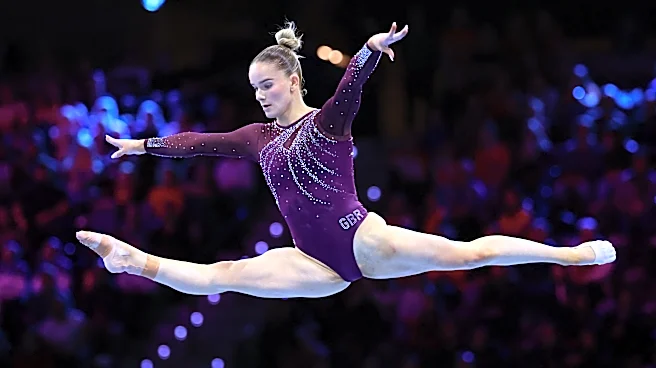








Even though Alice Kinsella didn’t make the podium at the recent world gymnastics championships, the British gymnast still left her mark.
One that might still be felt years from now.
Kinsella competed at worlds just 13 months after giving birth to son Parker. While top gymnasts competing well into their 20s is now the norm, it’s a rarity – think unicorn or pot of gold rare – for a gymnast to return to elite-level competition after having a baby. Not only has Kinsella done that, making both the all-around and floor exercise finals at worlds, the 25-year-old is the subject of a study tracking what she did during her pregnancy and after Parker’s birth that made it possible for her to return in such a short period of time.
"It shows if I’m getting stronger,
weaker, which I think is really, really helpful,” said Kinsella, a bronze medalist with Britain at the Tokyo Olympics. “I think it's really, really good and it will help – if other gymnasts do it, it will help with their (return) as well."
Women athletes have had to choose between sport, family
The question of when, or if, to have a child rarely has an easy answer, and even less so for women athletes. Their prime child-bearing years overlap with the peak of their athletic careers and, until recently in most sports, they were often forced to choose between the two.
Part of that was due to a lack of support, including maternity leave, child care and logistical support for breastfeeding. Allyson Felix, Kara Goucher and Alysia Montano are among the athletes who've detailed the hospitality they experienced from sponsors over their pregnancies.
But there is also a historic dearth of research focused specifically on women athletes, and studies on the impacts of menstruation, fertility, pregnancy, childbirth and postpartum on athletic performance are scant, at best.
“I cannot believe it’s 2026 and we still have the gap we have in male vs. female research,” said Julie Gooderick, a professor in sports rehabilitation at the University of Kent who is leading the study on Kinsella’s return. A paper on it, "Returning to sport postpartum: A case study of an elite gymnast" is expected to be published sometime next year.
"It’s positive on the one hand because we are at least now talking about it and we are recognizing the gap. But we need to be so much more proactive than we are."
Athletes who are also mothers are more prevalent in some sports, like soccer and running, than others. In those sports, there are recommendations for training during pregnancy and return-to-play protocols. Gymnastics has not been one of those sports.
Until now.
“It’s never going to be an exact blueprint that you’re going to take and copy for the next gymnast that chooses to get pregnant. But there will be aspects that you can take,” Gooderick said.
Strength training at core of Alice Kinsella's return
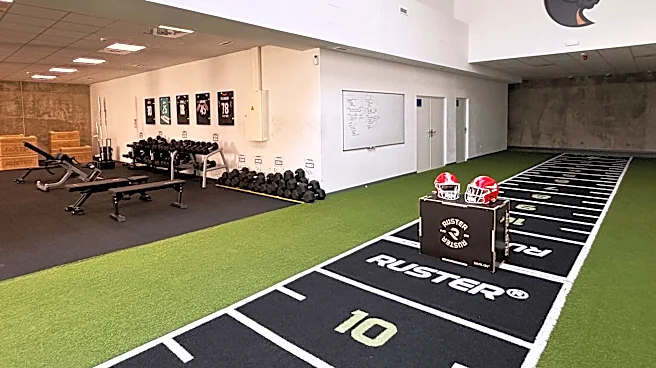
Kinsella’s return was centered around strength training. She continued to do lighter weights and conditioning throughout her pregnancy, reducing the loads as she neared childbirth.
"She didn’t lose that much strength, because we'd been able to go from more complex exercises to simpler exercises. A leg press for example, we slowly lowered the intensity of those,” said Ben Young, the senior strength and conditioning coach for British Gymnastics.
When Kinsella returned, about six weeks after having Parker, she and Young took the data from her workouts and did the reverse.
“It was basically like an inverted U, it builds up back from where she was,” Young said. “It allowed her to kind of assess her strength levels improving.”
But Kinsella simply regaining her strength wasn’t enough. Young’s training plan had her targeting specific, gymnastics-centered areas. The places her body needed to be strong to do the leaps and landings necessary in gymnastics. Her spine and shoulders. Her back and core. Her knees and ankles.
She also did isometric exercises in positions that mimicked what her body would be doing in gymnastics.
“So she became really strong through the whole spine, hips, the knees, ankles. But in isolated positions,” Young said. “It meant we could get really ahead of the game in terms of her tolerance to land and be impactful.”
Kinsella was cleared to resume high-impact, strenuous activities about 12 weeks after having her son, to ensure her abdominal muscles had healed. Upon that return, Young and Gooderick did frequent strength tests and let the data guide what Kinsella did in the three and four days a week she trained.
Alice Kinsella competes again six months after having son
Kinsella was back competing in March, finishing fourth on balance beam at the British Championships. In September, a year after having Parker, she won the all-around at a meet with France, Switzerland, Germany and Italy.
At worlds, Kinsella finished 13th in the all-around. She was eighth in the floor final, largely because of a lower difficulty score than the other seven gymnasts, but tied for the second-highest execution score.
“The most surprising thing really is just the speed of the return,” Gooderick said. “But also understanding that everything was done very properly. It wasn’t a quick return because we cut corners. It was a quick return because actually she was recovering really, really well, and the numbers were suggesting that we were safe to do more and more and more.”
Kinsella said she actually feels stronger than she did before she got pregnant, and Young said their data confirms that.
On one test, in which Kinsella is face down and presses down with her hand, she scored a 2.4 — well above the 1.8 that Young said is the target. Her triceps score has doubled, and Young said she’s increased her biceps score by a third.
“A case study like Alice’s shows that if you really are dedicated to physically progressing yourself, anything’s possible,” Young said.
Including having a baby and returning to elite-level gymnastics.
“If somebody doesn’t want to have a child mid-career, that’s absolutely their choice,” Gooderick added. “But certainly nobody should be feeling like they can’t because of a lack of knowledge or fear that they would never be able to come back. The more we can normalize this, the better.”
Having gotten this strong in just 13 months, Kinsella is excited to see what she can accomplish in the next 18 months as she eyes the 2028 Summer Games in Los Angeles.
“I’m really looking forward to the journey ahead,” she said “It’s going to be a very, very exciting one.”
This article originally appeared on USA TODAY: A British gymnast returned stronger after childbirth. Researchers are studying why