






NASA is calling off an ambitious mission to save a prized space telescope from plummeting back to Earth and being destroyed in the atmosphere.
The Swift Observatory has been observing the cosmos for more than two-decades, but its rapidly declining orbit has put it in jeopardy of reentering Earth's atmosphere and burning up. NASA had sought to prevent the telescope's demise by mounting a rescue mission sending a commercial spacecraft to grab Swift and boost it back up to a higher orbit.
A successful operation would have extended the life of the Swift Observatory by several more years, saving the U.S. space agency money needed to launch a replacement. It also would have marked the first time that a commercial robotic spacecraft captured a government
satellite that – unlike other spacecraft like the Hubble Space Telescope – was never meant to be serviced in space.
But the spacecraft sent to save Swift found itself in harm's way when it began spinning out of control less than a month into its mission.
“NASA should be willing to move quickly and take smart risks when the potential return is worth it, and that is exactly what we did with this mission,” NASA Administrator Jared Isaacman said in a statement. “This is not the outcome we were working toward, but it does not change why this mission was worth attempting."
Here's what to know about the Swift Observatory, and why the venture to save it failed.
What is the Swift Observatory?
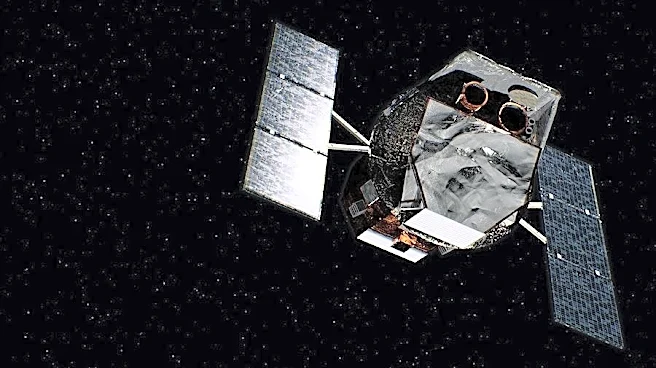
Launched in 2004, NASA's Swift Observatory has spent more than two decades orbiting Earth while studying a variety of cosmic phenomena. The satellite's primary objective, though, is to observe gamma-ray bursts – events triggered by the catastrophic deaths of massive stars and considered to be the most powerful types of explosions in the universe.
The satellite is equipped with three multiwavelength telescopes that are able to collect data in visible, ultraviolet, X-ray and gamma-ray light.
NASA calls off mission to rescue Swift Observatory
Residing in a region of space known as low-Earth orbit that is closer to the planet's atmosphere, the Swift Observatory had begun falling out of orbit faster than NASA has anticipated due to increased solar storms since fall 2024.
Now, NASA says a mission to rescue the space telescope by sending another spacecraft to boost it to a higher orbit won't be possible. The development, which NASA announced Wednesday, Aug. 19, comes more than a month after a Northrop Grumman rocket helped launch the rescue spacecraft to space following a July 3 liftoff from the Marshall Islands.
With no rendezvous with Swift in store, NASA's satellite will fall back to Earth later in 2026 and harmlessly burn up as it blazes through the atmosphere.
"NASA will continue to prioritize finding new options to react rapidly to cosmic events, using current missions to help fill the gap in the meantime," the agency said in a statement.
Spacecraft sent to boost NASA telescope encounters trouble
The ignominious end to what NASA referred to as the "Swift Boost" mission is due to troubles encountered with the spacecraft sent to rescue the observatory.
Arizona-based Katalyst Space developed the 5-foot-tall LINK spacecraft with a $30 million contract from NASA.
Powered by 20 feet of solar panels, the 880-pound spacecraft managed to establish communications the same day as the launch and send a signal back to Earth confirming its power systems were working as planned. The plan would have been for LINK to travel toward the Swift Observatory and grab the telescope with its robotic arms before raising its orbit to nearly 370 miles high.
But before LINK could begin its approach toward Swift, NASA reported that LINK "experienced issues" causing the spacecraft to spin out of control and send only sporadic communications to Earth. Despite efforts to slow LINK's spin rate with a series of electric propulsion thruster burns, Katalyst was unable to stabilize the spacecraft.
Katalyst, NASA announce new objective for LINK
While LINK will not capture and boost the Swift Observatory, Katalyst and NASA announced a new objective for the spacecraft: simply "conduct rendezvous and proximity operations" near the telescope to gather data to inform similar missions in the future.
“Katalyst designed, developed, and launched an experimental spacecraft to go after an ambitious mission on an aggressive timeline," Kataylst Space CEO Ghonhee Lee said in a statement provided to the USA TODAY Network. "We took on this high-risk, high-reward challenge and are proud of the milestones we reached along the way."
Eric Lagatta is the Space Connect reporter for the USA TODAY Network. Reach him at elagatta@usatodayco.com
This article originally appeared on USA TODAY: NASA's mission to save Swift Observatory fails. Here's what went wrong