


On a September day in 2006, a little red vehicle came tearing down the street toward a car meet organized by John Voelcker.
Voelcker, now a contributing editor at Car and Driver who has covered electric vehicles for 20 years, had no idea what he was seeing.
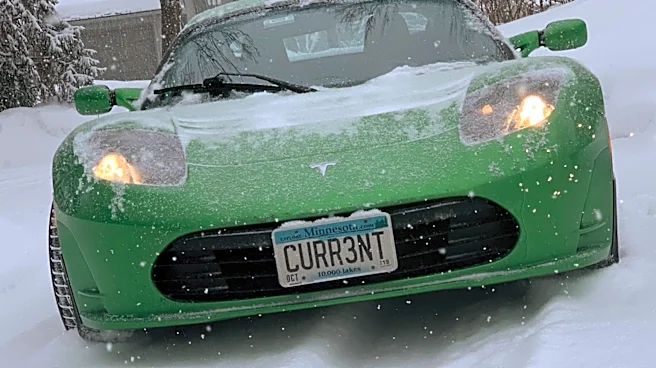
He had been corralling the vehicles attending the meet when the car approached. As it grew nearer, he realized it was a 2006 Tesla Roadster — a prototype vehicle from Tesla Inc., which was, at the time, a relatively unknown, wild-card company more akin to a tech startup than an automaker.
Voelcker had invited Tesla to the meet, though he didn’t expect its attendance. At the time, Voelcker asked Tesla to join on a whim, thinking it could be cool for attendees to see something novel.
It evoked
some hemming and hawing from Tesla — an automaker notoriously hesitant to deal with the press — but Voelcker made his case: There were going to be 800 cars there, many of them owned by wealthy Silicon Valley residents who might be interested in buying one.
And Voelcker struck a deal: if Tesla sold a car, he’d get a ride. By the end of the day, an attendee had written a $95,000 check for a Roadster, and Voelcker cashed in on his ride.
He has since described the experience as one that permanently changed him.
“What that (experience) taught me really was that the Tesla Roadster — as creaky, primitive and somewhat uncomfortable as it was — was a real car that did real car things with really staggering levels of performance,” he said.
At the time, electric vehicles were not a new concept, but were still viewed as moonshot pipe dreams, not so much a practical business proposal. The Roadster, of which Tesla built only about 2,500, convinced Voelcker otherwise.
It’s now been 20 years since Voelcker’s first ride in a Tesla. Over those two decades, Voelcker has watched as Tesla has morphed from an ambitious startup to an industry leader under the guidance of the controversial Elon Musk.
On Oct. 15, Musk addressed an audience of reporters, fans and investors and orchestrated an outlandish display: The sleek, next-generation Roadster — a promise nine years in the making — scaled a ramp, flew through the air and flipped in a scene that seemed to be pulled from an episode of The Jetsons.
Theories abounded about how the company actually got the car to fly and tumble through the air. Tesla stock jumped. And Voelcker, who has been tracking Tesla for 20 years, sighed.

Flying car is a ‘sideshow’
The Roadster, if it lives up to Tesla’s claims, will “crush every track record that has ever existed,” Musk said when he debuted the vehicle in Waco, Texas, earlier this month.
Indeed, some of the automaker’s claims are astonishing: A top speed over 200 mph and a 0.81-second 0-60 is nothing to scoff at. Tesla's website says there will be three levels of Roadster: A street-legal "Performance" version; a "Thrust" version, made for race-track driving, with "cold gas thrusters" that propel the vehicle to 0-60 in under one second, and the "Rocket" Roadster, which is not street legal but can fly, Tesla says.
While the car may be capable of great feats (Voelcker was, however, unwilling to speculate on whether the car really was flying in the demonstration), it’s not the type of product that will drive growth for Tesla, something the automaker may need as its sales have largely stagnated since 2023.
Tesla first teased the Roadster in 2017. Currently, the company says the new Roadster won’t be released until 2028, making for an 11-year build-up for the low-slung, uber-fast EV.
Even by Tesla’s standards, Voelcker said, the timeline for the Roadster is unusually long (the automaker famously takes a long time to launch new products and refreshes its portfolio rarely).
To him, the product’s drawn-out timeline and limited business case make it less important than the company’s broader decisions about what vehicles to build and where to invest as the EV market contracts with fewer federal incentives and more pressure from EV makers in China.

Tesla’s next Roadster may attract attention, but it is “not going to be a driver either of notable revenue or notable volume growth,” Voelcker said. “My take on this new Roadster is that it was a sideshow,” he added.
The original Roadster was a different story, one that helped Voelcker believe in the future of EVs and convinced him that Tesla was more than a Silicon Valley novelty.
In 2006, the original Roadster showed him that an electric vehicle could be something more than “a golf cart” or “a nerdy little box that gets 50 miles,” but “actually a real car,” Voelcker said.
That conviction has proven to be true, as EVs have become a practical choice for some car buyers. And among the United States’ key EV players, Tesla has largely led the pack in sales.
But now, with Musk “becoming interested in very different technologies and effectively taking his eye off the ball of what sells cars in the mass market,” Tesla may have lost an opportunity to continue dominating the EV space with cheaper EVs produced at scale, the likes of which are pouring out of Chinese factories and into other markets today.
What about an affordable EV?
Three years after the promise of the next generation of Roadster, Musk promised in September 2020 to release a $25,000 EV “about three years from now.”
Six years later, no such vehicle has been released. Instead, the automaker is getting ready to launch the flying Roadster on the heels of the release of the slow-selling, $75,000 Cybertruck, which Voelcker called “one of the most notable automotive product face-plants.”
The Cybercab, on the other hand, has potential to be a worthwhile product for Tesla if it can live up to the company’s ambitious production goals.
In 2024, Musk told investors the company could eventually produce up to 2 millionof the driverless vehicles annually, with mass production beginning in 2026. Production began in April, with Tesla currently claiming a production capacity of about 125,000 Cybercabs per year.
Neither Cybercab nor truck, however, are as promising as the seemingly abandoned project of the cheap EV Musk promised in 2020, Voelcker said.
“It was a great disappointment that (Musk) walked away from that $25,000 EV because three or four years ago, if any company in the world (outside of China) could have made a believable $25,000 EV and sold it in volume, it was probably Tesla,” Voelcker said.
Now, it may be too late in the game.
“The auto business is a really hard, long product cycle, heavily capital-intensive, very challenging one,” Voelcker said. “And going into mass volume, price competitive stuff is even harder.”
Still, he cautioned against writing Tesla off despite his concern over their business and his own lukewarm response to the flying car.
“There are two decades of journalists, analysts, commentators and whatnot who have learned through painful experience never to count Tesla and Mr. Musk out,” said Voelcker.
He would know. He's been around for all 20 of those years.
Liam Rappleye is an automotive reporter for the Detroit Free Press. Contact him: LRappleye@freepress.com.
This article originally appeared on Detroit Free Press: Tesla made the Roadster fly. Expert says its $25K EV mattered more