



Derek Godfrey was a youth gymnastics coach when federal authorities raided his northern California home in 2006 and found hundreds of videos and photos depicting sexual abuse of children.
A day later, he fled to the Netherlands.
Godfrey was still coaching gymnastics six years later, in Perth, Australia, when police there arrested him after finding more than 6,000 videos and images of child pornography on his devices. He was extradited to the U.S. and sentenced in 2018 to more than eight years in prison.
The loophole that helped Godfrey continue working in close proximity to youth athletes as he moved from country to country remains open. Closing it is one of the priorities for Gymnasts for Change, a group trying to draw attention to the problems
that remain 10 years after Larry Nassar was first charged with sexually abusing athletes under his care as a physician with Michigan State University and USA Gymnastics.
“Across the board, there is unanimous support and outrage there is no international banned and sanctioned coaches list,” said Claire Heafford, CEO of Gymnasts for Change.
“There’s, at some level, a governance issue with inadequate procedures and processes to handle these kinds of complaints,” Heafford said. “(But) it’s a very, very vulnerable population. It requires much higher levels of protection.”
Hundreds of gymnasts abused in Larry Nassar scandal
At the Nov. 22, 2016, news conference announcing the first charges against Nassar, Michigan’s attorney general said more than 50 women had made complaints against the physician. More than 300 women, including Olympic champions McKayla Maroney, Simone Biles and Aly Raisman, would eventually come forward to say Nassar had abused them.
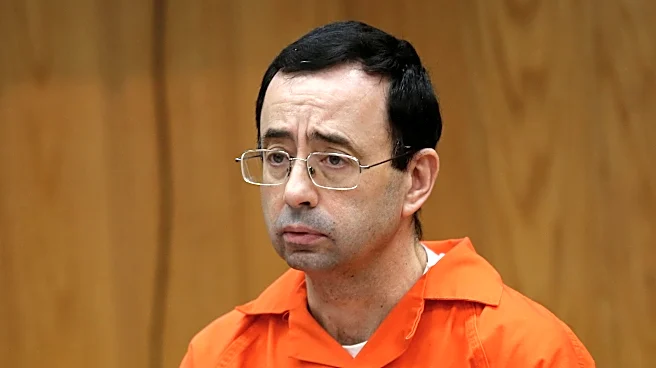
Nassar is currently serving an effective life sentence after pleading guilty in 2017 to federal child pornography charges and state sexual abuse charges.
Though there had been abuse scandals in other sports, the number and names of athletes Nassar had abused finally prompted changes in the United States. The Center for SafeSport opened in March 2017 to handle abuse claims in the Olympic and Paralympic movement.
As part of that work, SafeSport operates a searchable registry of people who are under investigation or who have been sanctioned for abuse. The database includes the person’s sport, the type of misconduct and the discipline.
But the registry only covers the United States. And, as Godfrey’s case showed, abusers can cross borders because there is no global way to track them.
“Within the U.S., I think things have gotten better. But I still don’t think it’s enough,” said Aimee Boorman, who was Biles’ first coach and has since coached in the Netherlands and Germany.
“Coaches can have a huge file of complaints, and justifiable complaints, in one country and then just go to another country and get a job. We see that as a systemic problem,” said Boorman, who is working with Gymnasts for Change.
“If we keep just allowing coaches to travel from country to country, they’re just leaving a string of abuse in their wake. And that’s bad.”
Advocates want a broader definition of abuse
Gymnasts for Change is also pushing for the definition of abuse to be expanded to include what Heafford calls non-contact physical abuse with coercive control. A coach demanding a gymnast do the same routine over and over despite being tired or ill or injured, for example. Or insisting athletes come to practice even when they’re sick.
That kind of manipulation leads gymnasts to believe they don’t have agency, and it helped create the atmosphere that allowed Nassar to prey on young athletes.
“Me personally, I want to attack this from the grassroots (with) the education of the coaches from early on,” Boorman said. “A barrier to that is we have these abusive coaches traveling around the world to different countries. Then we have younger coaches training under them so they think that action is OK. And then they’re going to our grassroots programs and they’re treating the children this way. And then the children grow up and think that’s how they’re supposed to be treated.”
Gymnasts for Change held news conferences and workshops during the world gymnastics championships last month in Rotterdam, Netherlands. It hopes that visibility will put pressure on World Gymnastics and individual national federations to be more proactive about protecting young gymnasts.
Because 10 years after Larry Nassar’s initial arrest, there is still work to be done.
“Why are we talking about protecting children but not actually protecting children?” Boorman asked. “It makes my blood boil.”
Follow USA TODAY Sports' Nancy Armour on social media @nrarmour.
This article originally appeared on USA TODAY: 10 years after Larry Nassar, gymnastics still has an abuse loophole