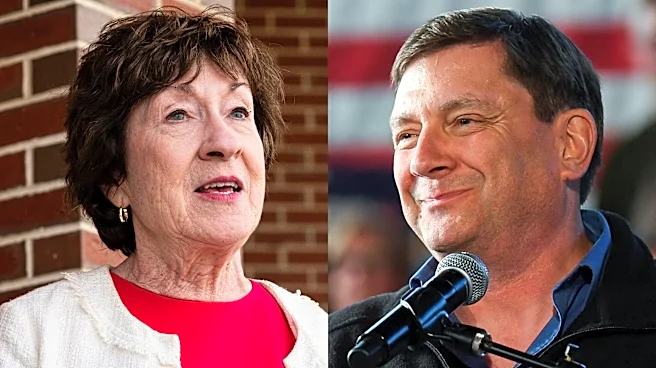






The crucial Senate race in Maine is a coin-toss, a new Suffolk University Poll finds, with Democratic challenger Troy Jackson at 49% and Republican incumbent Susan Collins at 47%.
At stake in the contest could be control of the Senate.
As Democratic candidates surge in competitive Senate races across the country, Collins has managed to stay all but tied by holding a narrow edge among independent voters and even drawing a 14% slice of those who disapprove of President Donald Trump.
The survey of 500 likely voters, taken by landline and cellphone Oct. 8-11, has a margin of error of plus or minus 4.4 percentage points.
"Either through her seniority as senator, her branding as a moderate, or possibly from disgruntled Graham Platner voters who were forced
to relinquish his Democratic Party nomination, somehow Collins is starting to erode the Democratic base of Jackson just enough to keep the race close," said David Paleologos, director of Suffolk University's Political Research Center. "As of today, the race hasn't broken open."
Platner withdrew from the campaign in July after a former girlfriend accused him of rape and sexual abuse. He has denied the allegations.

Gains among independent voters have boosted Democratic Senate nominees Josh Turek in Iowa and Abdul El-Sayed in Michigan, both key races, in recent Suffolk surveys.
To win control, Democrats must flip four Republican-held seats and hold all the Democratic ones.
In Maine's campaign, Collins has emphasized her independence from Trump, while Democrats have sought to tie her to the president, including her critical vote to confirm Supreme Court Justice Bret Kavanaugh.
Looking at crossovers: Collins has gotten support from 5% of the voters who reported backing Democrat Kamala Harris in the 2024 presidential race. That's more than the support Jackson gets from just one of the 237 respondents who said they had backed Trump.
A vote against the times, not for a candidate
The poll found a pessimistic public, disgruntled by the nation's politics.
The most frequent motivation cited for voting in the midterms was "expressing dissatisfaction with the current national political climate," followed closely by "fulfilling my civic duty." Only one in 10 said they were voting to support a specific candidate's vision.
Trump's disapproval-approval rating was a dismal 57%-37%. Even more, 64%, said the country was "on the wrong track."
Nearly 6 in 10, 58%, rated economic conditions in Maine as "poor." Only 7% said they were excellent or good.
The cost of gas and fuel prices topped the list of economic issues impacting their household budgets, cited by 36%. That was nearly double the No. 2 issue, grocery costs.
Worries about a cold winter
Heating oil is a particularly powerful issue in Maine, where about two-thirds of households use petroleum products to heat their homes, the highest of any state. As winter approaches, disruptions from the Iran war and the Russia-Ukraine conflict have contributed to fuel prices that have neared record highs.

In the governor's race, Democrat Hannah Pingree led Republican Robert Charles by double digits, 49%-38%. Independent Rick Bennett was backed by 8%, with 5% undecided. Term limits prevented the Democratic incumbent, Janet Mills, from seeking a third term.
The two Senate candidates met the night of Oct. 13 in the third of four scheduled debates.
Susan Page, the Washington Bureau chief of USA TODAY, has covered the past 12 presidential elections.
This article originally appeared on USA TODAY: Susan Collins, Troy Jackson in a coin toss, Maine Senate poll finds