



A 5.0 magnitude earthquake shook the Los Angeles area early Saturday morning, seismologists say.
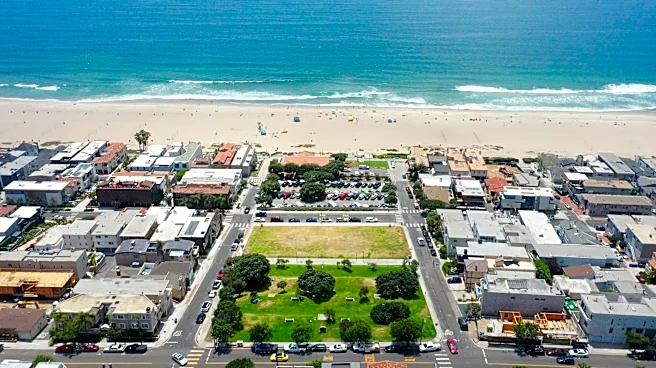
The tremor, which was about 8 miles deep, hit about 4 miles west southwest of Manhattan Beach at 9:30 a.m. on Nov. 28, according to the USGS.
The fault that caused the quake was not immediately known, but the epicenter was 2.1 miles southwest of Compton thrust fault, according to the USGS fault database.
In a post on X, the California Governor's Office of Emergency Services said it is working with local officials to assess potential impacts.
The National Tsunami Warning Center said there is no tsunami danger from the quake.
Two smaller earthquakes followed the 5.0 tremor: a 3.0 quake near Hermosa Beach at 9:34 a.m. and another 2.5 quake seconds later near Manhattan Beach, according to USGS.
What are earthquakes?
The surface of Earth is made up of large tectonic plates that slowly move past each other, which builds up stress. An earthquake is when the ground shakes as energy radiates from an abrupt slip on a fault, according to the USGS. Tectonic plates are always in motion, but friction can get their edges stuck. Earthquakes then happen when stress on those edges overcomes the friction.
Two plates in California are the Pacific Plate and the North American Plate. The main boundary between them is called the San Andreas Fault, which is notorious for frequent earthquakes, though most are small.
What are earthquake foreshocks, aftershocks and mainshocks?
Some earthquakes have foreshocks, which describe the smaller earthquakes before the largest in a sequence. The largest is called a mainshock.
Aftershocks — which can happen weeks, months or even years after the mainshock — are smaller earthquakes that happen after the largest earthquake in a sequence. Larger mainshocks usually cause larger, more frequent aftershocks that can occur over longer periods of time.
How can you prepare for an earthquake?
The Earthquake Country Alliance a seven-step guide for earthquake safety. The first four focus on preparation and are as follows:
- Secure spaces.
- This means looking for possible hazards and then securing anything that can move during an earthquake.
- Make an emergency plan.
- A plan ensures loved ones and/or whoever you live with know what to do during an earthquake. It should include how to evacuate and reunite, emergency contacts, and where you keep emergency supplies and important documents. The ECA's website also recommends you occasionally have drills to practice your plan and that you share it with anyone who cares for your kids, pets or residence.
- Gather emergency supplies and make sure they're accessible.
- Put together supplies you'll need in case of an emergency and store them somewhere easy to get to where you live, work, and, if applicable, your car. Some examples of things you should have ready for emergencies include cash, bottled water, copies of personal identification and a whistle to alert possible rescuers.
- The ECA has a list of emergency items and an Organize Emergency Supplies checklist on its website at https://www.earthquakecountry.org/step3.
- Minimize financial hardship.
- The ECA recommends you organize important documents like an emergency contacts list, copies of identification and insurance cards, and photos of household items that'll help if you need to file an insurance claim. Then place that paperwork in a sealed plastic bag that you store in an easy-to-grab "go bag."
- The agency also says to consider insurance coverage and, if you can, make sure your building has the structural integrity to withstand earthquakes.
What should you do during an earthquake?
Most people in California have the steps of what to do during an earthquake already drilled into them — drop, cover and hold on. But here's a more in-depth look into those steps from the ECA.
- Drop.
- Get onto your hands and knees wherever you are standing. This will keep you from getting knocked over by shaking and reduces the risk of something hitting you.
- If you're using a wheelchair or walker, lock its wheels. Earthquake safety accessibility tips are available at www.earthquakecountry.org/accessibility.
- Cover.
- Cover your head and neck with one arm and hand. Crawl under a sturdy table or desk for shelter if there's one close by. If there isn't one, crawl to an interior wall. Remain on your knees and bent over so you can keep vital organs safe.
- If you're using a wheelchair or walker and can't crawl to shelter, you can cover yourself with your arms, a book or a pillow.
- Hold on.
- Hold onto shelter with one hand and be prepared to move with it if necessary.
- If you don't have a shelter, the ECA recommends you hold your head and neck with both arms and hands.
What should you do after an earthquake?
The ECA's final two steps are to improve safety, and to reconnect and restore.
- Improve safety
- The ECA says to check for injuries and damage that need immediate attention. Look around for potential new hazards like leaking gas lines, which you may need to report to city or county government. Use first aid knowledge to help injured people.
- Take care of yourself first and follow your emergency plan. When possible, get to a safe location, since aftershocks can cause more damage.
- Reconnect and restore
- The ECA describes this final step as "reconnect and restore daily life by reuniting with others, repairing damage, and rebuilding community."
- This step comes when the immediate earthquake threat is over.
Earthquake magnitudes explained
The effects of an earthquake is dependent on the magnitude, according to the Michigan Technological University. Here is a breakdown of a tremor's effects based on magnitude:
- Below 2.5: Generally not felt
- 2.5 to 5.4: Minor or no damage
- 5.5 to 6.0: Slight damage to buildings
- 6.1 to 6.9: Serious damage
- 7.0 to 7.9: Major earthquake, serious damage
- 8.0 or greater: Massive damage, can destroy communities
What have been the biggest earthquakes in recorded California history?
California's largest recorded earthquakes since 1800, ranked by magnitude, according to the California Department of Conservation.
- 7.9: Jan. 9, 1857 in Fort Tejon Two killed; created 220-mile surface scar
- 7.8: April 18, 1906 in San Francisco Possibly 3,000 killed; 225,000 displaced
- 7.4: March 26, 1872 in Owens Valley. 27 killed; three aftershocks of magnitude >6
- 7.4: Nov. 8, 1980 just west of Eureka Injured 6; $2 million in damage
- 7.3: July 21, 1952 in Kern County 12 killed; included three magnitude 6-plus aftershocks in five days
- 7.3: June 28, 1992 in Landers. One killed; 400 injured; $9.1 million in damage
- 7.2: Jan. 22, 1923 in Mendocino. Damaged homes in several towns
- 7.2: April 25, 1992 in Cape Mendocino. 356 injuries; $48.3 million in damage
- 7.1: Nov. 4, 1927 southwest of Lompoc. No major injuries, slight damage in two counties
- 7.1 : Oct. 16, 1999 in Ludlow. Minimal damage due to remote location
This article originally appeared on USA TODAY: Did you feel it? Earthquake near Manhattan Beach jolts LA County