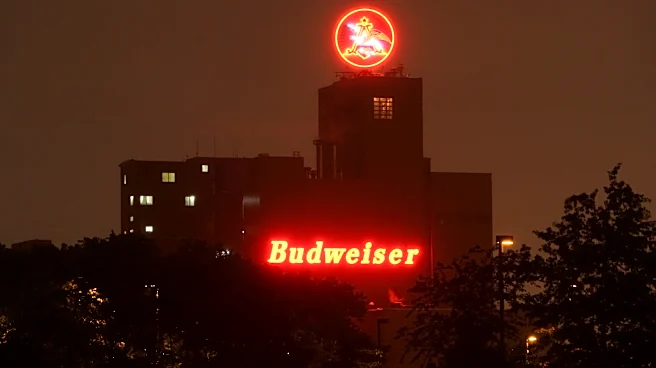





When the neon eagle finally came down from its perch atop the Anheuser-Busch brewery in Newark in early January, the chapter of New Jersey history in which we were the commercial brewing capital of the world came to its inevitable end. But what a chapter it was.
It starts in the 17th century with a brewery burned to the ground in a dispute, only for 60 breweries to rise from those issues two centuries later.
In this story, the Passaic River is not a Superfund site, but a pristine water source perfect for brewing and marketed in the way the folks at Coors did in their Tap the Rockies campaign.

There is beer delivered via fire hose during Prohibition, a giant bottle of Pabst Blue Ribbon erected, an eagle at Anheuser-Busch to welcome travelers to Jersey
— and then, slowly, then all at once, it was gone.
The closure of Anheuser-Busch may be the final stake in the coffin for commercial brewing here, but it provides an occasion to look back at what brewing meant to the region, particularly Newark.
“The history of beer is about so much more than just beer,” said Neil Maher, chair of the federated history department at New Jersey Institute of Technology and Rutgers-Newark. “Hopefully just as people remember the long and vibrant history of the city of Newark, they’ll remember that beer was a part of that and shaped it and made Newark an interesting, diverse and economically vibrant place.”
Beer capital of the world
A Dutch immigrant named Aert Tewnissen Van Patten built North Jersey’s first brewery in 1641 in Hoboken to supply early settlers. Only two years after he leased the land, though, the brewery was burned to the ground, reportedly by members of the Lenni Lenape tribe, said Christopher Morris’ book, "North Jersey Beer."
An inauspicious start, for sure, but an influx of European immigrants and ample natural resources, namely wheat, hops and water, buoyed the industry, Maher said.
“New Jersey was seventh among states in beer production, producing 2.5 million barrels of beer a year,” Maher said. “This was because of the huge German immigrant population in the city of Newark. They worked in the breweries, but they also drank a lot of beers.”
Scottish immigrant Peter Ballantine opened Ballantine Brewing Co. in Newark in 1840. It became the largest of the early brewers and later a sponsor of the New York Yankees. G. Krueger Brewing Co. opened in Newark in 1858; its glass bottles were typically used in restaurants and bars and then returned to the brewery to be refilled, a primeval growler.
Those two were followed by the Feigenspan (known for its labels saying “P.O.N.,” for "Pride of Newark"), Wiedenmayer and Hensler breweries, which completed the “big five” of Newark breweries. Paterson also had a few heavy hitters in Hinchliffe and Paterson Consolidated Brewing Co.

Ballantine enjoyed a sterling reputation throughout its run — in fact, a friend recently unearthed an old Ballantine bar sign, and I was shocked at how many people during a New Year’s Eve party had stories about this homegrown beer. An 1861 book on Newark businessmen says of Ballantine:
“Their productions have long held their present leading position in the market, being conceded by the chemists, by expert brewers, and by consumers in general, to have few equals, and no superiors, either in this country or elsewhere.”
By 1879, there were 58 commercial brewhouses in the state, with hubs in Newark and New Brunswick because of their proximity to the Passaic and Raritan rivers, respectively. Though the Passaic had the perfect water composition for brewing, it wasn’t long before the river was so polluted from that and other industries that brewers had to start digging wells 800 feet deep to get water, Maher said.
Prohibition puts a wrench in Jersey brewing
Though the industry was booming, Prohibition in 1920 put a wrench in the production line. In the 13 years it was illegal to make and sell beer, some breweries closed, and others worked covertly with the mob; one brewery in Paterson supposedly delivered beer via fire hoses.
Authorities were liable to look the other way in New Jersey, which held out on ratifying the 18th Amendment, said Michael Pellegrino, author of "Jersey Brew: The Story of Beer in New Jersey."
"The people who lived here really fought against it," Pellegrino told us in 2018. "And the local police generally wouldn’t arrest people for it. And local prosecutors often wouldn’t prosecute.”
The big five breweries survived Prohibition, Maher said, shipping the beers via boat, train and roadway through the 1930s and ’40s. They were a little worse for the wear, though; in a cost-cutting measure in 1935, Krueger became the first brewery in the country to package beer in cans. Ironically, that would seem like a badge of honor nowadays.
In 1951, Anheuser-Busch opened its Newark plant, the first for the behemoth outside of St. Louis. Though that brewery would operate for 75 years, the era in which it opened was likely the peak of commercial brewing in North Jersey.
The end of a brewing era and the dawn of a new one
It wasn’t Prohibition that knocked out commercial breweries, even if the era did create some problems. Resource availability, market consolidation, production shifting westward and demographic changes all undermined the North Jersey commercial brewing empire.
“What I try to argue was that there were a lot of changes in the accessibility in the resources that went into the beer. The hops industry — which was centered in upstate New York and made the best hops in the country — collapsed because of some diseases and insect infestations. That moved all the way out west,” Maher said. “[Newark] stopped planting grain, so that grain moved out to the Chicago area. And then the water got polluted. All of those things I suggest went into decreasing the profitability of beer making.”
Ballantine sold its name and assets in 1973 to the Falstaff Company, which then sold them to Pabst. Pabst tried to brew Ballantine beers, but at some point in the ownership transfer, the original recipes were lost. Ballantine IPAwas the longest holdout.
When the Newark facility closed in 1985, the water tower shaped like a beer bottle was dismantled and stored; Maher contends it’s stowed away somewhere if you’re looking for a giant lawn ornament. The Ballantine building was demolished and replaced by luxury condos.
Krueger was licensed to Narragansett in 1961; its building was demolished, though the mansion estate of its founder, Gottfried Krueger, has its own interesting history: It was purchased by Newark's first African American female millionaire, Madame Louise Scott, in 1958 and is now a refurbished makerspace.

Feigenspan and Hensler closed in 1958, the latter after a fire in its facility. Both were unable to compete with national beer brands, including Ballantine.
The last of the titans, Anheuser-Busch, announced the closure of its Newark plant in late 2025, citing the need to shift its production operations to other locations. The building was sold to an industrial manufacturer.
What’s left of the brewing industry in North Jersey may lack superlatives it could once claim, like “the biggest” or “the first,” but the four dozen or so craft brewers here, and 150 in total statewide, are producing excellent beer, albeit on a much smaller scale.
The Ship Inn, now Descendents Brewing Company, was the first craft beer spot to hit the state, in the 1990s, followed by Climax Brewing Company in Roselle Park and High Point in Butler. Newark Local Beer, a true microbrewery on Broad Street since 2021, is the last remaining brewery in the city of Newark.
Maher said the closure of Anheuser-Busch needn’t be seen solely in a negative light; he’s encouraged by the progress Newark has made over the last few decades and said the change is emblematic of a city that’s evolving.
“The story of Anheuser-Busch closing is a sad story because it means a book from the past is closed, in a sense,” Maher said. “But there are so many new opportunities and things happening in the city of Newark right now. I’ve worked in Newark for 25 years, and I think right now it’s doing better than it’s done ever.”
And for what it’s worth, the craft beer scene in North Jersey is still evolving, too. The future is bright, maybe brighter than the old Budweiser sign by the airport ever was.
Matt Cortina is a food reporter with NorthJersey.com/The Record. Reach him at mcortina@usatodayco.com.
This article originally appeared on USA TODAY: Anheuser-Busch closure marks end to 'beer capital of the world'