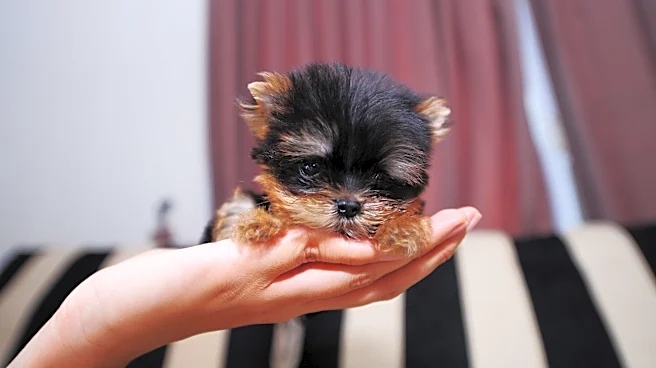







There's no denying that teacup pets are simply adorable, but looking past the puppy-like fur, veterinarians question the ethics of breeding such a small animal.
"Teacup" pets are pretty much exactly what they sound like. They're animals that are unusually small, and unlike their breed, only amount to a few pounds in their life. In short, they're animals that fit in a teacup. These pets are cute because they always look like a puppy or kitten, but according to veterinarians, this isn't always a good thing.
Dr. Jo Myers, a veterinarian at veterinary telemedicine company Vetster, said there are breeds like a chihuahua, Yorkshire terrier and Maltese that are naturally small, and there's nothing wrong with that. The problem comes when these animals
are bred to be unusually small.
The truth behind breeding a teacup pet
The term "teacup" isn't an official size or breed category, Myers said. It doesn't provide a standard for how big an animal will get, how it was bred or whether the parents met established health standards. It's actually a marketing term.
"There's nothing inherently unhealthy about being a healthy member of a naturally small breed. My concern goes up when we deliberately breed for increasingly extreme smallness to meet consumer demand. Humans have a pretty good track record of wanting pets because they're novel, cute, or fashionable without necessarily stopping to ask whether producing them is good for the animal," Myers said.
Myers said these teacup animals usually come about through reproductive technology and selective breeding, where people repeatedly breed the smallest animals, then use the smallest offspring to reproduce. This can lead to numerous health problems, including low blood sugar, fragile bones, traumatic injuries, congenital heart, airway and eye problems and even hydrocephalus, where excess fluid puts pressure on their brain.
These health problems can be paired with normal small dog health issues, like a small French bulldog or pug that struggles with its flat-faced anatomy.
"As a veterinarian, I consider it a red flag to use 'teacup' as a prominent selling point. It makes me immediately more cautious about the seller and whether their priority is producing healthy, sound animals or producing an extreme physical characteristic consumers will pay for," said Myers.
That said, every teacup animal isn't guaranteed to be unhealthy. Myers said the term "teacup" doesn't necessarily establish its own breed classification well enough to tell, but owners should be prepared for the possibility of medical problems, since an animal deliberately bred for extreme smallness may have different physical features than a soundly bred animal.

"What concerns me is breeding specifically for an extreme. I understand that some people find these animals incredibly appealing. As a veterinarian, I have a different reaction. After years of seeing what happens when anatomy works against an animal, it's difficult for me to see only the cute face or tiny body. I see the potential cost first, and instead of being overwhelmed by cuteness, I feel sad," said Myers.
If you're looking into buying a teacup pet, Myers recommended also considering the animal's lifetime. She said to ask yourself the following: Can this pet breathe comfortably, move normally, eat normally, keep its teeth healthy with reasonable care, regulate body temperature, and live an active life without its anatomy working against it?
How do you know if it's a teacup pet?
Natascha Hedegaard, an in-house veterinary advisor for JoyFull Pet, said breeders might not use the word "teacup," but there are ways to tell them apart from a regular small dog. Hedegaard said people should compare the dog's measurements and weight to the breed standard. The American Kennel Club provides typical size and weight ranges for every breed.
"If the breeder is advertising dogs significantly below those standards, even if they don't explicitly use the word 'teacup,' they essentially are," Hedegaard said.
Hedegaard recommended asking to see the parents, which is "one of the most important things a buyer can do." The parents show the breed standard as an adult, and if the parents are well below the breed standard, the animal could be a teacup.
While teacups have ethical practices around them, there are ethical ways to breed small animals. Myers explained that breeders can start with healthy animals that have sound anatomy, perform genetic and health screenings and maintain genetic diversity. Breeders shouldn't push size or physical characteristics to the point that it compromises the animal's health.
This article originally appeared on USA TODAY: Thinking of getting a 'teacup' pet? Vets have ethical concerns