




Michael Khalili always suspected his work tracking federal immigration officers in Minneapolis landed him on the federal government’s radar. The photos agents took of his car and face had to go somewhere.
Those fears became real when his status with Global Entry, a pre-screened flyer program, was revoked a day after one exchange in March with ICE. He then faced secondary airport screening when returning to the U.S. from an international trip this fall.
Now he has proof.
USA TODAY sued Immigration and Customs Enforcement under the Freedom of Information Act and obtained a St. Paul field office database that reveals what legal observers feared: Protesters are being tracked and logged into a secret database for what they argue is exercising protected
First Amendment speech.
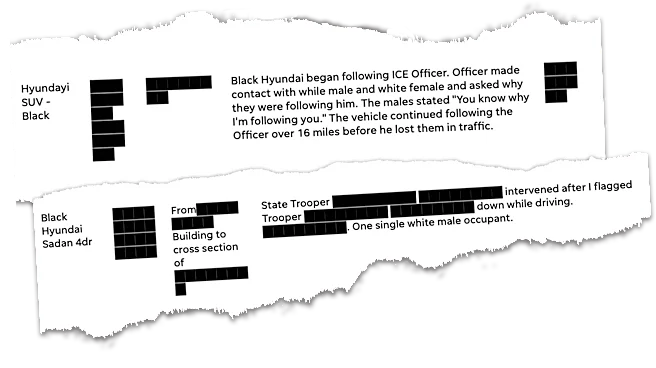
The document, titled simply Agitator Log, contains 60 instances of ICE officers in Minneapolis logging their interactions with protesters and legal observers around the Whipple Federal Building in the spring of 2026.
“I am in no way surprised. It was clear they were tracking us and trying to find reasons to crack down on us,” Khalili told USA TODAY. “I try to keep this in perspective, I wasn’t physically harmed, but American Democracy cannot operate this way.”
Each incident includes an ICE officer’s brief description of the interaction, along with information about the protester’s vehicle, license plates, photo of the car and whether the agent contacted local law enforcement. Personal information was redacted in the copy of the database released to USA TODAY.

While not identified by name, Khalili was driving a black Hyundai SUV during his interactions with ICE. Those incidents are described accurately in the database on the correct dates, he said.
“Black Hyundai began following ICE Officer. Officer made contact with while (sic) male and white female and asked why they were following him. The males (sic) stated "You know why I'm following you,” an ICE agent wrote in the database. “The vehicle continued following the Officer over 16 miles before he lost them in traffic.”
Homeland Security officials had insisted, for months, that no such database was being kept, captured, logged or maintained.
In a separate revelation on Oct. 2, a newly unsealed court filing in Maine revealed ICE is uploading photos of protesters into an “Investigative Case Management” database.
An ICE officer in the Maine case mentions a “Master List of Agitators,” though that list remains under court seal. The agitator lists may be part of a larger surveillance effort.
“This confirms exactly what we’ve alleged: They’re tracking information in a database, using the term ‘agitators’ as an excuse to retaliate against people who are observing and exercising their First Amendment rights,” said Maryam Jazini Dorcheh, an attorney with Common Cause who represents Khalili and other observers.
ICE and DHS spokespeople did not immediately respond to USA TODAY about the existence of the database, but as recently as Oct. 2 told other media outlets that it's a “lie that there is a database of ‘domestic terrorists’ run by DHS.”
Search the database
As new information emerges, ICE’s denials increasingly do not square with the truth, said JoAnna Suriani, an attorney representing the Maine protesters with Project Democracy.
“Our case was never about whether there is a standalone database with a particular name, but whether the government is tracking everyday Americans who record them. The government has now admitted there are records about observers,” Suriani said.
Concern over protests in Maine and Minnesota
Whether the government was tracking Americans became an issue in January, after Renee Good was shot and killed while monitoring ICE agents in Minneapolis. Senior Trump administration officials, including then Homeland Security Sec. Kristi Noem, called her a “domestic terrorist.”
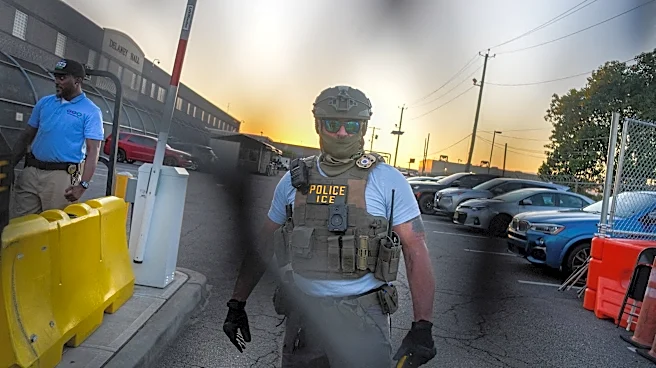
Weeks later in Maine, a masked ICE agent was caught on video taking a picture of a woman protester and saying: “We have a nice little database... And now you're considered a domestic terrorist.”
Former ICE Director Todd Lyons testified under oath to Congress about allegations that ICE was tracking protesters in February.
He was emphatic during the hearing: “There is no database for protesters,” he told them.
Noem did the same in March: “We’re not creating a database.”
Lyons told them again, in an April follow-up letter to Democratic Florida Rep. Maxwell Frost and 11 others, “(ICE) does not maintain any kind of database of U.S. citizens protesting ICE activities.” Lyons wrote that ICE was “fully committed to upholding the Constitution and respecting First Amendment rights of all individuals, including the right to peacefully assemble.”
Lyons claimed the only time ICE keeps information on protesters is if their actions “go beyond protected speech,” like threatening, assaulting or interfering with ICE operations.
Federal prosecutors charged 15 people in Minnesota in June for allegedly attempting to impede or injure federal law enforcement officers during the ICE surge last winter.
The ‘Agitator List’ released to USA TODAY appears to directly contradict Lyons.
“These records suggest that Americans were being documented in connection with simply observing what their government was doing,” Frost told USA TODAY. "No American should feel unsafe exercising their First Amendment rights or worry that watching and documenting their government could put them on a list.”
Kevin Riach, an attorney defending some of the Minneapolis defendants on the criminal case, received a version of the same ICE database released to USA TODAY.
He said what ties the incidents on the released list together is that they originated at the Whipple building. Riach says he believes DHS was trying to build support for criminal charges against the protesters and the list only represents a small fraction of the documented interactions throughout the Twin Cities.
Minnesota data shows legal observers
ICE agents often reported benign interactions, such as, “I was followed,” to enter a protester’s detailed information into the database, according to the records released to USA TODAY.
Others include details of cat-and-mouse evasions that ended with local law enforcement stepping in.
In an April 10 entry, an ICE officer wrote that a “bright blue Toyota car” followed them out of the main gate of a federal building. “One occupant, 30s female with glasses… followed very aggressively, I ended up losing her in a neighborhood.”
Three days later, an ICE agent took down the plates of a “Maroon Chevy 4-door SUV Midsize” and wrote “Subject remained stopped at a stop sign at [redacted] for longer than a reasonable time with no traffic approaching and drove slower than reasonable in clear weather conditions.” The records indicate the officer photographed the SUV and reported it to Bloomington Police.

“Called 911, they were not helpful…” an ICE officer wrote in a May 13 log that ended up in the database. “A separate lady tracking movements also began filming my vehicle and making hand gestures.”
Some of the “agitators” in the database appeared to understand they could draw more scrutiny if they followed ICE agents across the state border between Minnesota and Wisconsin. That’s at the heart of the government’s case against 15 protesters charged with interstate stalking, which can carry a five-year prison sentence.
On May 27, an officer described an incident with a 2005 black Honda Civic. The ICE agent called local police as he was traveling east toward Wisconsin. The dispatcher arranged to have a police officer connect with them and stop the Honda if it followed the officer across state lines. The Honda took the last exit, just before crossing the bridge into Wisconsin.
Redactions make it difficult to definitively match the vehicles in the ICE database with any of the 15 people charged by Minnesota federal prosecutors.
However, many of the vehicles and situations line up, including in the case against Natasha Rakotz, who prosecutors claim drove her black Honda Civic into an ICE officer’s Ford pickup truck on May 15 and has been charged with assault.
In general, following ICE officers, shouting at them or recording them in public spaces is lawful. But speeding, running red lights or driving recklessly makes it a crime, which some officers alleged in the database.
Tracking protesters solely for expressing their constitutionally protected speech could be a violation of the First Amendment, said Mindy Haas, an international affairs professor at University of Pittsburgh.
“If you end up chilling speech,” Haas said, “... we’re pushing up against the line of thought crimes.”
This article originally appeared on USA TODAY: ‘They were tracking us:’ ICE tracks protesters in secret database