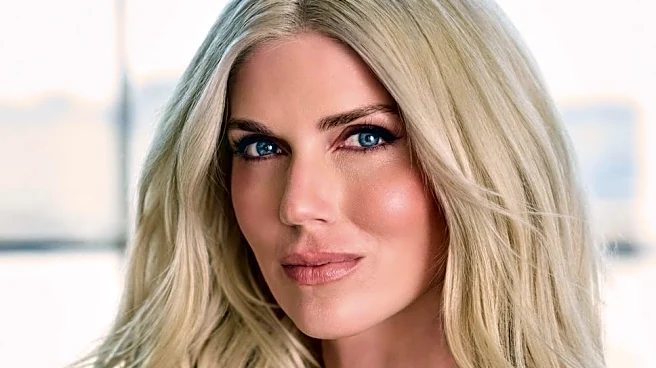

When former Christian pop singer Julianna Glasse started questioning her evangelical life, she read philosophy books in secret. She says when her husband found her copy of Simone de Beauvoir’s feminist
“The Second Sex,” he threw it on the floor and said, “This is what happens when you read.”
Today, she becomes an author herself, having published a memoir she hopes will “liberate” women the same way reading widened her perspective.
“This is What Happens When Women Read” (out now from Spiegel and Grau) is named after the phrase that served as a wake-up call to Glasse, who left her church and began a new life in 2019. Her foundation of the same name promotes women’s intellectual autonomy across the world and encourages access to literature and academia.
Glasse, who shares her journey with nearly 100,000 online followers, is one of many Americans undergoing religious deconstruction. About 40 million American adults have stopped attending church in the past 25 years, USA TODAY reported in 2024.
Julianna Glasse grew up ‘subservient’ to the men in her life

Glasse, 42, grew up evangelical and married young. She and her ex-husband, Ben Zobrist, had thriving careers in the public eye. Zobrist was a professional baseball player. Glasse was a Christian pop singer who sang at President Donald Trump’s National Prayer Breakfast in 2017.
Glasse did grow up reading, but she was taught to read exclusively “through the lens of Christianity.” When she read something she disagreed with, her instinct was to prove it wrong.
“I like to compare it to having contact lenses put on your eyes as an infant without your consent,” Glasse tells USA TODAY. “It is the water that you are swimming in and it paints not just the ways in which you worship, but it is also your philosophy, your ethics, your morals, your understanding of what it means to be a woman, your political leanings … Part of that understanding was that a woman’s role was to be subservient to, first, her father and then eventually to her husband.”
In her memoir, she looks back on old annotations in her Bible. “I will not deprive my husband of sex. My body is not my own,” she wrote once. In her journal: “Break whatever in me still clings to my own will. Make me joyfully small if it means you will be glorified.”
What 'liberated' Julianna Glasse? 'The gays and the books'
Glasse likes to joke that what changed everything was “the gays and the books.” A pivotal dinner conversation with her neighbors, a gay pastor and his husband, helped her empathize with a community she had been taught to despise.
She started questioning other things, too. She wanted to go back to school, but was discouraged. She started reading the poet Rumi, but was told during marital counseling that it gave her an “unhealthy obsession with love.”
She read “The End of Faith” by Sam Harris, which taught her “to see the extremes of religion.” She envisioned herself in Plato’s allegory of the cave as not the enlightened, but the human in the cave who knows nothing but the shadows. What else was out there? What else could she question and discover?
She started second guessing the “statements of faith” she was often required to sign to speak or sing at a Christian event.
To her family and community, it wasn’t a welcome shift.
“Reading was such an opportunity for expansion in a way that I had never given myself permission to entertain,” Glasse says. “Being a public figure in Christianity and just being a very committed Christian is that you really don't surround yourself with anyone that thinks differently than you because your whole goal is to convert them. So there's really no healthy discourse or debate or dialogue around these ideologies that are apparently fundamental to an eternity in heaven or an eternity in health. When I started questioning them and kind of poking holes in them and asking questions I wasn't supposed to ask, it was very clear to me very quickly where I was safe to – and I mean psychologically safe – to have these questions and where I was not.”
So she started hiding books. She refused to sign the statements of faith. She lost her third book deal and was dropped from her next music release deal and tour. She found solace in a friend and pastor − who she eventually had an affair with − who was the only person she could talk to about philosophy. Then her husband found her books.
When Zobrist found she owned Plato’s allegory of the cave, Walt Whitman’s “Leaves of Grass” and de Beauvoir’s “The Second Sex,” he mocked them and threw them on the floor, Glasse says.
“I left the room that day and pulled out my phone and in all caps and my notes app wrote, ‘THIS IS WHAT HAPPENS WHEN WOMEN READ’ because it was really like the runway of my life lit up,” Glasse says. “He was so right. Everything happens when we read, we read to liberate ourselves. To set ourselves free. And that's what I was doing.”

Turning a ‘public shaming’ into a mission
Glasse left her husband in 2018 before a brief reconciliation and, eventually, divorce in 2019. In 2021, Zobrist filed a $6 million lawsuit against the pastor, Byron Yawn, seeking damages from the extramarital affair and allegations that Yawn defrauded Zobrist’s charity foundation.
The public backlash was swift and damaging, Glasse says. She received violent death threats and unsolicited photos of genitalia. A crowd gathered outside of her front lawn, threatening her and calling her “vile names.”
Zobrist dropped the lawsuit months later. But the threats – many of them violent and sexual in nature – brought back memories of when Glasse was raped as a child. She turned to alcohol to cope. “I’m not convinced I will survive this,” she wrote in a book at the time.
In the years since her own “public shaming,” Glasse has turned outward and now helps other women find the resources they need when they leave isolated religious communities and high conflict zones. She went back to school and studied business at Oxford.
She started her foundation, which has reached over four million people across 67 countries. She founded a scholarship program through Oxford to provide curricula and community to women. Her website has a button to quickly closes the browser in case women are not in a supportive environment, like she used to be.
“I’m so proud of our scholars. Really, what they have done to liberate themselves is astounding,” Glasse says. “Many of them did not even tell their families that they were going to study at Oxford until like a week before because it would be so disruptive to the cultural expectations or the familial expectations. Our scholars are refusing arranged marriages and hopping a plane to the UK. They're refusing (forced genital mutilation) and refusing child marriages. They are incredibly brave women.”
Clare Mulroy is USA TODAY’s Books Reporter, covering buzzy releases, chatting with authors and diving into the culture of reading. Find heron Instagram, subscribe to our weeklyBooks newsletter or tell her what you’re reading at cmulroy@usatoday.com.
This article originally appeared on USA TODAY: She hid feminist books from her evangelical husband. How he reacted changed everything.