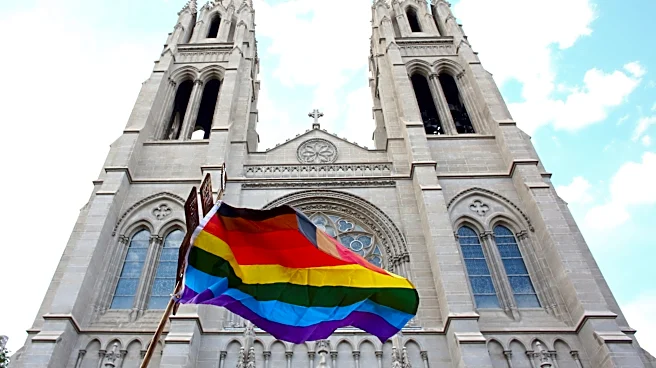





WASHINGTON – Colorado, a state where early advocates for gay rights share their mountainous home with a major pocket of Christian conservatives, has become the epicenter for Supreme Court fights over balancing protections for the LGBTQ+ community with religious and free-speech rights.
In 1996, the justices struck down a state constitutional amendment that blocked legal protections for gays and lesbians, the first Supreme Court decision to recognize equal protection rights for queer people.
But in recent years, the court has ruled three times that Colorado’s antidiscrimination efforts have gone too far. Since 2018, the justices have sided with a cake baker and a website developer who opposed providing certain services to gay customers because of
their religious beliefs. The court also agreed with a Christian counselor who argued that the state’s ban on “conversion therapy” for minors violated her free speech rights.
On Nov. 3, the justices will debate yet another Colorado case: whether Catholic preschools in Colorado must accept children of gay parents if taxpayers are footing the bill.
“It’s fall. The weather is turning colder. We’re watching football and that means Colorado is going to the Supreme Court with a bad First Amendment case,” said Mark Rienzi, the head of the Becket Fund for Religious Liberty, which represents the Catholic parishes.
A 'clear outlier'
Colorado is not the only state where these battles are being fought.
But the Rocky Mountain State has generated five of the fewer than a dozen Supreme Court cases on the topic, according to Mark Satta, an associate professor of philosophy and law at Wayne State University.
“It has been an especially fertile source of Supreme Court cases that require balancing LGBTQ rights with the First Amendment rights of conservative Christians,” Satta said. “In fact, Colorado is a clear outlier here among the states.”
Experts say the reasons include Colorado’s demographics and political makeup − which has become markedly more liberal in recent decades − and the state’s proactive approach to LGBTQ+ rights.
“For much of the twenty-first century, Colorado has been ahead of the curve in its protection of queer rights,” Satta said. “And this has generated backlash."
First backlash
The first backlash came in the 1990s.
At the time, Colorado was a largely conservative state with pockets of liberalism. The progressive communities of Denver, Boulder and Aspen had passed local laws barring discrimination based on sexual orientation.
In response, a group called Colorado for Family Values successfully pushed for a constitutional amendment to erase those protections and bar future ones. The group was based in Colorado Springs, which is sometimes referred to as “Jesus Springs” or the “Evangelical Vatican” because it’s home to more than 50 evangelical Christian organizations.
“In this state we have Boulder, which is a bastion of the left. We have Aspen, a wealthy bastion of the left,” said Krista Kafer, a columnist for the Denver Post. “And then you have Colorado Springs, which is a bastion of the right.”
Kafer said that when groups with opposing views are in close proximity, they may move farther apart. As an example, she pointed to Manitou Springs, a “cute, artsy, liberal enclave” close to Colorado Springs.
“Almost every shop and restaurant has a gay rights flag flying,” she said. “The reason for that isn’t that it’s any different in any other cute, little tourist town. It’s that it is right next to Colorado Springs. It’s their way of pushing their identity. 'We are not them.’”

Animus on both sides
When the Supreme Court, in 1996, struck down Colorado’s constitutional amendment barring LGBTQ protections, then-Justice Anthony Kennedy wrote that animus towards gays and lesbians appeared to be the likely motivation.
But 22 years later, when the court sided with the Colorado cake baker, Kennedy said the state showed hostility toward the baker’s sincere religious beliefs.
One reason for the sea change could be the court’s landmark 2015 decision legalizing same-sex marriage nationwide, said Southwestern Law School’s Luke Boso, who writes about constitutional law and antidiscrimination issues.
Although the ruling in Obergefell v. Hodges was a huge victory for gays and lesbians, Boso said it also sent a message that there are limits.
“I read Obergefell as kind of issuing a warning that those limits are when antidiscrimination and other LGBTQ protective laws arguably infringe or burden religious peoples’ free speech rights, their free exercise rights,” he said. “So, I think Obergefell was kind of as far as this court was willing to go.”

'Refusal to take no for an answer'
Those boundaries keep being debated in cases from Colorado, which became more liberal over the years and, in 2018, elected the nation’s first openly gay governor, Democrat Jared Polis.
The state wasn’t just passing protections for the LGBTQ+ community. Colorado was also upholding them.
“These aren’t laws that are just paying lip service,” Boso said. “There are enforcement mechanisms built in.”
Jim Campbell, chief legal counsel for Alliance Defending Freedom, the conservative Christian law firm based in Arizona that brought the three recent successful Colorado challenges, said there’s another reason for the frequent litigation.
“It shows Colorado’s refusal to take no for an answer,” he said.
As an example, Campbell pointed to what happened after the court said Colorado’s conversion therapy ban infringed on the free speech rights of a Christian counselor.
In an 8-1 decision, the court said the ban was not viewpoint neutral because it allowed counselors to help a minor accept a gay or transgender identity but not to change that orientation or identity.
In response, Colorado amended its law, redefining what’s banned.
Alliance Defending Freedom has gone back to court, arguing the law is still unconstitutional.
“Colorado is very committed on these issues, and it doesn’t mind overriding people’s First Amendment rights,” Campbell said.

'Colorado seems to double down'
Scott Skinner-Thompson, whose scholarship at the University of Colorado School of Law includes a focus on LGBTQ+ issues, said the changes the state made to the ban were a sincere attempt to comply with the ruling.
And in the dispute over Catholic preschools that the justices are taking up next, Skinner-Thompson said, Colorado worked hard to include religious education providers in its universal preschool program. More than 40 faith-based providers − including six Catholic Charities preschools – joined the program when it began in 2023.
“The state listened to the Supreme Court,” he said. “The narrative that Colorado is flouting the Supreme Court, or trying to target religious people, is just not accurate.”
But Doug Friednash, a Denver attorney who was chief of staff to former Democratic Gov. John Hickenlooper, said that after being used by Christian conservatives as a testing ground for challenges, Colorado has “leaned in probably harder.”
“To the extent it’s affected things,” he said, “Colorado seems to double down.”

Plenty in the pipeline
Polis, the outgoing governor, declined an interview request, as did the office of Colorado Attorney General Phil Weiser. Spokespeople said they couldn’t comment while litigation is ongoing.
Weiser, who is expected to be elected to succeed Polis on the same day the Supreme Court will hear the Colorado preschool case, has pledged to protect LGBTQ+ Coloradans.
“Our LGBTQ friends and family, they need us,” Weiser said in remarks at the Democratic Party’s state assembly in March.
The state is defending new challenges brought by Alliance Defending Freedom to rules that the group says criminalizes the deadnaming and misgendering of transgender people, or referring to a person by a name or gender they no longer go by. Alliance Defending Freedom has also gone to court over whether doctors in Colorado who provide puberty blockers and hormone therapy to treat hormonal conditions in cisgender children must also provide gender-affirming care for transgender patients.
“There’s still plenty in the pipeline,” Campbell said. "We do sometimes joke about opening a Colorado office."
Friednash said both sides in the fight have strength in the state.
“Colorado really has become ground zero,” he said, “when it comes to the interplay between LGBTQ rights and religious liberties.”
This article originally appeared on USA TODAY: LGBTQ+ rights vs. religious liberty: Why Colorado is 'ground zero'