

On the Monday, August 24, 2026, episode of The Excerpt podcast: For years, Republicans have had a lock on those who base their vote on their religious preferences and values. Now Democrats are trying to do the same. Will it work? USA TODAY Senior National Politics Reporter Sarah D. Wire joins The Excerpt to share her reporting.
Hit play on the player below to hear the podcast and follow along with the transcript beneath it.
This transcript was automatically generated, and then edited for clarity in its current form. There may be some differences between the audio and the text.
Podcasts: True crime, in-depth interviews and more USA TODAY podcasts right here
Dana Taylor:
For years, Republicans have had a lock on those who base their vote on their religious
preferences and values, something that has only grown with the rise of the evangelical right. But this year, an unusually high number of Democratic candidates in red states are sharing their faith in an effort to connect with voters in the midterm elections. Will it work?
Hello, and welcome to USA TODAY's The Excerpt. I'm Dana Taylor. Today is Monday, August 24, 2026. Joining me now to talk about how Democratic candidates are using their faith on the campaign trail is USA TODAY Senior National Politics Reporter Sarah Wire. Sarah, it's so good to have you back on the show.
Sarah D. Wire:
Thanks for having me.
Dana Taylor:
Sarah, you write about a novel democratic strategy being deployed in the run-up to the midterms, and that's using faith as a way to reach voters, particularly in red states. Why is this a new approach for Democrats?
Sarah D. Wire:
For the last several decades, Republicans have really connected their faith with their voters. They talk about conservative values of things like supporting the unborn, and maintaining the country as a Judeo-Christian country. And we haven't heard that from, especially white Democrats, for the last few decades. And there's obviously some notable exceptions. You've got Jimmy Carter and Al Gore and Bill Clinton.
But for the average candidate, we're hearing from more secular Democrats who are willing to put their faith in the center of their campaigns.
Dana Taylor:
This new democratic campaign strategy of integrating religion on the trail has really ignited a debate on what it means to be Christian in America today. How are voters responding here?
Sarah D. Wire:
It's been really interesting talking to the candidates and what they're hearing from voters. They are talking about this more from, kind of a liberal perspective, that they're talking about the church's responsibility to heal the sick and take care of the hungry and the poor. And that, as Christians living their values, they need to do the same. They're not necessarily saying that they're going to write policy that way. They don't believe that the Bible should dictate policy.
And that seems to be connecting with voters. Several of these candidates are polling very well. Several of them came through the primaries with a lot of support, but the big question is going to be November.
Dana Taylor:
And how are Democrats responding when they're challenged on some of the foundational policy positions that Republicans have embraced for decades, like anti-abortion or being against trans athletes?
Sarah D. Wire:
These candidates all seem to be coming from more liberal denominations. They're Methodist, they're Presbyterian. They don't really fit into the evangelical side of Christianity. And so, they're not trying to defend those positions. They're not trying to be Republicans at all. And these are denominations that have been more embracing of the trans community or LGBTQ rights. And they're talking more about some of the more socially political aspects of the religion, and less cultural aspects, I would say.
Dana Taylor:
One of the people you profiled in your piece is a pastor from Kansas City named Adam Hamilton. Tell me about him and what his proposition to Kansas voters is.
Sarah D. Wire:
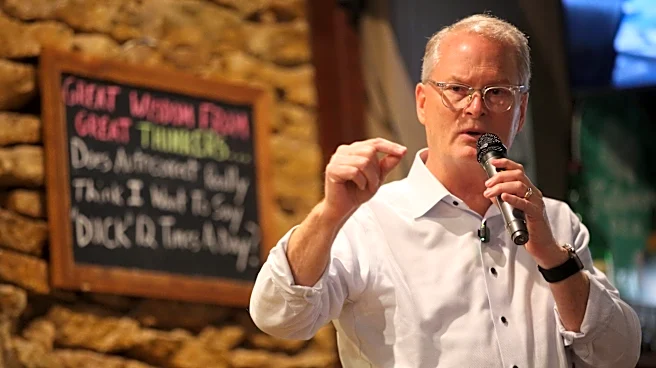
Hamilton has been a pastor for 36 years, and he leads the largest United Methodist church in the country. He reaches something like 25,000 people every Sunday. And he told me that for the last 18 months, he has been seeing something come out of Washington that does not reflect his religion and what he has preached for those decades. And his wife finally nudged him and said, "Stop complaining, do something about it."
And as he's talked to voters across the state, he's hearing the same thing. They're not happy what they're hearing out of Washington. Immigration arrests and the criticism of people who are different, the attacks on DEI, things like that. He is very cognizant that not everyone shares his religion or his religious values. So he does frame things more social, the social values that he thinks anyone could agree on.
He's framed himself as a centrist, and that he's ready to work with Democrats and Republicans. He doesn't have to be part of the entire big tent in order to move forward and still be a Democrat. He told me he's been a registered Republican and an independent, and the thing that matters most to him is the person and not the party.
Dana Taylor:
Sarah, how long has it been since a Democrat was elected to represent Kansas in the Senate?
Sarah D. Wire:
It has been 94 years. I mean, this is an uphill climb and he's aware of that. Kansas has really gone back and forth in the last few decades. They have a Democratic governor. So, the polling doesn't seem to indicate that it's impossible, but he's got a big road to climb, especially coming up against an incumbent like Roger Marshall.
Dana Taylor:
Well, I was going to ask you about incumbent Republican Senator Roger Marshall. Tell me about him. How long has he represented Kansas in Washington, and what's his pitch to voters?
Sarah D. Wire:
Marshall is on his first term as a US Senator. He's asking for a second term. Before that, he served in the House for several years. He's a former physician and military officer. He's been promoting the things he's managed to do for the state, which is what every candidate's doing right now as they try to get another term.
He has criticized Hamilton as being outside of the mainstream of religious values, and outside the mainstream of just Kansas values. He's really trying to portray him as too woke for Kansas.
Dana Taylor:
There are a few other states where the Democrats could potentially make inroads with voters on faith. What can you tell me about those races?
Sarah D. Wire:
It's been really hard to nail down how many Democrats are framing their campaigns this way. Some of them have careers in religion. Some of them just talk about the religion and what they heard on Sunday. But we know, specifically, there are a handful of really key races where this could be important.
Biggest one is in the Texas Senate race to replace John Cornyn, where you've got James Talarico. He's a seminary student and has been talking a lot about his religion. It's gotten him into trouble as people have gone through some of his past statements. He said he's been intentionally provocative in some cases, such as when he said that God is non-binary. And he's kind of backed away and apologized for some of them, but he's not pulling back from putting faith in the middle of the conversation. He's really talked about our responsibility to take care of our neighbors as Americans, and voters' responsibility to lean on one another, make sure that everyone is taken care of.
That's probably the key one that most people are aware of. In Iowa, there's two races that I'm watching that could be pivotal to House control if Democrats manage to take them. I spoke to one of the candidates for the story, Lindsay James, and she talked about how she was prepared for attacks on her religion from the other side, but how insulting she has found it. And she finds it insulting, not just for her as a pastor, but for Christians in general, people who share her view of what America should look like and what Jesus would want them to do.
But like I said, there's so many of these candidates. I spoke to one in Arkansas. It wasn't even really on my radar until the national party mentioned him. And he started his life in Christian nationalism and now pastors a very liberal church. And he said he woke up one day with questions that he didn't feel like he could answer, and he wanted to start a church that people could come to find those questions answered.
Dana Taylor:
Why are Democrats making this pivot now? Aren't issues like the Iran war and affordability giving them enough of a lift on the campaign trail?
Sarah D. Wire:
I've talked to the national party, I've talked to experts, and I'm hearing two very distinct things. National party says they want candidates that reflect the communities they want to serve. And, making inroads with people of religion is another way to kind of broaden the base.
When I've talked to experts, they've said the way maps are currently drawn has really made it so that Democrats can't win in certain areas. And so, they have to broaden the base of who they're speaking to.
And especially in some red states, you've got to speak the language of religion in order to connect with the majority of voters there. I spoke with one expert, that secular voters are more willing to accept a Democratic candidate talking about religion than they are a Republican candidate talking about religion. His research had shown that they are not quite as scared that a Democrat might place religion over politics, and over policy, the way they are with Republican politicians.
Dana Taylor:
What are the political pundits saying about this new strategy overall? It could really open up a whole new ground campaign for Democrats, couldn't it?
Sarah D. Wire:
In theory, it could. The pundits are talking about that this could be transformational, especially in some areas. There are large portions of the South where Democrats are no longer routinely successful. But if they can speak to especially younger voters who have either left the church, or who still want to be connected, that they might have some luck.
Some of the experts I spoke to said that this change is happening right now, because the number of religious voters has dropped so much, but those who have stayed in religion have become more and more progressive. And so, this is a way of reaching them and helping to draw them into political activism.
Dana Taylor:
Sarah Wire is a senior national politics reporter for USA TODAY. Sarah, this is fascinating. Thank you so much for sharing your reporting here.
Sarah D. Wire:
Thanks for having me.
Dana Taylor:
You're caught up in under 20 minutes. Come back tomorrow for another take on a story that matters. I'm Dana Taylor. Thanks for listening.
This article originally appeared on USA TODAY: Can faith help Democrats win in red states? | The Excerpt