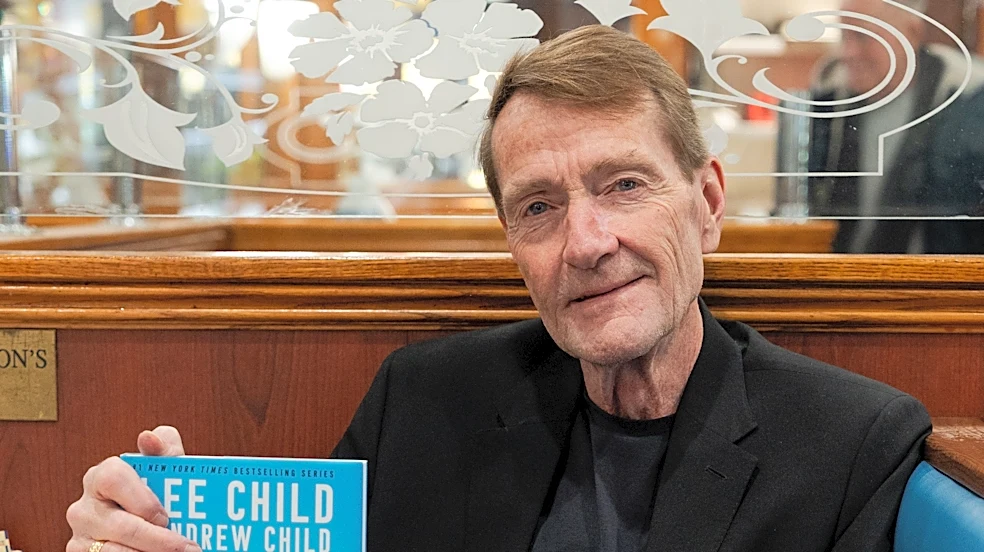







NEW YORK – Like Jack Reacher in one of his bestselling thriller books, Lee Child is coming to the rescue.
Child, the 6-foot-4 British author, is across from me at a midtown diner, flicking a small cockroach that has appeared out of nowhere and is encroaching on my grilled cheese. I’m freaking out. He does it mid-conversation, without much fanfare. The cockroach flies through the air and lands somewhere below our table. I’m still eyeing the spot where the roach was, but he continues nonchalantly, telling me about his coffee habits over a steaming mug. He drinks about 20 cups of coffee a day (yes, he’s serious; his record is 36), interspersed with gum, cigarettes and maybe a piece of toast.
At 71, Child’s day-to-day as an author looks very different
from a decade ago, save the cigarettes and coffee. He lives with his wife, Jane, in the U.K. Their adult daughter, Ruth, is a writer and linguist. Right now, Child is focusing on nurturing his antihero Reacher into a new era, one flanked by Alan Ritchson on Prime Video and his brother Andrew Child, who has taken over writing the series.
But he has been writing some short stories. He’s a night owl — he starts work in the afternoon and continues working even past midnight.
“I firmly believe nothing of value ever happens in the morning,” he tells me.
He and Andrew collaborated closely on the plot of new book “Chain Reaction” (out Oct. 20 from Bantam), but even last year when we spoke, he admitted the series is “all (Andrew’s) now.” What does it look like then, to watch your beloved character adventure beyond you?
All work and no play makes Lee Child a bestselling author

Child does miss getting into Reacher’s head, he admits. Child, the UK's first-ever Prison Reading Laureate, meant to improve prisoner’ literacy skills, tells me about an inmate who he encouraged to express his feelings through a fictional alter ego. Reacher is a little like that for him.
“I'm making a person that is really me, if I could get away with it. This is wish fulfillment for me,” Child says. “But Andrew does it really well. So when I read Andrew's stuff — that's something that I've really ruminated over since we've been doing it together and then he's taken over — to what extent am I influencing his books? The only way to answer that is: to what extent is he influencing my books in the earlier days?”
Andrew calls himself the “original Reacher fan.” He was the first to read Child’s “Killing Floor” manuscript. He considers the character an “invisible brother.”

The pair are 14 years apart. Child jokingly refers to Andrew as a “much later menopausal mistake” of his parents’. They weren’t close until Andrew was a tween, but they formed an “alliance.” Child’s adult house often served as a reprieve for Andrew from their parents.
“My parents were very repressive, very boring, very strict. Absolutely committed to avoiding pleasure if possible,” Child says. "It was a dull life and I had survived it. And I saw Andrew struggling with it as a little kid.”
When there was nothing to do, Child read thrillers “obsessively.”
“By the time I was 10, I had been 200 different people,” Child says. “I look back on my life and it was just a blaze of excitement because I was constantly reading. And so I came to writing because of reading, like most writers do. And Andrew was the same.”
Child’s work as a published author, though, didn’t begin until he was fired from a career in television at 40. He retreated back to his longtime hobby and decided he’d take a crack at writing.

Bringing Reacher into a new era
Now 31 books, two adaptations and over 100 million copies sold worldwide, Child sits at the top of a thriller empire that he’s seen through nearly three decades. He reminisces on mailing in that first “big, bulky manuscript” to his agent in 1995. He had never sent an email before.
How times have changed. In “Chain Reaction,” Reacher finds himself in a tiny, remote town with more data centers than people. Artificial intelligence plays a major role. Child credits his brother for preventing Reacher from becoming a total luddite. Technology is one of the major series changes that Andrew has contributed.
His personal thoughts on AI? It’s “a real conundrum,” he says. With genre fiction that follows specific tropes and arcs, what happens if the readers start asking AI for new stories rather than humans?
“If you said, write a Reacher novel in the style of Lee Child, it would absolutely do a decent job,” Child says. “The only thing that AI cannot do is make crazy new ideas. Every book every author writes, there is some little mad part that is new. … AI won't do that. But does the reader care? Because the whole point of writing a series is that it's kind of consistent, it's familiar, and AI will fill that hole. But I would think after about five books, the reader is going to say this nothing is ever new. So after five years, they might be fed up of AI Reacher, but the problem with that is that after five years, we're all out of work and there's nobody around to supply the new, original books.”
He’ll wait to see how the readers react, whether they embrace it like other new elements of technology or run in the other direction.
“The reader is king. That is my number one lesson over my career,” Child says. “It is not about me, it is about the reader.”

How Lee Child would end Jack Reacher for good
As we chat, Child and I meander through a wide-ranging conversation that touches the evolution of the publishing industry, family dynamics, the Beatles. He reflects on how completely the Beatles changed music and fandom. They leave a long legacy.
What about his own?
He doesn’t think too much about it, because “that would be a terrible thing,” he says. He’s not interested in that sort of celebrity part of the gig.
“It's inconceivable that I'll be studied 100 years from now or anything like that. I mean, that's ridiculous,” Child says. “This is commercial fiction. It is about as many people as I can get. I want millions and millions of readers, and I want them to buy that book with great anticipation. And I want them to have a great two or three days.”

While many writers cap off decades-long careers in publishing with a memoir, Child contends that would be a “monstrously egotistical thing to do.” He has dabbled in nonfiction, notably “Reacher: The Stories Behind The Stories” and “The Hero,” which explored the history of the archetype. If anything, he would consider writing a book of tips for other writers, including a few mantras he tries to live by.
“You go where the love is, which is not necessarily the most money, not necessarily the most famous people or whatever, but the people that really want to do your stuff,” Child says. “You chase the people that love the project.”
He has, however, given some thought to how he’d sunset Reacher. There are three options. In one, a scrapped final project Child called "Die Lonely," saw Reacher in a desperate situation where the only two options are to give up the person he’s protecting or himself. Of course, he’d go with the latter, “bleeding to death on a filthy floor in a motel bathroom.” The second option is less dramatic: Reacher would end like all the other books do, on a bus, and we never find out where he’s going. It just ends.
The third option is a civilian route: “He's on his way to the bus depot at the end of the book as normal, and he suddenly stops and he says, you know what? I kind of like it here. Maybe I'll adopt a dog and rent an apartment,” Child says.
Whichever option he and Andrew go with, he’s confident that even the end of Reacher won’t really be the end of Reacher. The character is "perpetual," he says. In fiction, at least, there will always be a strong, silent type to beat up the bad guys.
Clare Mulroy is USA TODAY’s Books Reporter, covering buzzy releases, chatting with authors and diving into the culture of reading. Find heron Instagram, subscribe to our weeklyBooks newsletter or tell her what you’re reading at cmulroy@usatoday.com.
This article originally appeared on USA TODAY: Lee Child knows exactly how he'd end his bestselling Jack Reacher series